
You found a two-flat that looks cheap on rent. The listing price is $400,000, and both two-bedroom units are offered at $1,900. On a calculator that is $3,800 a month before a single bill. In western Chicagoland that rent can still leave almost nothing once taxes, insurance, a repair, and one empty month hit the same year.
A rental property to buy is not a rent figure. It is the cash left after real costs, measured against the money you put in, and tested on the street where the building sits. Elmhurst and Melrose Park will not treat the same price the same way.
Table of Contents
- What Makes a Rental Property Worth Buying
- The Formulas That Decide Whether a Deal Works
- Single-Family, Condo and Multi-Family Compared
- Running One Two-Flat Deal From Rent to Verdict
- Financing and Landlord Duties to Plan Before You Buy
- Choosing Between Western Chicagoland Submarkets
- Stress Test Before You Make an Offer
What Makes a Rental Property Worth Buying
Start with that two-flat. Two rents of $1,900 look like a bargain next to $400,000. Subtract property tax, a landlord insurance quote, repairs, management, and the months a unit sits empty, and the leftover can fail to cover the mortgage.

Treat the building like a small business. Tenants are the customers. Operating costs are the payroll. The mortgage is a debt payment due every month whether a unit is occupied or not.
A rental is worth buying when the income left after real operating costs covers the mortgage and still leaves a cushion you can keep through a bad year. Rent alone never decides it.
The same asking price and the same rent can pencil in Elmhurst and fail in Melrose Park, because taxes, lease-up time, and nearby new buildings differ by town. Before you trust the seller's rent roll, compare it with a comparative market analysis built from recent sales and leases, not from the listing photo.
Keep a calculator open and type your own listing numbers beside every line below.
The Formulas That Decide Whether a Deal Works
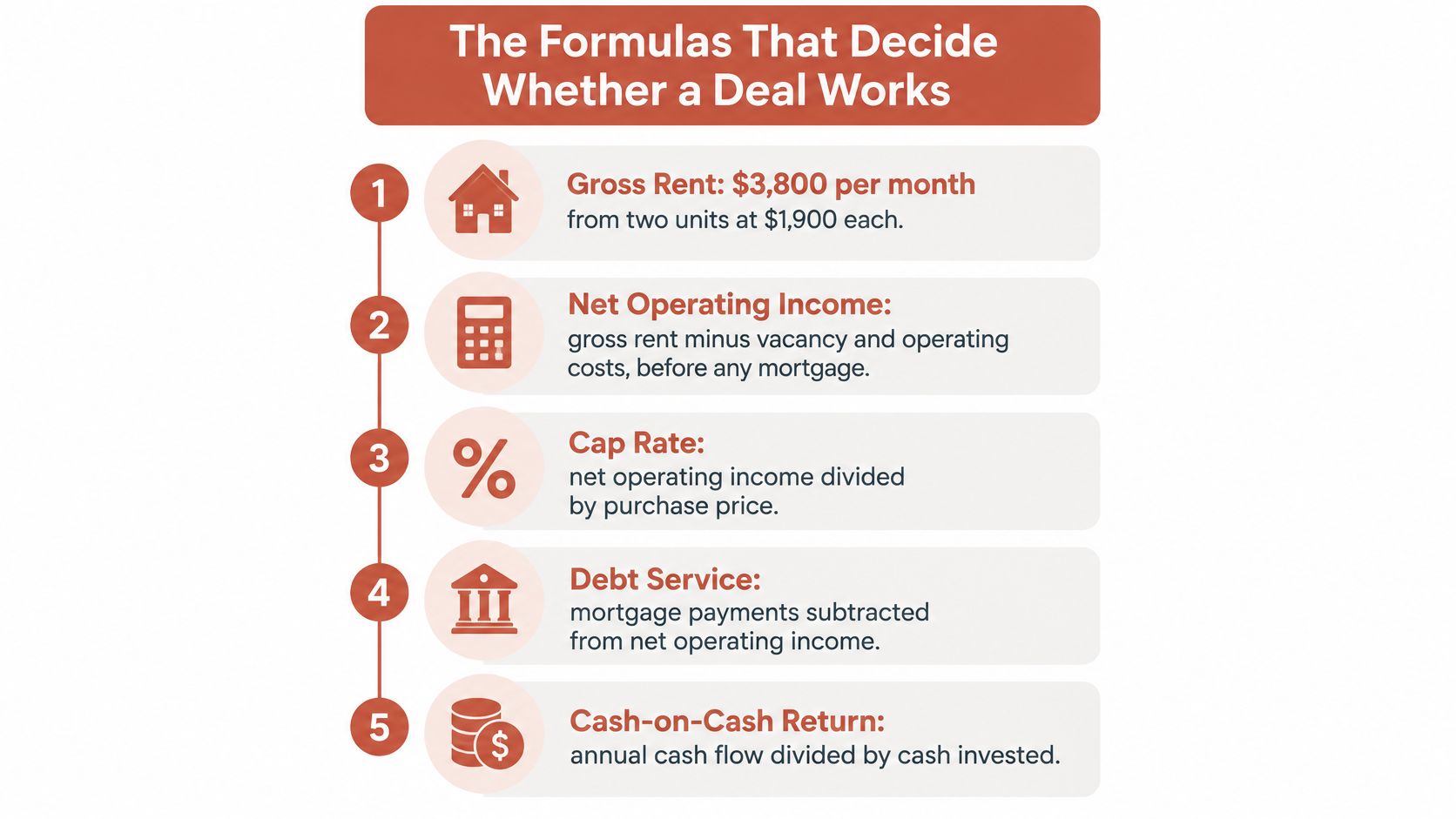
Net operating income comes first, because every other metric depends on it. Net operating income (NOI) is gross rent minus vacancy and operating costs, before any mortgage payment. If taxes or repairs are guessed low, NOI is fiction.
Cap rate, cash-on-cash, and the fast screens
Cap rate is NOI divided by purchase price. It works like a price-to-earnings ratio for a building: what the property earns compared with what it costs, no matter how you finance it. Its blind spot is the loan. A decent cap rate can still produce almost no cash once the payment is subtracted.
Cash-on-cash return is annual cash flow after the mortgage, divided by the cash you put in. It answers a different question: what did your down payment and closing costs earn? It ignores appreciation and loan paydown, so it will not flatter a building you are buying only for future value.
The 1% rule is a fast screen. Monthly rent at or above 1% of price passes the first filter. It ignores Illinois property taxes and insurance, so use it to reject weak listings, not to approve them. A gross rent multiplier, purchase price divided by annual gross rent, has the same job and the same hole.
Vacancy needs a local rate, not a national average. The Census Bureau reported 2023 rental vacancy rates of 7.5% in the Midwest and 8.3% in the South, compared with 4.3% in the West and 4.1% in the Northeast.
| Metric | Formula | What It Tells You | Blind Spot |
|---|---|---|---|
| Gross rent multiplier | Purchase price ÷ annual gross rent | Quick price-to-rent screen across listings | Ignores taxes, insurance and vacancy |
| Net operating income (NOI) | Gross rent − vacancy − operating costs (no mortgage) | Income the building earns before debt | Fails when taxes or repairs are guessed low |
| Cap rate | NOI ÷ purchase price | Building value independent of financing | Says nothing about the cost of your loan |
| Cash-on-cash return | Annual cash flow after mortgage ÷ cash invested | Return on the money you actually put in | Ignores appreciation and loan paydown |
| Vacancy allowance | Gross rent × expected share of empty months | Realistic income after turnover and marketing time | National averages hide local rates |
| 1% rule | Monthly rent ÷ purchase price | Fast filter for rejecting weak listings | Ignores local taxes and insurance |
Cap rate tells you what the building earns. Cash-on-cash tells you what your money earns.
When the two disagree, use cap rate to compare buildings and cash-on-cash to decide whether your own purchase works.
Single-Family, Condo and Multi-Family Compared
Match the building to the hours you can spend and to how much one empty unit would hurt the month.
| Type | Who pays rent | Who handles upkeep | Main risk | Buyer it suits |
|---|---|---|---|---|
| Single-family | One household | You, or a manager you hire | A vacancy means zero rent | Someone who wants simple financing and a wide resale pool |
| Condo | One household, plus association dues | The association for common areas, you for the unit | Rising dues, special assessments, leasing limits | Someone who will read bylaws before offering |
| Two-flat or three-flat | Two or three households | You, often on an older building | Aging boilers, wiring, and roofs | Someone who can live in one unit and spread vacancy |
| Five or more units | Several households | A more formal operation | Commercial-style lending | A buyer ready for a separate loan path |
Single-family homes put the whole rent on one tenant. Every vacancy is a zero month. Financing is usually the simplest, and the resale pool is broad, which helps when you exit.
Condos add a monthly association bill that can rise, plus special assessments for roofs or shared systems. Bylaws may limit leasing or set a minimum lease term. Check the rental percentage before you offer. A building with too many rentals can also make later mortgages harder.
Two-flats and three-flats, common in older Chicago blocks and western suburbs, spread vacancy across households. Living in one unit often lowers the cash needed to start. The cost is an older building: boilers, wiring, and roofs do not care about your spreadsheet.
Five or more units leave the one-to-four-unit loan world and move into commercial-style lending. That is a different down payment, a different underwriting file, and a different time commitment.
Choose by the repair hours you will realistically give the building, and by whether one empty unit would break the month.
Running One Two-Flat Deal From Rent to Verdict
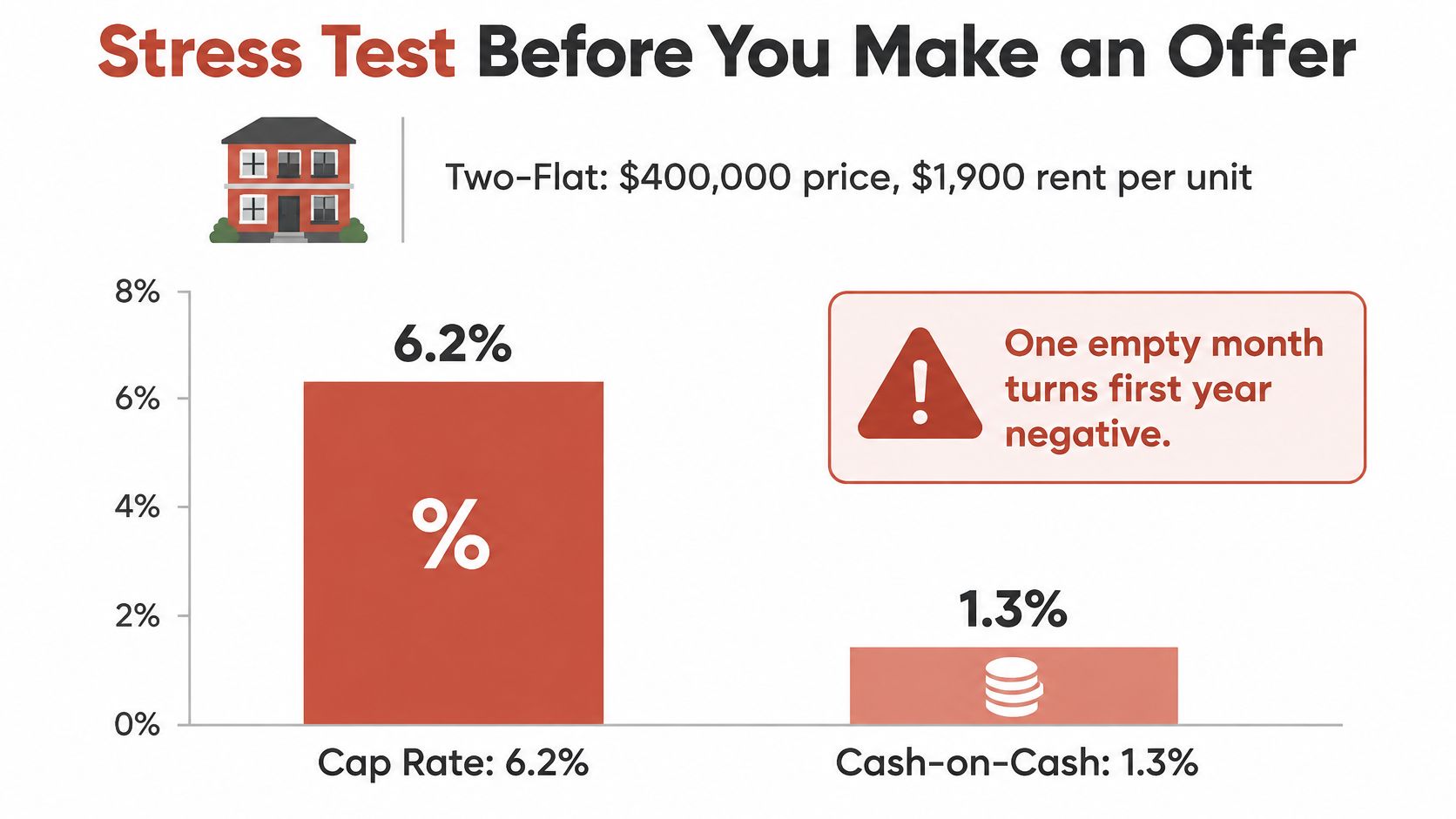
On this $400,000 two-flat, a 6.2% cap rate looks acceptable and cash-on-cash of about 1.3% is thin. Monthly rent is 0.95% of price, just under the 1% screen.
The setup is two two-bedroom units at $1,900 each, $100,000 down, about $8,000 in closing costs, and a $300,000 loan assumed at 6.75% over 30 years. Cash invested is about $108,000.
The order of the math
- Pull three recent sold comparables for similar two-flats within about a mile. Test $400,000 against what buyers paid, not only against the asking price.
- Pull three to five recent rent comparables for the same unit type within about a mile. If they disagree with the seller's rent roll, use the comparables.
- Set vacancy at 5%, or at the local rate if it is higher. On $45,600 of annual gross rent, 5% is $2,280, so effective gross income is $43,320.
- Pull the last two years of property tax bills. Reassessment can change the number the seller is showing you.
- Get an insurance quote for landlord coverage. This example uses $2,400 a year. Your address may not.
- Budget repairs, management, and common utilities. Management at about 8% of collected income is roughly $3,466. Repairs here are $3,000. Do not copy those if the boiler is original.
- Subtract operating costs from effective income to get NOI. In this illustration, NOI of $24,800 is what produces the 6.2% cap rate ($24,800 ÷ $400,000). Property tax and common utilities are the plug you must fill from bills, not from hope.
- Divide NOI by price for cap rate. Subtract the annual mortgage payment for cash flow. Divide that cash flow by $108,000 for cash-on-cash. About $1,400 of annual cash flow is roughly 1.3%.
| Line item | Amount |
|---|---|
| Vacancy at 5% | −$2,280 |
| Effective gross income | $43,320 |
| Management at 8% of income | about −$3,466 |
| Insurance | −$2,400 |
| Repairs and maintenance | −$3,000 |
| Property tax and common utilities combined | from the last two tax bills and utility records |
| Net operating income (NOI) | $24,800 in this illustration |
| Annual cash flow | about $1,400 after the mortgage |
| 1% rule (monthly rent ÷ price) | 0.95% |
What would have to change
A lower price raises both cap rate and cash-on-cash, because NOI is spread over less money and the loan is smaller. A better rate helps cash-on-cash only. It does not change NOI or cap rate.
Practical rule: If cash-on-cash stays near 1% after you use real tax bills, you are buying a thin margin, not a cushion.
Apartment occupancy averages do not promise that this two-flat leases on your timeline. Underwrite the unit, not the metro headline.
Financing and Landlord Duties to Plan Before You Buy
The loan route sets the down payment and whether you must live in the building. Investment loans usually price above owner-occupied rates, and many lenders want several months of payments held in reserve after closing.
| Route | Typical down payment | Must you live there? | What it changes |
|---|---|---|---|
| Conventional, one to four units | Often 15% to 25% | No | Simplest path for a pure rental, at a higher rate |
| FHA, two to four units | Lower than many investment loans, with mortgage insurance | Yes, one unit as your primary home | Cuts cash to start, ties you to occupancy rules |
| DSCR | Often 20% to 25% or more | Usually no | Qualifies mainly on rent against the payment |

Duties that show up after the keys
A landlord policy should cover the dwelling and liability. A standard homeowners policy often does not. Written leases should state rent, deposits, and who pays which utility.
Screen for income, rental history, and credit. Many landlords want income near three times the rent, which on $1,900 is a high bar in some suburbs and an easy one in others. If you will not take the calls, budget a manager. On the worked deal, 8% of collected income was already in the NOI.
Chicago's Residential Landlord and Tenant Ordinance applies inside city limits. Suburbs write their own rules, and many require rental registration or inspections. Confirm the municipality before you offer. Deposit return deadlines come from state and city law, not from habit.
Condo buyers have an extra file. Before you assume a unit can be leased, understand condo rental requirements in the association documents, including minimum lease terms and any cap on rented units.
The cost of the landlord job is either that management percentage or the hours you spend if you self-manage nights and weekends. A second home versus an investment property is also a loan question, not only a lifestyle one, because occupancy and use change the rate and the rules.
Choosing Between Western Chicagoland Submarkets
Chicago is not one rental market. Average apartment rent reached $1,838 in Q1 2025, up 3% year over year, while rent growth was strongest in outlying suburbs and slower in inner Cook County, according to the HUD Chicago housing market analysis. Southeast DuPage County recorded 5% annual rent growth.
A cheaper home in a tight suburb can beat a city property with weaker rent momentum, even when the city building shows a higher paper yield. Elmhurst, Downers Grove, Naperville, Oak Park, Glen Ellyn, and Melrose Park each need their own check.
Chicago's rental vacancy rate was estimated at 5.5% in 2025, down from 7.5% in 2020, and vacancy was below 3% in all five counties of the housing market area as of May 2025, in that same HUD analysis. Low vacancy supports demand. It does not set your tax bill.
| Signal | Where to Check | Strong Market Sign |
|---|---|---|
| Rent growth | Market reports and listing history for the town or county | Steady year-over-year increases, such as about 5% annual growth in Southeast DuPage County |
| Vacancy rate | Census tables and HUD housing market analyses | Low vacancy, such as below 3% in all five counties of the Chicago housing market area as of May 2025 |
| New supply | Municipal permit records and new-building pipelines | Few new rental units competing with older buildings |
| Property tax rate | County assessor records and actual tax bills | A lower effective rate that protects net operating income |
| Commute and transit | Metra schedules and commute times to major job centers | Easy access that widens the tenant pool |
| School quality | State report cards and district data | Strong schools that attract family renters |
Pull rent and sold data for each town, then line the signals up side by side. Nearby new construction can weaken occupancy even where today's vacancy looks tight. Local agents with Midwest Real Estate Data access, including Homes By Carmen's neighborhood pages for these towns, can pull street-level sold and rental comparables so you are not underwriting "Chicago" as a single number.
Stress Test Before You Make an Offer
The cap rate is the trap. This two-flat clears 6.2%, and cash-on-cash is still about 1.3%. One empty month turns the first year negative, because about $1,400 of cash flow cannot absorb $1,900 of lost rent.
Multifamily occupancy ended 2025 at 95.0%, above the 10-year average of 93.7%, and Chicago rent growth reached 3.7% year over year, but 82.4% of 2025 deliveries were concentrated in suburban markets, including DuPage County, per the Cushman & Wakefield Chicago multifamily report. Strong occupancy does not mean your older two-flat leases quickly when new buildings open nearby.
| Scenario | Added Cost or Lost Rent | Annual Cash Flow After |
|---|---|---|
| Base case from the worked example | None | About $1,400 |
| One month vacant | $1,900 of lost rent | Negative for the year |
| Property tax up 10% | +10% of the property tax bill | Lower than base, set by the real bill |
| Insurance up 25% | About $600 more on a $2,400 premium | Roughly $800 left |
| Vacant month, tax rise and repair together | Lost rent, a higher tax bill, and one repair | Below zero, reserves take the hit |
Hold enough cash to cover the worst single shock. Offer only if base cash-on-cash meets your target and reserves can absorb that shock without forced borrowing. If the combined case drains reserves, cut the price or walk away.
Book the building inspection before the offer deadline, and use negotiation room on price and credits when the stress case only works at a lower number.
Homes By Carmen helps buyers in Melrose Park and nearby western suburbs search rentals and small multifamily buildings, compare neighborhood rents and sales, and coordinate inspections through closing. If you are judging a rental property to buy on cash-on-cash rather than headline rent, start with local comparables before you write the offer. Visit Homes By Carmen to line up a search and a building-level review.