
Most homeowners begin with the same advice: enter your address into a free valuation tool and accept the number as a starting point. That advice is incomplete. A comparative market analysis free of charge can be useful, but the value doesn't come from the word “free.” It comes from whether someone has selected relevant closed sales, verified the property details, understood the neighborhood, and explained the adjustments.
A Chicago-area home isn't priced by square footage alone. A finished basement, an unusual lot, a renovated kitchen, a legal bedroom, a busy street, or a condition issue can move the property into a different competitive group. A credible CMA produces a supported price range and pricing strategy, not a guaranteed sale price and not a substitute for a licensed appraisal.
Table of Contents
- Why Automated Estimates Fall Short
- Building a Defensible Pricing Profile
- Interpreting Comps and Market Adjustments
- Evaluating DIY Tools Versus Professional Analysis
- Connecting Valuation to Current Market Conditions
- Securing a Local MLS-Powered Valuation
Why Automated Estimates Fall Short
A free automated number can be useful and still be wrong enough to distort a selling decision. It can process an address quickly, but it usually cannot inspect the basement, determine whether a finished room qualifies as a legal bedroom, distinguish a careful renovation from a dated update, or recognize why buyers value one side of a neighborhood boundary differently.
That matters throughout western Chicagoland. A home in Melrose Park should not automatically be compared with one in Elmhurst, Oak Park, Glen Ellyn, Downers Grove, or Naperville because the properties share a broad size category. Buyers respond to the specific market area, including access, competing listings, local demand, street conditions, housing stock, and nearby amenities.
The data problem behind the number
Automated valuation models are limited by the records and market signals available to them. Independent audits consistently show median error rates in the mid-single digits even for on-market homes, with materially larger errors for off-market homes. On a $400,000 suburban property, an error in the range of $31,600 is enough to change the listing strategy, the seller's expectations, and the response to early buyer feedback. The Zestimate methodology explains why automated estimates become less reliable when recent transactions are limited or a property differs from nearby homes.
The issue is not that an automated estimate has no value. It is that a single figure can hide uncertainty. Incomplete records may miss a renovation, misstate finished area, overlook a basement's condition, or fail to capture a location disadvantage such as traffic exposure. Consumer valuation guidance also points to local data quality and property completeness as factors affecting accuracy.
A number without its supporting evidence is a weak pricing tool.
Practical rule: Use an automated estimate to start the conversation. Base the pricing decision on relevant closed sales, verified property facts, current competition, and clear adjustment logic.
What a local CMA adds
A local agent can identify homes that attracted the same buyers, review photographs and listing remarks, verify condition differences, and separate useful evidence from convenient but weak matches. That analysis matters when the property is older, renovated unevenly, includes a finished basement, or sits in a micro-market with few recent sales.
For an initial reference point, request a free home valuation. Bring the result to a pricing discussion and ask which comparable sales support it, what adjustments were made, and what local evidence could move the range higher or lower.
Building a Defensible Pricing Profile
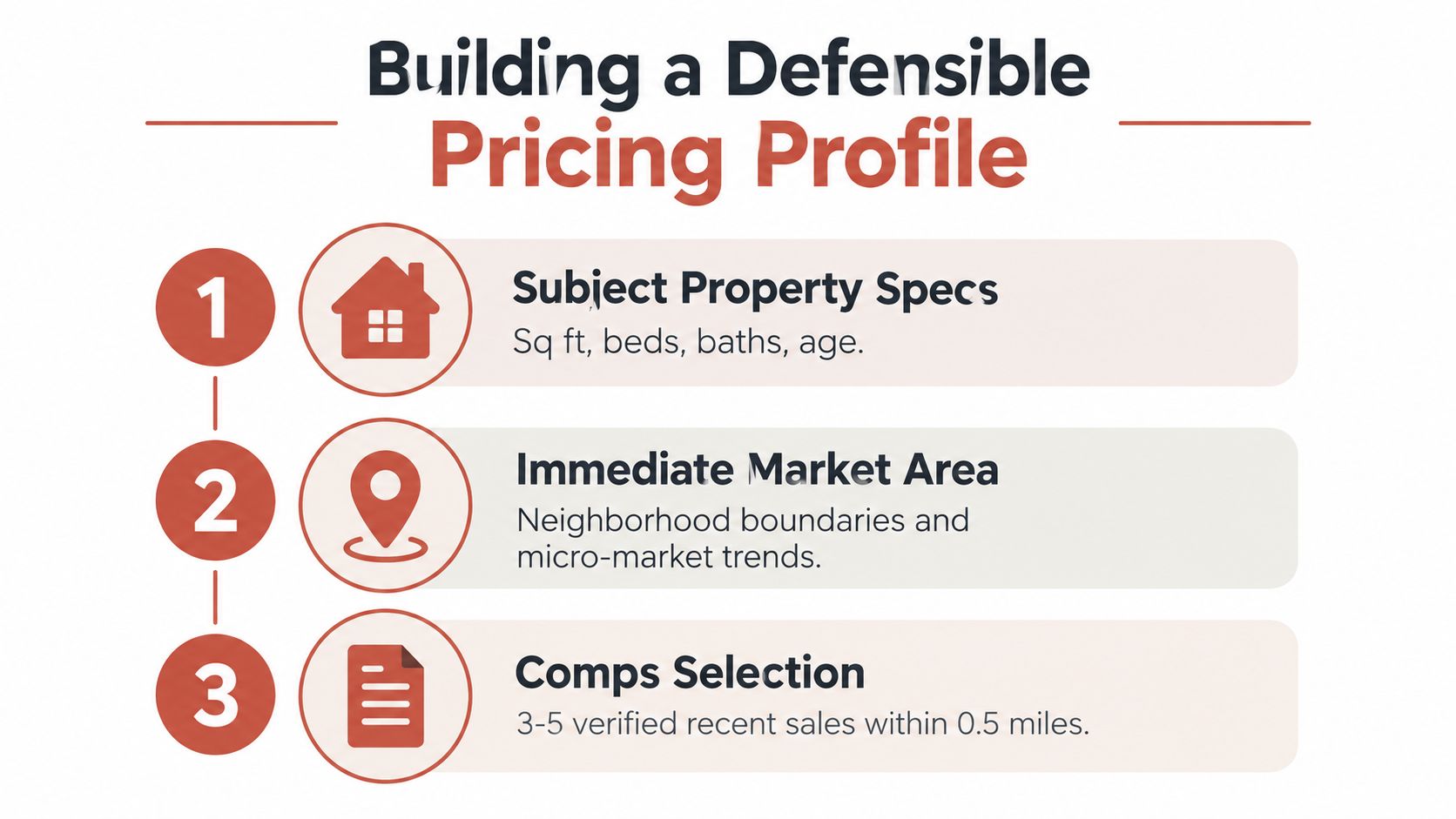
A defensible CMA starts before anyone searches for comparable sales. The analyst needs a complete profile of the subject property and a clear definition of the market in which it competes. An address alone doesn't tell the pricing story.
1. Verify the subject property
Start with the facts a buyer and an appraiser would notice:
- Physical profile: Confirm finished area, bedroom and bathroom count, architectural style, age, lot characteristics, garage, basement, and major amenities.
- Condition profile: Record the quality of the kitchen, bathrooms, flooring, mechanical systems, exterior, roof, windows, and visible maintenance.
- Legal profile: Check whether additions, bedrooms, finished areas, and other improvements are represented consistently in available records and disclosures.
- Marketability profile: Note layout limitations, access concerns, busy-road exposure, unusual site features, and improvements that may appeal strongly to one buyer group but not another.
Public records can contain useful baseline facts, but they may not reflect recent renovations or the way buyers experience the home. A seller should give the analyst a written update list, invoices where available, permit information, and a candid description of deferred maintenance.
2. Define the actual market area
The right market area is the geography supplying most of the property's demand and competition. It might be a subdivision, a neighborhood bounded by major roads, or a group of streets with similar housing stock. Broad citywide averages usually blur the differences that matter most to a buyer comparing actual homes.
Fannie Mae's guidance emphasizes selecting comparable sales from the same market area because neighborhood-level prices capture shared location advantages and disadvantages, including access, competition, and local demand. That principle explains why a Melrose Park property should be measured against the market where its buyers shop, rather than against a convenient average drawn from several suburbs.
3. Assemble relevant evidence
The strongest starting point is a set of verified closed sales. Fannie Mae's lending guidance requires appraisers to report at least three closed comparable sales in the sales-comparison approach, with preferred comparables generally closing within the previous 12 months, although an older sale may be more appropriate when it better reflects the subject property's market and characteristics. See the Fannie Mae comparable-sales guidance for the underlying framework.
Use pending and active listings for context. Pending listings show current buyer response without revealing the final closed price, while active listings show the competition a new listing must beat. They shouldn't replace closed sales as the primary evidence of achieved value.
Interpreting Comps and Market Adjustments
A CMA report isn't a pile of nearby addresses. It is a sequence of judgments. The analyst identifies competitive homes, verifies the circumstances of each sale, adjusts for meaningful differences, and reconciles the results into a range that reflects the strength of the evidence.
Fannie Mae describes the comparable-sales process through four core stages: describe the subject, select sales based on characteristics, proximity, and recency, adjust for differences, and reconcile the adjusted indications into a final value opinion. Its guidance also makes clear that comparable properties don't need to be identical. They need to appeal to the same market participants.
Read the evidence in the right order
Closed sales provide the clearest evidence because a buyer and seller completed the transaction. Pending sales help reveal whether current demand supports the older closed-sale evidence. Active listings indicate competition, but an asking price is a seller's position, not proof that a buyer accepted it.
A useful report should identify:
- Selection logic: Why each property was considered competitive.
- Sale verification: Whether the transaction was arms-length and whether unusual financing or concessions affected the price.
- Physical comparison: Differences in site, room count, finished area, style, condition, and legal characteristics.
- Adjustment support: The market evidence behind each adjustment.
- Reconciliation: Why some comps receive more weight than others.
Adjust for market reaction, not habit
If a comparable is superior to the subject, its sale price may need a downward adjustment. If it lacks a feature the subject has, its adjusted indication may move upward. The direction is straightforward. The amount isn't.
A finished basement doesn't automatically add the same value as finished living area above grade. A second garage stall, renovated kitchen, larger lot, or legal bedroom can matter differently depending on what local buyers pay for those features. Fannie Mae says adjustments must reflect observed market reaction and shouldn't be constrained by unsupported rules of thumb. That is why arbitrary adjustment caps can make a report look tidy while weakening its reasoning.
When local inventory is thin, expanding the search area is better than forcing dissimilar comps into the analysis. The report should explain why a distant or older sale was used, what makes it relevant, and how the uncertainty affects the final range. A home valuation report should help a seller follow that logic without needing to decode unexplained formulas.
Evaluating DIY Tools Versus Professional Analysis
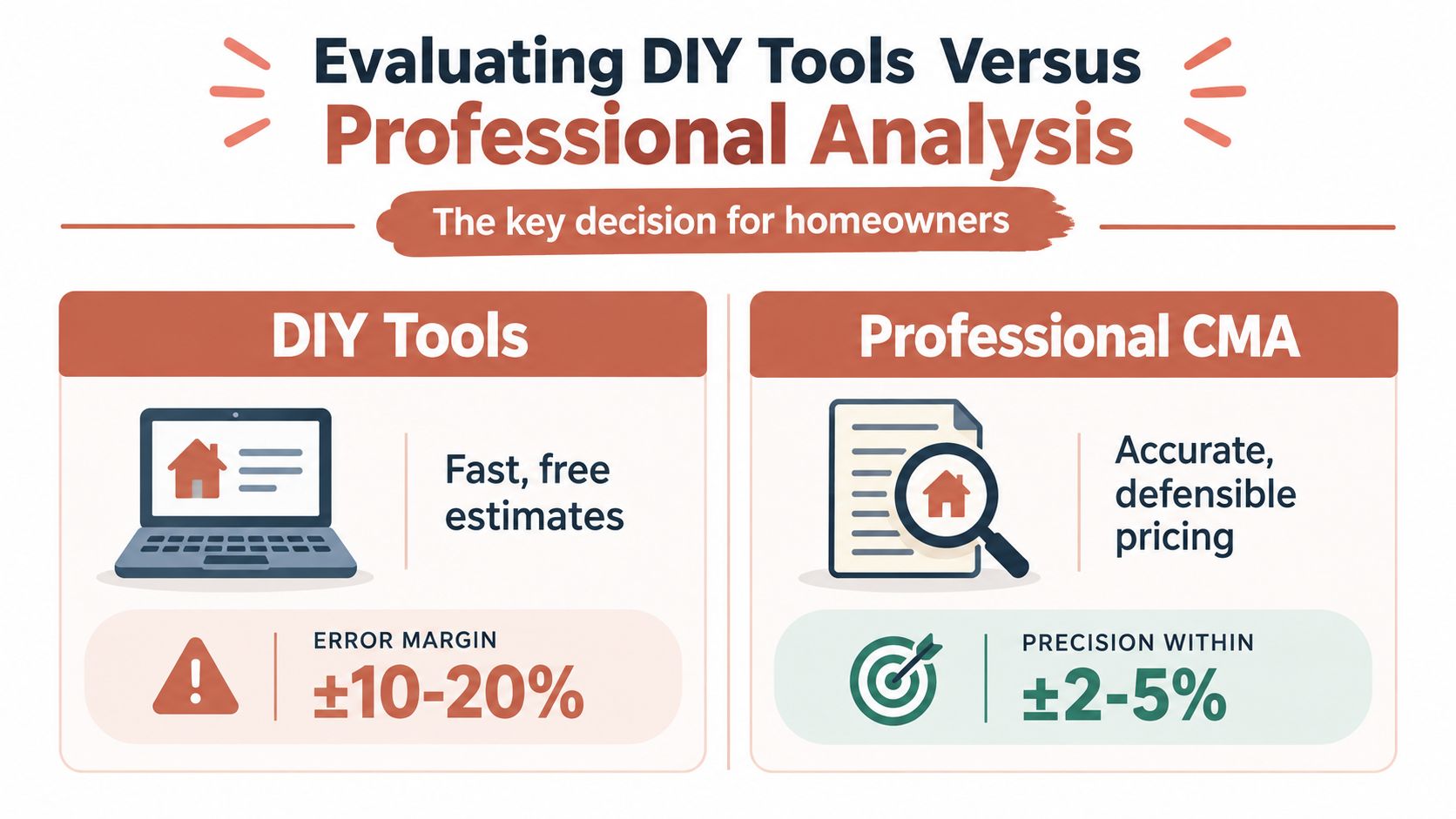
DIY tools and professional CMAs solve different problems. A homeowner considering a future sale may want a quick orientation. A homeowner choosing a list price, planning repairs, or evaluating an inherited property needs a more deliberate review.
When a DIY estimate helps
An automated estimate can help you form an initial question. It may indicate whether your expectations are broadly aligned with the local market, give you language for a first conversation, or help you identify a need to investigate your records. Its speed and convenience are real advantages.
The limitation is that you must supply the missing judgment. You need to check whether the home is represented accurately, whether the comparison set includes similar condition and layout, and whether the estimate accounts for improvements or deficiencies that public records don't show.
When professional analysis earns its place
A professional MLS-powered CMA is more useful when the decision has financial consequences. The analyst can audit the source information, distinguish arms-length transactions from distressed or unusual sales, review permits and renovation status, and compare the subject with current competition.
The quality-control process should include:
- Input audit: Check square footage, bedrooms, baths, lot size, permits, and renovation status.
- Transaction screening: Separate ordinary sales from unusual conditions, concessions, or distressed transfers.
- Comp stratification: Group properties by location, type, size, age, condition, and sale period.
- Cluster testing: See whether adjusted prices converge or reveal separate market segments.
- Competition review: Compare the subject with active listings to identify pricing pressure.
- Range stress test: Test how the recommendation changes when stronger and weaker comps receive different weight.
You can use a home valuation calculator for an early estimate, but don't confuse calculation with verification. A calculator can process inputs. It can't decide whether a finished basement is comparable to above-grade living area or whether a renovated property belongs in the same condition tier as an as-is home.
A free report saves money only if its uncertainty is visible. A precise-looking number built on weak inputs can cost more than a carefully explained range.
A CMA also isn't an appraisal. The historical distinction matters. A Fannie Mae study reviewed 3,751,547 appraisals tied to home-purchase loan applications submitted between January 2012 and December 2015, and described the comparable-sales method as the universally adopted residential valuation approach. A CMA can support marketing and pricing decisions, while a lender-ordered appraisal is a formal valuation product governed by appraisal standards and underwriting requirements, as detailed in Fannie Mae's appraisal research.
Connecting Valuation to Current Market Conditions
A comparable sale tells you what a buyer paid under earlier conditions. Pricing a listing requires one more question: what will buyers compare it with today?
Recent Chicagoland reporting described 1.5 months of supply, a median price near $403,250 for detached suburban homes, and an average of 53 days on market. The same report said attached-home prices rose 5.6%, while market time increased from 42 to 54 days. These figures come from Chicago Agent Magazine's spring market report, and they point to an uneven market rather than a single regional experience.
Separate value from launch strategy
A CMA should distinguish three decisions:
- Likely market-value range: The reconciled estimate supported by comparable evidence.
- Strategic launch price: The price designed to attract the right buyers and generate early attention.
- Expected net proceeds: The amount left after repairs, concessions, taxes, commissions, credits, and other selling costs.
Those numbers answer different questions. A seller may choose a launch price near the upper end of a defensible range when the home is strongly differentiated and competition is limited. Another property may need a sharper position because buyers can compare several similar homes immediately.
Rising prices don't excuse poor positioning
A higher median price doesn't guarantee that an overpriced home will sell quickly. Buyers still compare condition, layout, location, monthly payment, and competing inventory. If a detached home attracts strong demand while a nearby condo takes longer to sell, applying the detached-home trend to the condo creates a misleading recommendation.
Days on market, sale-to-list behavior, inventory, and financing conditions belong in the pricing conversation because they influence liquidity. A home can have a sound long-term value and still miss its launch window if the asking price places it above the buyer set most likely to act.
The practical question isn't, “What is the highest number someone might pay?” It is, “Where does this home sit among the choices buyers can act on now?” That answer should guide preparation, launch timing, and the decision to protect proceeds rather than chase an unsupported headline price.
Securing a Local MLS-Powered Valuation
For homeowners in Melrose Park, Elmhurst, Oak Park, Glen Ellyn, Downers Grove, Naperville, and nearby western suburbs, a generic estimate leaves important questions unanswered. A local CMA should show how the property competes within its neighborhood, housing type, condition tier, and buyer pool.
MLS access through Midwest Real Estate Data, commonly known as MRED, gives an agent a stronger working record of listing history, closed sales, property descriptions, photographs, status changes, and comparable market activity. The data still needs judgment. MLS access doesn't remove the need to verify facts, investigate condition, and explain why one comparable deserves more weight than another.
What the consultation should produce
A useful local valuation conversation should leave you with:
- A verified property profile that corrects missing or outdated facts.
- A neighborhood-specific comp set based on competitive buyer behavior.
- A transparent adjustment discussion covering condition, renovations, layout, site, and legal characteristics.
- A reconciled price range that acknowledges uncertainty instead of manufacturing precision.
- A launch strategy tied to current competition, timing, and likely buyer response.
- A net-proceeds discussion so the list price connects to the financial result you want.
That process is more valuable than receiving a number by email because it converts market data into decisions. It tells you which repairs may matter, which improvements may not recover their cost, whether your expectations fit the competition, and how the property should be positioned when it reaches the market.
A free CMA is a reasonable first step when it follows this workflow. It isn't reliable because it costs nothing. It becomes useful when the analyst uses relevant closed sales, verifies the subject property, makes market-supported adjustments, and gives you enough context to understand the recommendation.
Homes By Carmen provides complimentary, MLS-powered comparative market analyses and pricing consultations for homeowners across western Chicagoland. Visit Homes By Carmen to request a neighborhood-specific valuation and discuss a practical listing strategy for your property.