
The most popular advice about a second home versus investment property is that you're choosing between a place to enjoy and a place to rent. That's too simple, and in Chicagoland it can become an expensive mistake. You're really choosing how lenders, tax authorities, insurers, and local rules will classify the property based on how you intend to use it.
A home in southwest Michigan, the Chain O' Lakes, or a western suburb can look identical on the listing sheet. The financing, reporting requirements, rental restrictions, and acceptable occupancy may change sharply once your primary purpose changes. Before you compare appreciation or projected rent, decide which use you can document.
Table of Contents
- Why This Choice Matters More Than Buyers Realize
- What Makes a Property a Second Home or an Investment Property
- Financing and Down Payment Differences
- Tax Treatment and the IRS Occupancy Test
- Rental Rules and Usage Restrictions in Chicagoland
- Cash Flow and Appreciation Tradeoffs
- Which Option Fits Your Situation
- Next Steps Before You Make an Offer
Why This Choice Matters More Than Buyers Realize
A second home and an investment property aren't interchangeable just because both sit beyond your primary residence. The address doesn't determine the classification. Your intended use does. A lender wants to know whether you'll personally occupy the home, while tax authorities focus on how many days you use it and how many days you rent it.
That decision affects the money you need at closing, the interest rate you're offered, the reserves required in your accounts, the way you report income, and the insurance policy you need. It can also affect whether a homeowners association or local municipality permits your intended rental activity. Those questions arise before a tenant signs a lease or your first weekend guest arrives.
The practical rule: Don't choose “second home” because the financing looks better. Choose it only if your actual use supports it.
For buyers comparing a lake property with a Chicago-area rental, current Chicago housing market trends can provide useful context, but market direction doesn't override occupancy rules. A property that depends on rental income should be analyzed as an income-producing asset even if you plan to visit occasionally.
The historical growth of second-home ownership also shows why this category exists separately from pure rental housing. Academic research summarized in this overview of second-home mortgage rates reports that second homes increased by about 20% in the United States and 22% in Canada between 1995 and 2005. The same source describes faster expansion in other countries, reinforcing that second homes are a recurring housing category shaped by personal use, wealth, and regional demand.
Your first question shouldn't be, “Which option has the better return?” It should be, “How will I use this property, and can I prove it?”
What Makes a Property a Second Home or an Investment Property
A second home is a property you maintain for personal use while keeping your primary residence elsewhere. It might be a weekend retreat, a seasonal residence, a work-related home, or a future retirement property. It doesn't need to be a traditional vacation cottage, and it doesn't become an investment property merely because it's located near a popular destination.
An investment property is purchased primarily to produce rental income, build a rental portfolio, or generate a return through resale or appreciation. You might rent it to a long-term tenant, offer permitted short-term stays, or leave it vacant while waiting for a future sale. The central purpose is economic return, not personal occupancy.
Start with the intended use
Ask yourself three direct questions before you speak with a lender:
- Who will sleep there most often, you or paying occupants?
- Would you buy the property if it couldn't produce rental income?
- Can you document a personal-use schedule that matches your loan application and tax position?
If the answer to the second question is no, you're probably looking at an investment property. Occasional personal visits don't automatically change that conclusion.
Distance from your primary residence also shouldn't drive the decision. A home near Naperville that you use regularly can be a second home, while a cottage in Michigan can be an investment property if tenants occupy it for most of the year.
The IRS uses a use-based test
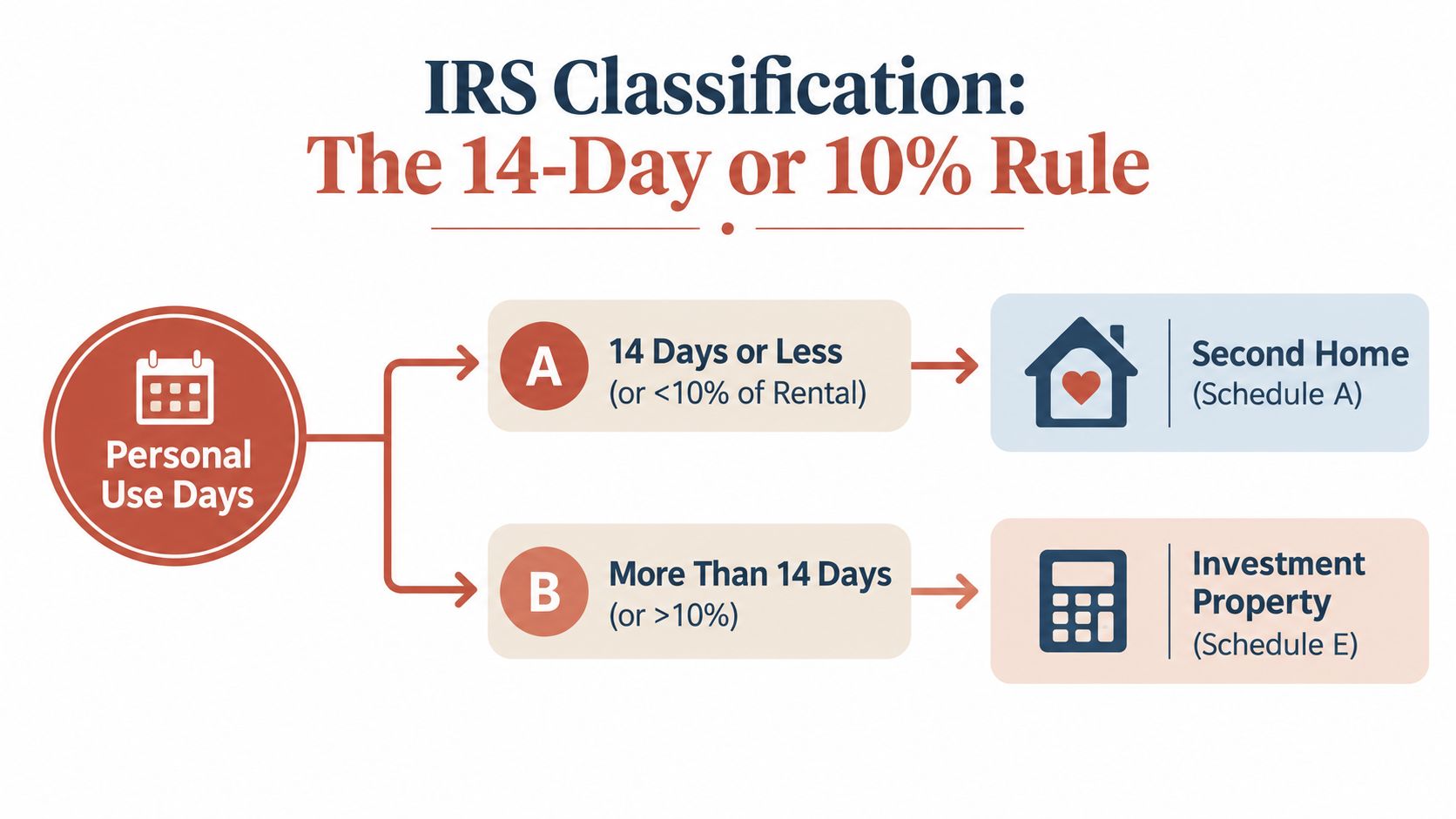
For U.S. tax purposes, a property generally supports second-home treatment when personal use exceeds 14 days per year or exceeds 10% of the days it's rented at fair market rent, whichever threshold is greater. The occupancy rule is explained in this second-home and investment-property guide.
That means a property rented occasionally may still qualify for personal-use treatment, but you need accurate records. Keep calendars, booking information, utility records, and travel documentation. Don't rely on a label in the listing or on your own informal understanding of “occasional use.”
Financing and Down Payment Differences
Financing is where the classification becomes tangible. A second-home loan generally receives more favorable treatment because the borrower is expected to occupy the property personally and has a financial reason to protect it beyond rental income. An investment-property loan assumes that income production is central, so lenders typically apply tighter standards.
A standard one-unit second home may qualify for financing up to 90% loan-to-value, which means as little as 10% down. A one-unit investment property is generally capped at 85% loan-to-value, requiring at least 15% down. Underwriting guidance also commonly calls for two months of reserves for a second home versus six months for an investment property. These distinctions are summarized in this comparison of second-home and investment-property loans.
Financing Differences at a Glance
| Requirement | Second Home | Investment Property |
|---|---|---|
| Primary use | Personal, seasonal, or occasional occupancy | Rental income, resale, or portfolio return |
| Typical maximum financing for an eligible one-unit property | Up to 90% loan-to-value, or as little as 10% down, under standard guidelines cited above | Generally up to 85% loan-to-value, or at least 15% down, under the same cited guidelines |
| Typical reserve expectation | Two months of reserves in the cited underwriting comparison | Six months of reserves in the cited underwriting comparison |
| Rate position | Usually closer to second-home or owner-use pricing | Commonly 0.50% to 0.75% higher than second-home rates, according to lender guidance in the cited comparison |
| Rental-income role | May be limited or excluded depending on the program and use | Often central to the repayment analysis, subject to lender documentation rules |
| Occupancy certification | You must certify genuine personal use | You must disclose that the property is primarily income-producing |
The rate gap matters because a loan that looks affordable on a second-home worksheet can become much more expensive under investment-property pricing. A separate lender guide notes that investment-property rates may run 0.50% to 0.75% above second-home rates, while investment-property down payments commonly range from 15% to 25%, depending on the property and loan structure. See the published requirements comparison for the lender-specific framework.
Debt-to-income analysis also changes. The lender may count existing housing payments, scrutinize your liquid assets, and apply its own rules to projected rent. Don't assume a rent estimate from a listing will allow you to qualify automatically.
My advice at the kitchen table: If rental income is what makes the purchase affordable, disclose that from the beginning. A lower down payment is never worth misrepresenting the property's purpose.
Tax Treatment and the IRS Occupancy Test
The IRS does not decide a property's tax treatment based on the label in your purchase contract. It examines how you use the home. Personal-use days, rental days, and the property's operation during the year can affect whether the home fits a second-home framework or rental-property reporting. For a U.S. property, personal use generally needs to exceed 14 days or 10% of the days rented at fair market rent, whichever is greater, under the threshold described in this lender explainer of the 14-day and 10% personal-use thresholds.
Personal-use reporting
If you primarily use the property yourself, mortgage interest and eligible property taxes may fall under the personal-use rules, subject to federal limits and your individual tax position. Rental income and expenses are handled differently from those of a property operated mainly to produce income.
A second home still creates recordkeeping duties. Track rental periods, personal stays, expenses, and fair-market rental activity. Even occasional bookings can create reporting requirements while the home remains primarily personal.
Rental-property reporting
If the home operates primarily as a rental, owners generally report rental income and eligible expenses through the rental-property framework. Potential expenses include portions of mortgage interest, insurance, property taxes, utilities, maintenance, and other operating costs. You must allocate those costs correctly when you also use the property personally.
Depreciation and passive-loss rules may also apply. The result depends on your income, participation, personal use, and the way the property operates. A rental loss does not automatically offset every other source of income.
Hybrid use requires disciplined records
Mixed use creates the greatest risk of misclassification. You might occupy the home during the summer, rent it on selected weekends, and change the plan later. You cannot reliably reconstruct that year from memory. Keep the dates, purpose of each stay, rental price, expenses, and periods when the property was available but unoccupied.
Illinois property taxes add another local consideration. The amount on your bill, the property's assessment, and any appeal process can change your carrying costs and tax planning. Before choosing a classification, have a tax professional review the personal-use and rental-use allocation.
Rental Rules and Usage Restrictions in Chicagoland
A second home can be personally occupied without becoming a landlord operation. An investment property cannot be evaluated that way. Once you rent it, you're dealing with lease requirements, disclosures, maintenance duties, insurance conditions, and potentially municipal or association restrictions.
The biggest mistake I see is assuming that a property can legally operate as a short-term rental because similar homes appear on a booking platform. Listings don't prove compliance. Check the municipality, the building rules, the association documents, and the insurance requirements before you make an offer.
Rental Rules and Second Home vs. Investment Property in Chicagoland
| Rule Area | Second Home Use | Investment Property Use |
|---|---|---|
| Personal occupancy | You use the home for seasonal or occasional stays | Personal use is secondary to the income plan |
| Long-term leasing | May be occasional or absent | Requires a compliant lease, tenant screening, maintenance plan, and operating budget |
| Short-term stays | Must be allowed by the municipality, building, association, and insurer | Requires careful review of every applicable restriction before projected income is counted |
| HOA or condominium rules | May limit or prohibit rentals even if you personally occupy the unit | Can restrict rental frequency, tenant counts, lease terms, or platform use |
| Local landlord obligations | May be minimal if no tenant relationship exists | Can include registration, disclosures, inspections, habitability duties, and eviction procedures |
| Insurance | Must accurately reflect personal and any occasional rental use | Usually needs coverage designed for income-producing occupancy |
Chicago and its suburbs don't operate under one uniform rental rulebook. Requirements can differ by municipality, property type, neighborhood, and building governance documents. A condo declaration may be stricter than the city, while a suburban association may prohibit short-term stays even when a local ordinance doesn't.
If you're buying a rental, review the applicable rental application process and prepare to verify tenant-facing requirements before closing. For a Chicago investment property, ask specifically about registration, inspections, disclosures, security deposits, and eviction procedures. For a suburban property, ask the village and the association the same questions in writing.
Don't build a deal around short-term income until those approvals are clear. If the property only works as a long-term rental, underwrite it as a long-term rental.
Cash Flow and Appreciation Tradeoffs
A second home is often a lifestyle purchase with an equity component. An investment property is a business decision that should work without relying on wishful appreciation. That distinction gives you a practical way to evaluate the numbers.
Start with carrying cost. Include principal, interest, property taxes, insurance, utilities, repairs, vacancy, furnishing, association charges, and management. A second-home owner may accept a monthly shortfall because the property provides family time. An investor needs rent to cover the operating burden and debt service with a margin for surprises.
Cash Flow vs. Appreciation Framework
| Factor | Second Home | Investment Property |
|---|---|---|
| Main benefit | Personal use, flexibility, and long-term ownership | Income generation and portfolio growth |
| Carrying-cost test | You may knowingly treat some costs as lifestyle spending | Rent should support operating costs and debt service |
| Vacancy | A vacant home may be intentional | Vacancy reduces revenue and must be included in the underwriting |
| Management | Often self-managed because you're present | May require professional or local management |
| Appreciation | Can justify ownership when personal use is important | Should support the investment thesis, but shouldn't rescue weak cash flow |
| Best underwriting question | “Is this experience worth the cost if rent is limited?” | “Does the property work after realistic expenses and financing?” |
For a two-flat in Chicago, a condo in Lakeview, or a single-family rental in the western suburbs, calculate gross rent first, then subtract operating expenses and debt service. Don't confuse gross rent with cash flow. A property that collects rent but needs frequent repairs, sits vacant between tenants, or carries expensive financing may not produce the return you expect.
A second-home buyer may look at Michigan's Harbor Country or Wisconsin lake counties and accept limited rental activity because personal access matters. That can be a sound decision, but call it what it is. You're buying a personal asset with possible appreciation, not pretending that a weak rental worksheet is a strong investment.
Use a home-loan repayment calculator to test the payment under the correct occupancy classification. Run the calculation with conservative rent assumptions, realistic maintenance, and no guaranteed appreciation.
A clean decision rule: If the property works because tenants pay the costs, lean toward investment classification. If it works only when you value personal use and future equity, treat it as a second home and finance it honestly.
Which Option Fits Your Situation
The right classification becomes clearer when you match it to your actual life. Don't start with the loan product. Start with the behavior you expect after closing.
The weekend lake user
You're buying near the Chain O' Lakes or in southwest Michigan. Your family plans to use the home throughout the year, and rental income would be helpful but isn't necessary. You'll spend personal time there and can maintain a calendar showing that use.
Recommendation: choose second-home treatment if your documented use satisfies the applicable rules and your lender approves the arrangement.
This buyer benefits from financing designed for personal occupancy and avoids turning every family weekend into an accounting exercise. Occasional permitted rentals may still be possible, but they shouldn't be the reason the purchase works. Before signing, verify that the municipality, association, insurer, and loan documents all permit the limited rental activity you have in mind.
The future-retirement buyer
You're purchasing near Naperville, the North Shore, or another community where you may eventually spend more time. For now, the property is primarily for family use and long-term ownership. You may leave it vacant for periods rather than lease it to a tenant.
Recommendation: keep it classified as a second home while personal use remains the genuine purpose.
This approach preserves a financing structure aligned with owner use and keeps the operating plan straightforward. If your circumstances change and you begin renting for most of the year, revisit the classification before changing the property's use. Retirement plans are not a substitute for current occupancy facts.
The income-first investor
You're evaluating Pilsen, Bronzeville, or a west-side neighborhood because rental revenue drives the purchase. You're comparing tenant demand, operating expenses, financing, and long-term equity. Personal stays may happen, but they aren't the reason you're buying.
Recommendation: use investment-property financing and underwrite the property as a rental from day one.
That means holding the required reserves, budgeting for maintenance and vacancy, checking local requirements, and treating projected rent as an assumption that must be verified. Short-term rental income may not be available, so your analysis should survive under a lawful long-term lease if that's the realistic operating model.
Matching Chicagoland Buyer Profiles to the Right Classification
| Buyer Profile | Primary Use | Recommended Classification | Why It Fits |
|---|---|---|---|
| Weekend lake user | Personal family stays with limited optional rentals | Second home | Personal occupancy drives the purchase |
| Future-retirement buyer | Personal use and long-term equity | Second home | The property serves a personal housing plan |
| Income-first investor | Tenant income and portfolio return | Investment property | Rental performance drives the decision |
My short version is simple: if personal use is the genuine priority, choose a second home. If tenants are expected to carry the property, choose an investment property. Don't let a favorable financing label make that decision for you.
Next Steps Before You Make an Offer
Before you write an offer, put the intended use on paper. Write down how often you'll occupy the property, whether you'll rent it, what kind of rental you're considering, and what would cause your plan to change. That document gives your lender, Realtor, insurer, and tax professional something concrete to evaluate.
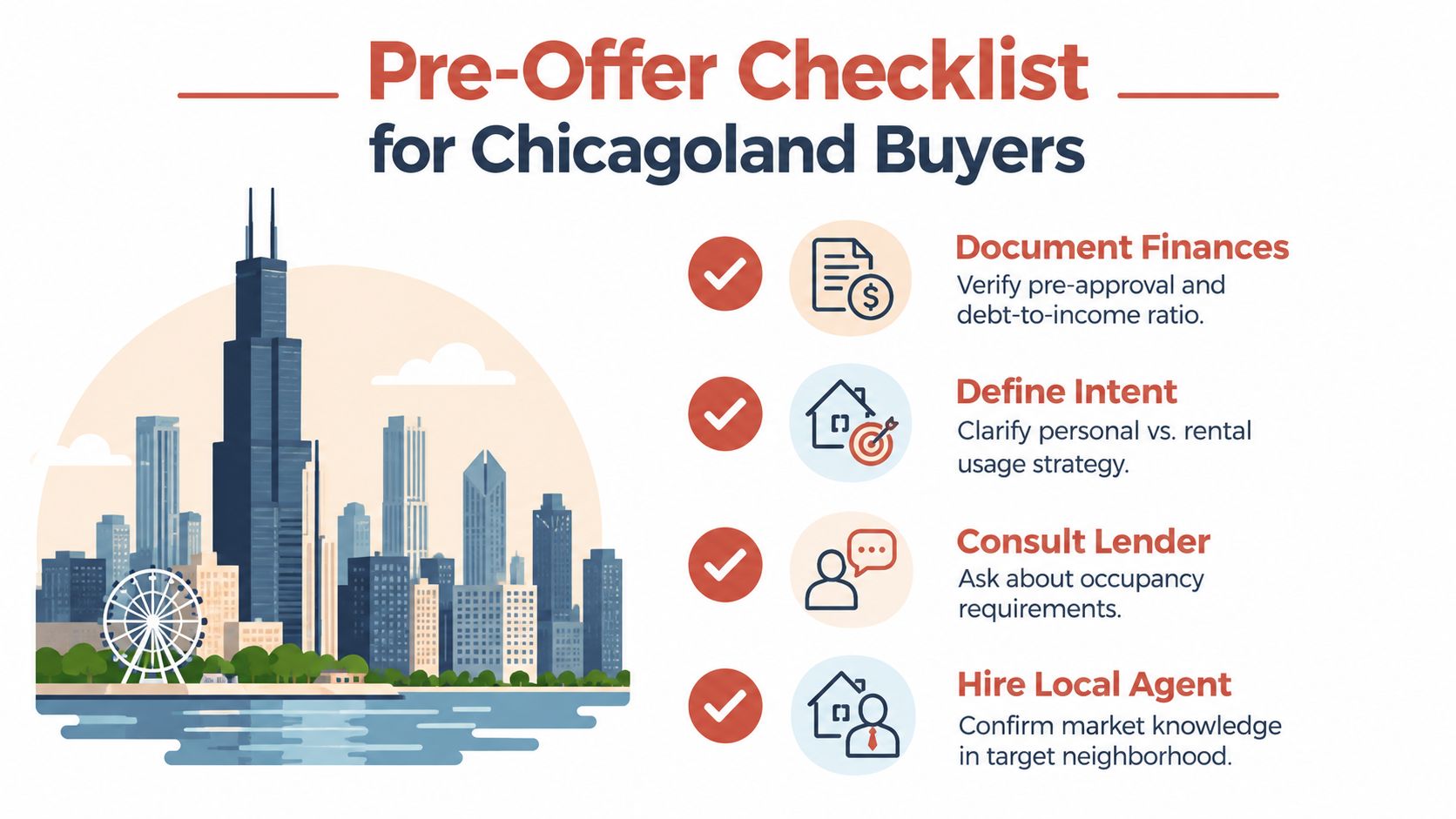
Your pre-offer checklist
- Document finances: Gather your income records, tax returns, assets, existing mortgage obligations, and realistic payment assumptions.
- Define intent: State whether personal occupancy or rental income is the primary purpose.
- Test the occupancy rule: Compare projected personal-use days with rental days and apply the applicable 14-day or 10% test described earlier.
- Check restrictions: Review municipal rules, association documents, condominium declarations, lease limits, and insurance requirements.
- Compare loan scenarios: Ask the lender to underwrite the property as both a second home and an investment property when both uses are possible.
- Build reserves: Set aside enough liquidity for vacancy, repairs, taxes, insurance, and unexpected ownership costs. Your lender may require a specific reserve amount based on the classification.
- Verify the income case: Request comparable rental information and test the property with conservative expenses rather than optimistic gross rent.
Ask the lender how rental income will be treated, how the property's occupancy certification will be documented, what reserves are required, and what happens if your use changes after closing. Ask your Realtor whether the municipality and association permit the proposed rental strategy, how comparable properties are really performing, and whether similar homes have faced appraisal or financing obstacles.
Ask a tax professional how personal and rental days affect expense allocation, interest treatment, depreciation, and loss reporting. Get that answer before you submit an offer, not after your first tax return.
Lock the classification in writing before you sign. Reclassifying after closing can create financing, reserve, insurance, and tax problems that are much harder to fix than an honest pre-offer conversation.
Homes By Carmen can help you compare Chicagoland homes through both an owner-use and rental-property lens, with local guidance on neighborhoods, comparable properties, offers, inspections, and closing details. If you're deciding between a second home and an investment property in Melrose Park or the greater Chicago area, visit Homes By Carmen to start a practical conversation before you make an offer.