
You're standing in a western Chicagoland open house, trying to picture your furniture in the living room while two other couples sign in behind you. The listing agent says offers will be reviewed Tuesday night. Suddenly, “we'll think about it” sounds less like caution and more like a decision to lose the house.
A competitive offer isn't just the highest number. It's the package a seller can accept with the least hesitation, uncertainty, and follow-up. Price matters, but financing strength, earnest money, contingency structure, and closing timing can decide the result when several offers are close.
Table of Contents
- What a Competitive Offer Looks Like
- Preparing Before You Write the Offer
- Pricing the Home the Right Way
- Building Clean Terms Around the Price
- Escalation Clauses and Inspection Strategy
- Submitting, Negotiating, and Holding the Deal Together
- Your Competitive Offer Checklist for the Next Tour
What a Competitive Offer Looks Like
At a western Chicagoland open house in Naperville, Elmhurst, Downers Grove, or Glen Ellyn, the winning buyer rarely succeeds by throwing out a random premium. The stronger move is an offer that answers the seller's practical questions before the listing agent needs to ask them.
A competitive offer is the package a seller can accept with the least hesitation, uncertainty, and follow-up. Price leads the discussion, but the terms determine how much risk the seller takes.
Sellers commonly weigh these five elements, roughly in this order:
- Price: Does the offer reflect the home's current value and the competition?
- Financing strength: Is the buyer likely to reach closing without a loan problem?
- Closing timing: Does the proposed date fit the seller's move?
- Contingency length: How long will the seller remain exposed to uncertainty?
- Earnest money: Has the buyer committed meaningful funds to the transaction?
That order changes with the property and the seller's situation. A seller who already bought another home may value a workable closing date more than a modest price difference. Someone selling an older property may examine the inspection language closely. If the home could face an appraisal gap, the seller may prefer a buyer who has addressed that risk clearly.

A higher price cannot repair a weak package. A vague pre-approval letter, an unrealistic closing date, or an inspection contingency that gives the buyer too much time can push a seller toward a lower offer. The listing agent wants a buyer who appears prepared, financially credible, and unlikely to create a problem late in the transaction.
Practical rule: Write the offer you would want to receive if you were moving, carrying the property, and choosing between several buyers.
Competition returns whenever demand outruns supply. Research covering 14 million home sales across 30 U.S. states found that bidding wars were once uncommon, at roughly 3% to 4% of transactions, then roughly tripled from 1995 to 2005 and exceeded 30% in some markets during that run-up. The same research found bidding wars remained about twice as common after the housing bust as before the late-1990s surge. The housing-market study reinforces the lesson western Chicagoland buyers already see: price alone does not make an offer competitive.
Set each term deliberately without exceeding your financial limit. Choose a price that can withstand comparable-sales analysis, financing that gives the seller confidence, earnest money you can reliably deliver, short but workable deadlines, and a closing date that fits the seller's plans.
Preparing Before You Write the Offer
The strongest offer preparation happens before you find the house. If you're still collecting documents, comparing lenders, or deciding your financial limit after the seller announces an offer deadline, you're already behind.
Get financing ready first
Ask for a fully reviewed pre-approval, not a casual pre-qualification. A pre-qualification may reflect information the buyer provided without a complete review of income, assets, debts, and credit. A stronger pre-approval gives the listing agent more reason to believe the loan can move forward.
Ask the lender:
- What has been reviewed: Confirm whether income documents, asset statements, credit, and employment information have been examined.
- Who handles the file: Know whether a responsive loan officer and underwriting contact can answer questions quickly.
- How fast the lender communicates: A seller wants confidence that requested documents and approval updates won't disappear into a queue.
- What happens after acceptance: Understand appraisal timing, underwriting milestones, and the documents you'll need to provide.
A local lender may offer useful speed and familiarity with area attorneys, title companies, and closing practices. A national online lender may also work, but don't assume a polished letter means the file is strong. Ask for evidence of actual review and make sure your agent can reach a real person when the offer is being evaluated.
Set your limits before the tour
Choose your buyer's agent before you need to submit. Your agent should know the neighborhoods you're considering, understand local contract practice, reach the listing agent promptly, and explain the consequences of each term without pressuring you to overextend.
Write down two separate lists:
- Your walkaway price: The highest all-in amount you'd pay and still feel financially secure.
- Your must-haves: Terms you won't sacrifice, such as a particular financing protection or the ability to complete a professional inspection.
Keep earnest money liquid and accessible. Don't count funds that are trapped in an account with a withdrawal delay or committed to another obligation. Before touring a likely target, confirm with your lender and agent how the deposit will be delivered and when the funds must be available.
Build a fast weekend routine
Western suburban listings often attract the most attention around the weekend. Ask your agent about agent previews and early tour opportunities so you're not seeing a popular property for the first time after several other buyers have already prepared offers.
At the property, don't focus only on finishes. Check the age and apparent condition of the roof, mechanical systems, windows, basement, drainage, and major appliances. Review disclosures promptly, ask whether the seller has an offer deadline, and find out whether the seller has a preferred closing or possession arrangement.
Your offer should be ready to move as soon as the facts are clear. That doesn't mean rushing into a purchase. It means doing the financial, legal, and inspection planning before the emotional pressure arrives.
Pricing the Home the Right Way
The list price is the seller's marketing position. Your offer price must come from the home's evidence, the current western Chicagoland competition, and the highest amount your budget can carry without creating financial stress.
Start with closed sales from the last three to six months, while giving the greatest weight to the most recent 90 days when the market is moving quickly. The property valuation guide explains why a defensible value rests on comparable properties, not on the seller's preferred number or an attention-grabbing list price.
Build the comparable-sales picture
Use nearby homes that match the subject property in features that affect buyer demand and value. Review:
- Size and layout: Square footage, bedroom and bathroom counts, and whether the floor plan functions well for the target buyer.
- Lot and location: Lot size, street position, rail-line and traffic exposure, nearby parks, and proximity to commercial areas.
- Condition: Original finishes compared with renovated kitchens, updated baths, newer windows, roof age, and mechanical systems.
- Basement utility: An unfinished basement does not equal a finished basement with legal or usable living space.
- Buyer appeal: Garage capacity, outdoor improvements, natural light, storage, and school or transit access when relevant.
A home in Naperville, Downers Grove, Schaumburg, or another western suburb may command a different response based on block, condition, and commute convenience, even when its basic statistics resemble another listing. Adjust for those differences instead of copying a price per square foot.
Active and pending listings provide current context, but they are not closed-sale proof. They show what buyers are pursuing now and may indicate the ceiling the market is testing. A property that went under contract quickly can signal that older sales understate the competition you face today.
Price per square foot is useful as a rough check, not as the answer. Older suburban housing stock makes the measure unreliable by itself. A smaller, fully updated home and a larger property with an unfinished basement can produce very different buyer reactions despite similar mathematical ratios.
Separate your starting price from your ceiling
Your starting offer is the number you are prepared to present. Your ceiling is the highest amount you will accept before walking away. Set both before a counteroffer arrives, because emotional bidding is how buyers turn a competitive purchase into an uncomfortable one.
Industry coverage has put premiums around 5% to 10% over list price, with some active markets seeing 11% to 24% above asking, as described in The offer-pricing methodology. Those figures do not justify adding a premium automatically. They show why list price can be a poor anchor when a seller deliberately prices below expected value to attract attention.
| Pricing Anchor | Strength | Weakness |
|---|---|---|
| List price | Easy to identify and useful for understanding the seller's marketing position | May be intentionally low, optimistic, or disconnected from nearby sales |
| Recent comparable sales | Ties the offer to actual transactions | Can lag in a rapidly changing market and requires careful adjustments |
| Active and pending competition | Shows what buyers are pursuing right now | Final prices and pending terms may not be known |
| Your all-in ceiling | Protects your budget and future cash flow | May require you to walk away when another buyer pays more |
Do not bid against an imaginary buyer. If the evidence supports a value below the amount you are considering, ask whether you want the house or only fear losing it. A buyer who bid 15% to 20% over comparable values during the 2021 to 2022 surge, for example, can regret that decision when the market softens, even if the offer won.
The right number is the highest price you can defend with the property, the comparable sales, your financing, and your future budget. Price is only one part of a competitive offer, so do not spend your entire advantage on a number the home cannot support. If the seller expects more than your evidence-based ceiling, pass.
Building Clean Terms Around the Price
Two offers can sit close together on price and carry very different levels of risk. In Naperville, Schaumburg, or Downers Grove, a listing agent is usually looking for four things: proof that you can close, earnest money that shows commitment, deadlines you can meet, and a closing date that fits the seller's next move. Build those terms before you submit, not after the seller raises concerns.
Strengthen the financing story
Attach the strongest pre-approval your lender can issue. It should identify the buyer, match the proposed financing, and support the offer amount. A generic letter or one that leaves the lender's availability unclear weakens your position. Ask for a revised letter before submission, and give the listing agent a direct lender contact who will respond quickly.
Cash buyers have a structural advantage because they remove financing and appraisal risk. Roughly one-third of U.S. homes sold in the first half of 2025 were bought with cash, according to recent cash-buyer housing coverage. A mortgage buyer usually cannot erase that advantage, but can narrow it with verified funds, responsive underwriting, a realistic appraisal plan, and complete documentation.
Ask your lender what could still delay approval. Then address those issues before the offer reaches the seller.
Use earnest money deliberately
Earnest money shows that you intend to perform, but it cannot rescue an inflated price or unreliable financing. A deposit in the range of 1% to 3% can strengthen a competitive offer when the funds are liquid and you understand the contract terms governing their release or return.
Set the amount against your cash reserves and the protections in your contract. Do not raise it just because you fear another buyer. Confirm delivery instructions early, and never wire funds from an unverified email. Call a known contact through a trusted phone number before transferring money.
Shorten contingencies without making reckless promises
Sellers generally prefer a short inspection period, prompt lender milestones, and a clear appraisal plan. Tighten each deadline only as far as you and your professionals can support. Removing a protection you do not understand is poor negotiating, not a clean offer.
Normal contract data indicates that roughly 4% to 7% of home-sale contracts fall apart because of financing, inspection, or appraisal problems. The contingency-failure overview explains why certainty matters to sellers while reinforcing the buyer's need to keep reasonable safeguards. In western Chicagoland, confirm the inspection schedule with your attorney and make sure your lender can meet every financing deadline before shortening the timeline.
Match the seller's calendar
Closing timing can decide a close contest. A DuPage County seller may prefer a same-price offer with a shorter closing schedule when that date coordinates with a purchase, move, or post-closing arrangement. The offer with the best timing can beat a slightly higher offer that creates a scheduling problem.
Ask what date the seller needs. Confirm that your lender can meet it, find out whether the seller wants post-closing possession, and make sure your attorney can review the contract promptly. Include those conversations in your offer strategy. For an overview of buyer expenses that may affect your cash planning, review Illinois closing costs for buyers.
| Term | Weak Version | Strong Version |
|---|---|---|
| Financing | Basic pre-qualification with no clear lender contact | Fully reviewed pre-approval and responsive lending team |
| Earnest money | Funds unavailable or delivery plan unclear | Liquid funds with verified delivery instructions |
| Inspection | Long, vague review period with broad renegotiation language | Short, workable timeline with a defined response strategy |
| Closing date | Buyer chooses a convenient date without asking about the seller | Date aligned with the seller's move and lender capacity |
The strongest clean offer is not the one with the fewest words. It is the one that removes avoidable objections while keeping risks you can afford.
Escalation Clauses and Inspection Strategy
Price gets attention in a multiple-offer situation, but terms decide how much risk you accept to win. Escalation clauses, appraisal-gap promises, and inspection concessions address different problems. Do not trade one protection for another without knowing the financial consequence.
Standard escalation clauses
A standard escalation clause increases your offer when the seller receives a legitimate competing offer, up to a stated maximum. It should identify the increase applied to each competing bid and require evidence that the other offer exists. Set the cap before emotions take over. Your maximum is the amount you can pay and still feel comfortable after closing, not the number you might invent during a bidding war.
Use escalation language only when the listing process allows it. Some sellers want a clean fixed offer because it is easier to compare. Others will accept an escalation clause but require specific documentation or a defined response deadline. Ask your agent how the clause will work before relying on it.
In western Chicagoland, this tool fits a home that appears likely to attract several serious offers, especially when comparable sales support your ceiling. It is less useful when the seller is collecting offers but gives no sign that price will be compared mechanically. A strong fixed offer may be easier for the seller to accept.
Appraisal-gap language
An appraisal gap addresses valuation risk, not competition by itself. You agree to bring additional cash if the appraised value falls below the contract price. The lender generally bases financing on the appraised value and loan terms, so the gap becomes your responsibility.
Set a specific dollar limit. Confirm with your lender and attorney that you can cover it after accounting for your down payment, closing costs, moving expenses, and emergency reserves. Do not offer an unlimited gap because you fear another buyer will promise one. A low appraisal can turn a modest price advantage into a cash obligation that strains the entire purchase.
Inspection response strategy
You can keep an inspection contingency and still present a focused offer. One approach preserves the right to negotiate material defects. Another limits requests to serious safety, structural, or major mechanical problems. Choose the approach based on the property's age, condition, disclosures, and your repair budget.
An older home deserves a more deliberate inspection plan. A property built before 1980 may have aging mechanical systems and building components that require attention soon after closing. That does not justify demanding that an older house perform like new construction. It does require you to identify the risks before narrowing your remedies.
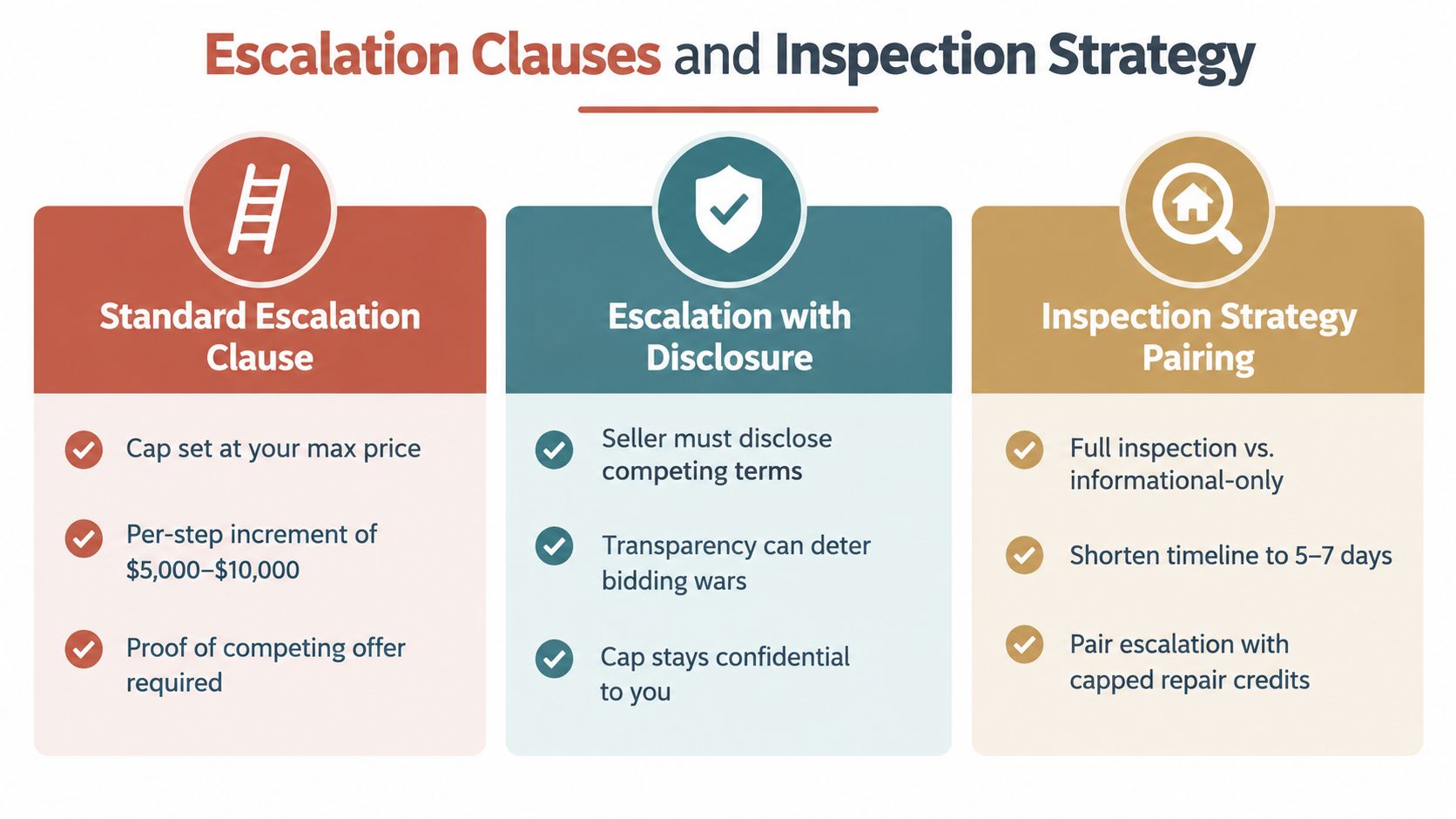
Consider a hypothetical $500,000 Naperville offer. If another buyer is only slightly higher and the comparable sales support the value, an escalation clause may protect your position. If the accepted price rises well above the strongest comparable sales, an appraisal-gap promise could expose you to a much larger cash requirement. The strongest-looking clause may create the wrong risk for that property.
Contingencies also affect whether a contract survives, as explained in the contingency analysis. Competitive behavior is not an instruction to copy every concession other buyers make. A winning offer that leaves you unable to handle the inspection findings or appraisal is not a win.
Decision rule: Use escalation language when multiple offers are likely, set an appraisal-gap limit only after verifying your reserves, and narrow inspection responses only after you understand the home's condition.
Submitting, Negotiating, and Holding the Deal Together
Offer timing should follow the seller's stated process, not a generic rule. If the listing agent says offers will be reviewed Tuesday evening, submit early enough for the agent to confirm receipt and ask questions, but don't send a rushed document that contains avoidable errors.
A Friday afternoon offer can get buried under weekend showings if the seller hasn't invited an early decision. Ask your agent when the seller plans to review offers, whether the deadline is firm, and whether the seller prefers electronic delivery or another process.
Your cover email should be short and useful. State the buyer's name, offer price, financing type, pre-approval strength, proposed closing date, earnest money, inspection approach, and the best contact for questions. Don't turn the message into a sales pitch.
Personal letters require caution. Keep the communication focused on the property and transaction, not personal details that could create fair-housing concerns. A clear summary of your terms is more useful than an emotional story.
Read the counteroffer calmly
Sellers commonly counter on the items that affect their schedule or risk:
- Closing date: They may need more time to move or want a faster settlement.
- Earnest money: They may seek a larger deposit or clearer release language.
- Inspection scope: They may want a narrower repair obligation.
- Price: They may ask for a modest increase when the rest of the offer works.
Respond to the actual change. If the seller requests a small price increase, say, “We can increase to this amount, provided the closing date and inspection terms remain unchanged.” If the seller asks for a repair credit, say, “We can discuss a credit for documented material issues, with the inspection deadline and other terms unchanged.” If the seller requests a closing-cost credit, ask the lender whether the credit is permitted and whether it changes the loan structure before agreeing.
Written terms control the deal. A phone call can clarify intent, but it doesn't amend the contract.
Never agree verbally to a new price, credit, closing date, or contingency change and assume it's settled. Nothing changes until both parties sign the appropriate counteroffer or addendum. A buyer's agent should explain the paperwork, but the buyer must read the revised terms before signing.
For a clearer understanding of the buyer-side responsibilities involved in this process, review what a real estate agent does for a buyer. A disciplined process protects the offer after acceptance, when deadlines become just as important as negotiation.
Your Competitive Offer Checklist for the Next Tour
Save this checklist with your touring notes. Run through it before you submit, not after the seller has announced a deadline.
Before and during the tour
- Confirm the offer deadline: Ask the listing agent when offers will be reviewed and whether the seller may accept one early.
- Review the property condition: Note the roof, basement, mechanical systems, windows, drainage, updates, and disclosure concerns.
- Ask about seller timing: Find out the preferred closing date, possession needs, and any flexibility.
Before pricing the offer
- Set your true budget cap: Include the monthly payment, taxes, insurance, repairs, closing costs, and cash reserves.
- Review recent comparable sales: Give the most weight to similar homes sold within the last three to six months, especially the newest sales.
- Decide your walkaway price: Choose the maximum before seeing a counteroffer, and don't raise it just because you feel attached.
Before signing
- Verify financing strength: Confirm the lender has reviewed your documents and can answer the listing agent quickly.
- Confirm earnest-money access: Make sure the funds are liquid and can be delivered safely when required.
- Choose your contingency position: Decide what inspection, financing, and appraisal protection you can responsibly keep.
- Set escalation limits: If using an escalation clause, define the cap and increment before emotions take over.
- Align the closing date: Make sure the date works for both your lender and the seller's timeline.
After acceptance
- Schedule the inspection promptly: Know whether you're inspecting for negotiation, information, or both.
- Track every deadline: Put inspection, financing, appraisal, attorney review, and closing milestones on one calendar.
- Document every change: Require signed written amendments for all revised terms.
If any item forces you to overextend financially, pass on the house. A lost offer is cheaper than a purchase that leaves you unable to handle the payment, repairs, or appraisal risk.
Homes By Carmen helps western Chicagoland buyers evaluate comparable sales, prepare offers, coordinate inspections, and negotiate price and terms with local context. If you're preparing for a competitive offer in Melrose Park, Elmhurst, Naperville, Oak Park, or a nearby suburb, Homes By Carmen can help you build the offer before the deadline arrives.