Property valuation is a formal estimate of what a home is worth on the market, and modern valuation draws on more than 47.3 million appraisals in the FHFA's public UAD dataset. The number you need still depends on who's asking and why, whether you're pricing a sale, arranging financing, or dealing with property taxes.
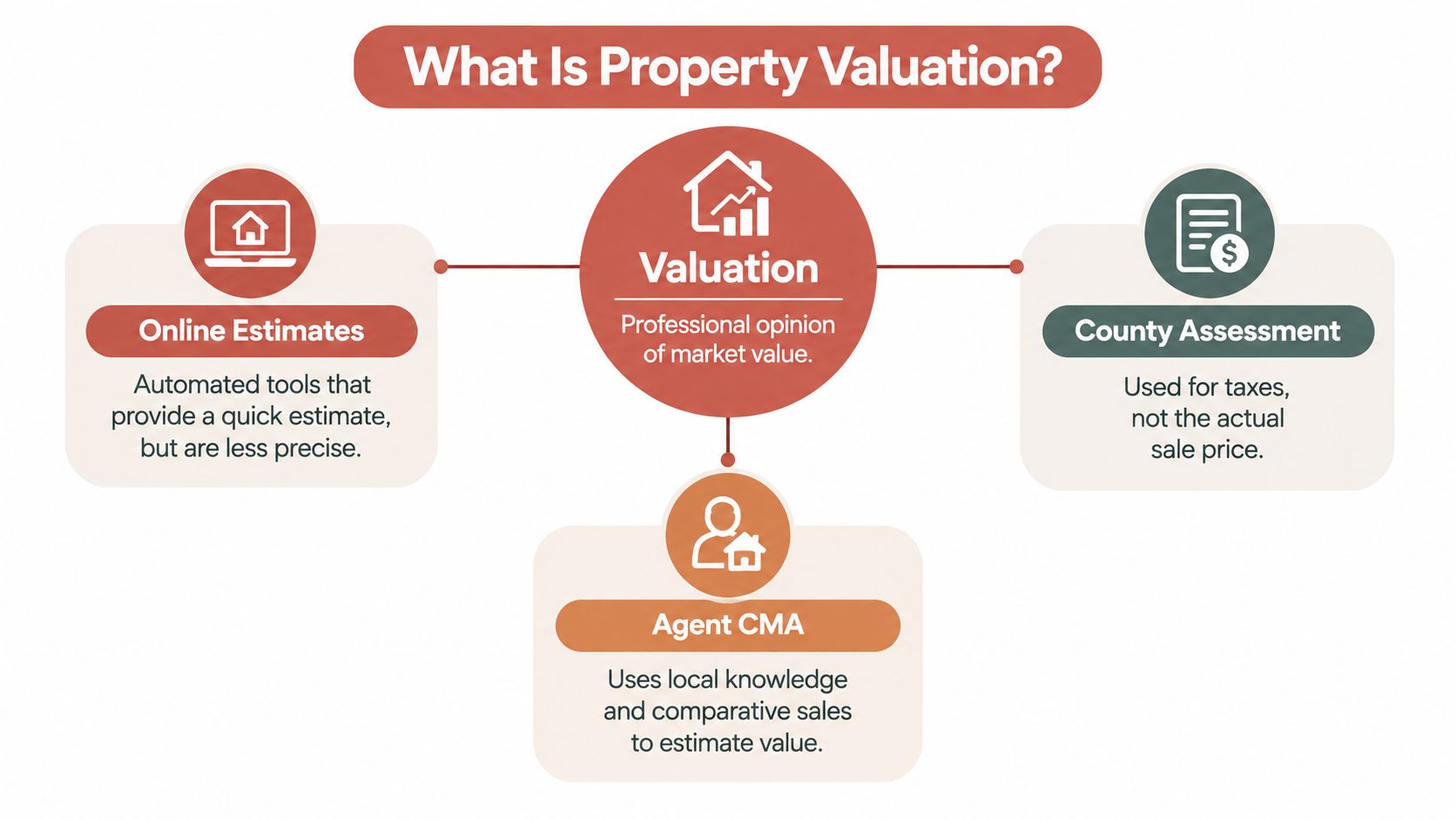
You may be seeing that confusion firsthand. An online estimate puts your Elmhurst home at one figure, the county's assessment shows another, and a local real estate agent gives you a third number after looking at recent sales. None of those figures is automatically “the actual value.” Each one may answer a different question.
A useful way to understand what is property valuation is to ask one question first: What will this number be used for? A sales price needs a market-focused estimate. A mortgage usually calls for a formal appraisal. A tax bill relies on an assessment created for taxation, not necessarily the price your neighbor might pay.
Table of Contents
- What Is Property Valuation Really Telling You
- Market Value Versus Assessed Value
- The Three Core Valuation Methods Explained
- Comparative Market Analysis Versus Professional Appraisal
- Automated Estimates and Where AI Fits In
- How Valuation Works in the Chicago Suburbs
- Your Steps to Getting and Reading a Valuation
What Is Property Valuation Really Telling You
Suppose you own a three-bedroom house near downtown Naperville. The kitchen was updated recently, the basement is unfinished, and two similar homes sold nearby. An automated estimate sees the address, square footage, public records, and surrounding sales. The county applies its assessment process for tax purposes. An agent studies the competing listings, the condition of your home, and the buyers currently shopping in that neighborhood.
Those three people, systems, or offices can produce different numbers because they aren't performing the same job. Property valuation is an opinion or estimate of market value supported by evidence, but the evidence selected and the standards applied depend on the assignment.
The FHFA describes its Uniform Appraisal Dataset Aggregate Statistics as the first publicly available dataset of aggregate appraisal-record statistics in the United States. The dataset includes more than 47.3 million appraisals, with quarterly information spanning 2013 Q1 through 2024 Q3 and annual information from 2013 through 2023 (FHFA's UAD Aggregate Statistics). That scale shows how valuation has moved beyond one person's instinct about one house. Professionals can study comparable sales, property characteristics, and geographic patterns across a very large body of evidence.
The purpose changes the answer
For a homeowner, the practical distinction looks like this:
- Selling: You need a realistic estimate of what qualified buyers may pay in the current market.
- Financing: Your lender needs support for the collateral value behind the loan.
- Taxes: The county needs a consistent assessment method for determining taxable value.
Practical rule: Never accept a valuation number without asking, “Valued for what purpose?”
By the end of this guide, you'll be able to read an online estimate, an agent's comparative market analysis, an appraisal, and a county assessment with the right expectations. You'll also know when the number is useful, when it needs professional review, and which valuation type fits a sale, mortgage, or tax question.
Market Value Versus Assessed Value
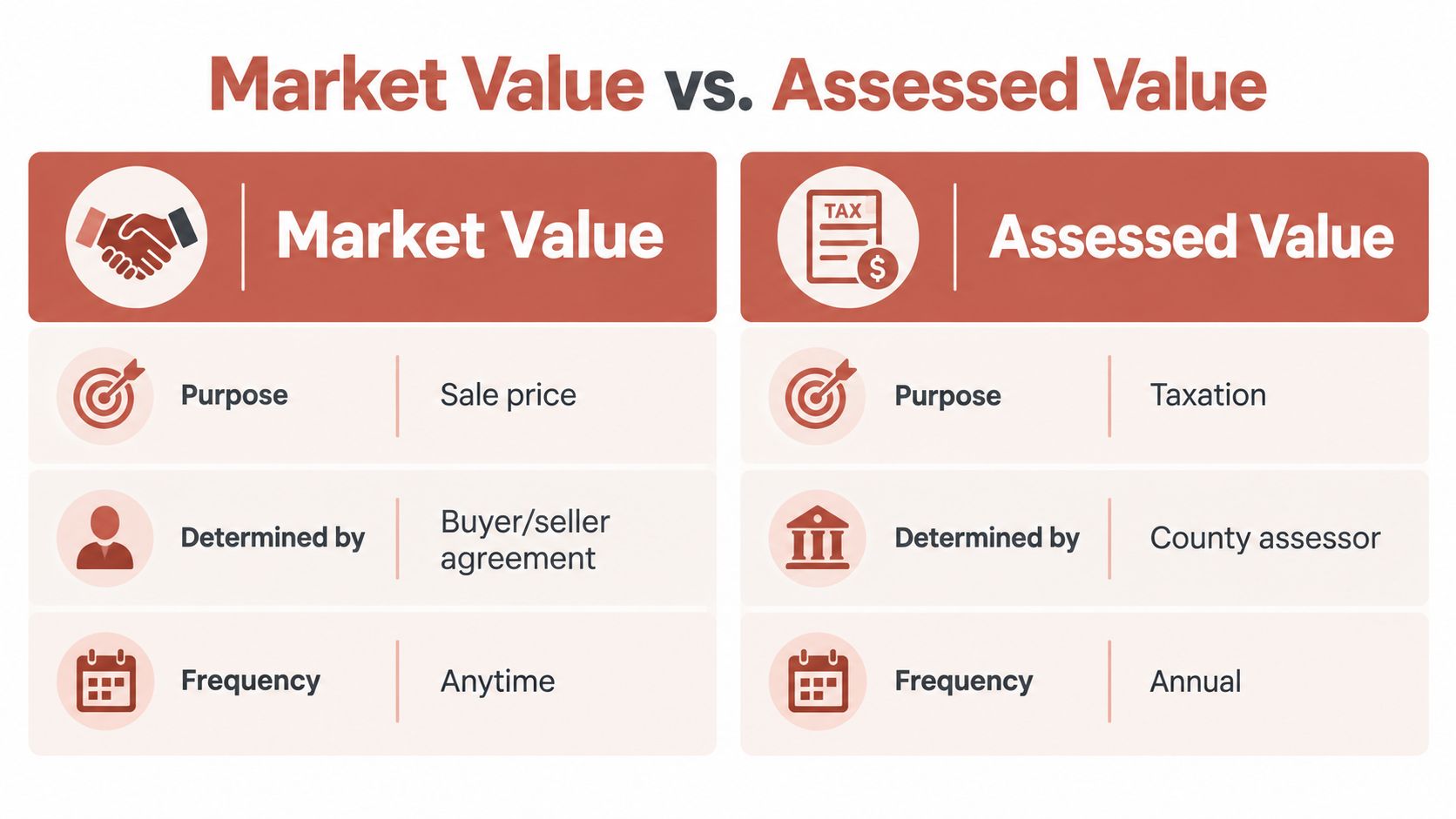
Market value is the amount a property could reasonably command in an open transaction between a willing buyer and willing seller, assuming normal conditions and no unusual pressure. In a practical sales conversation, it's the price your Oak Park bungalow might attract when buyers compare its location, condition, layout, improvements, and alternatives available at the same time.
Assessed value serves a different purpose. The county assessor creates it for property taxation, using an organized process intended to apply consistently across many properties. It isn't a promise that your house would sell for that amount, and it shouldn't be treated as a listing recommendation.
Consider a Downers Grove bungalow with an older bathroom, a finished attic, and a newer roof. A nearby renovated home may sell for substantially more because buyers value its condition and presentation. The county record may not reflect every interior improvement immediately, and the assessment system isn't designed to imitate a live negotiation between one buyer and one seller.
Compare the numbers by purpose
| Question | Market value | Assessed value |
|---|---|---|
| Primary purpose | Estimate a likely sale price | Support property tax calculations |
| Who determines it | Market participants, often analyzed by an agent or appraiser | County assessor |
| When it matters most | Selling, buying, refinancing, estate planning | Reviewing a tax bill or considering an assessment appeal |
| What influences it | Comparable sales, condition, location, demand, and timing | Assessment rules, property records, local data, and standardized procedures |
Which figure should you use?
If you're preparing to sell, start with a market-focused analysis rather than your tax bill. Buyers compare your home with other homes they can purchase, not with the county's assessment figure.
If you're refinancing, ask your lender which valuation product it requires. A lender may use a desktop valuation, an automated model, a drive-by review, or a full inspection depending on the loan and its risk requirements. If you're questioning your taxes, the assessed value is the relevant number, but a market analysis or appraisal may help you evaluate whether the assessment appears out of line.
The key is not to force both figures to match. Market value answers a transaction question. Assessed value answers a taxation question.
The Three Core Valuation Methods Explained
Professional valuation generally relies on three recognized approaches: the sales comparison approach, the income approach, and the cost approach (RICS overview of valuation methods). Think of them as three different ways to answer the same question: what evidence best explains this property's value?
Sales comparison approach
This is the method most homeowners encounter when pricing a suburban house. An analyst reviews recent sales of similar properties, then considers differences such as location, size, condition, updates, parking, lot characteristics, and finished living space.
For example, a ranch in Glen Ellyn may look similar to another ranch nearby, but a finished basement, renovated kitchen, or position on a busier road can change what buyers will pay. The comparison isn't a simple average. A careful analysis asks how each difference affects the relationship between the subject property and the comparable sale.
This approach works best when there are enough recent, reasonably similar sales. It's especially useful for owner-occupied houses, condos, and other properties that buyers commonly compare.
Income approach
The income approach treats a property as an income-producing asset. Instead of asking only what a neighboring home sold for, the analyst estimates the income the property can generate and converts that expected cash flow into a present value.
That makes this approach particularly relevant for a two-flat in Melrose Park, a rental condo, or a small investment property. An investor will care about rent, operating expenses, vacancy, maintenance, and the income that remains after those costs. A house purchased solely as a family residence usually won't depend on this method as heavily.
Cost approach
The cost approach asks what it would cost to replace the property with a similar building, then accounts for depreciation and other factors that reduce value. Land value and the condition of the existing improvements also matter.
This method can be helpful for newer construction, unusual properties, or buildings with limited comparable sales. It isn't the same as saying, “I spent this much remodeling, so the home must be worth that much.” Construction cost and market value overlap, but buyers don't always reimburse every dollar spent on personal design choices.
A strong valuation professional chooses the approach that fits the property and reconciles the evidence rather than applying one formula mechanically.
Comparative Market Analysis Versus Professional Appraisal
A comparative market analysis, often called a CMA, is an agent's estimate of a likely selling range. The agent reviews comparable sales and competing properties, then applies local knowledge about condition, buyer behavior, and current positioning. For an Elmhurst homeowner deciding whether to list, a CMA is usually the practical starting point.
A professional appraisal is a formal report prepared for a defined purpose, often lending or taxation. It follows professional standards, documents the reasoning, and is designed to be defensible to the party relying on it. The report may include comparable sales, property details, market conditions, adjustments, photographs, and an explanation of the final opinion.
The distinction in one view
| Aspect | Comparative Market Analysis | Professional Appraisal |
|---|---|---|
| Purpose | Set a listing price or evaluate a likely sale price | Support lending, tax, legal, or other formal decisions |
| Prepared by | Real estate agent or broker | Qualified professional appraiser |
| Typical data | Local comparable sales, competing listings, property condition, agent market knowledge | Comparable sales, property inspection or review, market data, professional standards |
| Cost | Often provided as part of a seller consultation | Usually ordered as a paid professional service |
| When you need it | Before listing, evaluating an offer, or planning a sale | When a lender, court, tax process, or formal requirement calls for it |
Why lenders don't simply use an agent's estimate
A seller's agent is trying to help position a property in a marketplace. The agent may discuss likely buyer response, presentation, timing, and pricing strategy. A lender, by contrast, needs an independent opinion about the property securing the loan.
That difference explains why a CMA and an appraisal can disagree without one being automatically wrong. The agent may know that buyers in a particular Oak Park pocket are responding strongly to a certain layout. The appraiser must document a supported opinion under the assignment's requirements.
For a mortgage, ask the lender what valuation it will accept before ordering anything yourself. For a sale, request a CMA that explains the comparable choices and the recommended pricing strategy. The right report is the one that matches the decision in front of you.
Automated Estimates and Where AI Fits In
An automated valuation model, or AVM, produces a value estimate from available property records, comparable-sale data, geographic information, and statistical relationships. It can give you a quick starting point for a home in Naperville or Oak Park, but it doesn't personally inspect the property.
That limitation matters. Public records may show the room count and square footage, yet fail to capture whether the kitchen is dated, the basement has water concerns, or the roof was recently replaced. An algorithm may also struggle with street-level differences, unusual floor plans, additions that aren't recorded consistently, or a home that is much better or worse than nearby properties.
Useful as an anchor, not a verdict
An online estimate can help you form an initial question: does the number seem broadly consistent with nearby homes? It shouldn't be the final pricing decision, especially when you're preparing to list, negotiating a major purchase, or dealing with a formal financial matter.
You can use a home valuation calculator as an initial reference, then test that estimate against actual comparable sales and the condition of the specific property. The more unusual the home, the more important local human review becomes.
Lenders may use different valuation types depending on loan risk. Guidance for consumers describes desktop or AVM-based reviews, kerbside valuations, and full inspections as possible options (consumer guidance on property valuations). The lender decides what satisfies its process, so a homeowner shouldn't assume that an online estimate will replace an appraisal.
AI is changing the workflow
AI doesn't necessarily mean that appraisers disappear. A 2025 research paper reported that an AI valuation tool reduced valuation time and differences between valuers while leaving accuracy largely unchanged (2025 research on an AI valuation tool). That finding supports a hybrid direction, where software organizes evidence and identifies patterns while a professional evaluates the property's unusual details and local context.
The human contribution remains important when the data is incomplete or the house doesn't fit the model. A computer can flag nearby sales. A local professional can explain why a busy road, school boundary, flood concern, renovation quality, or micro-location changes the comparison.
How Valuation Works in the Chicago Suburbs
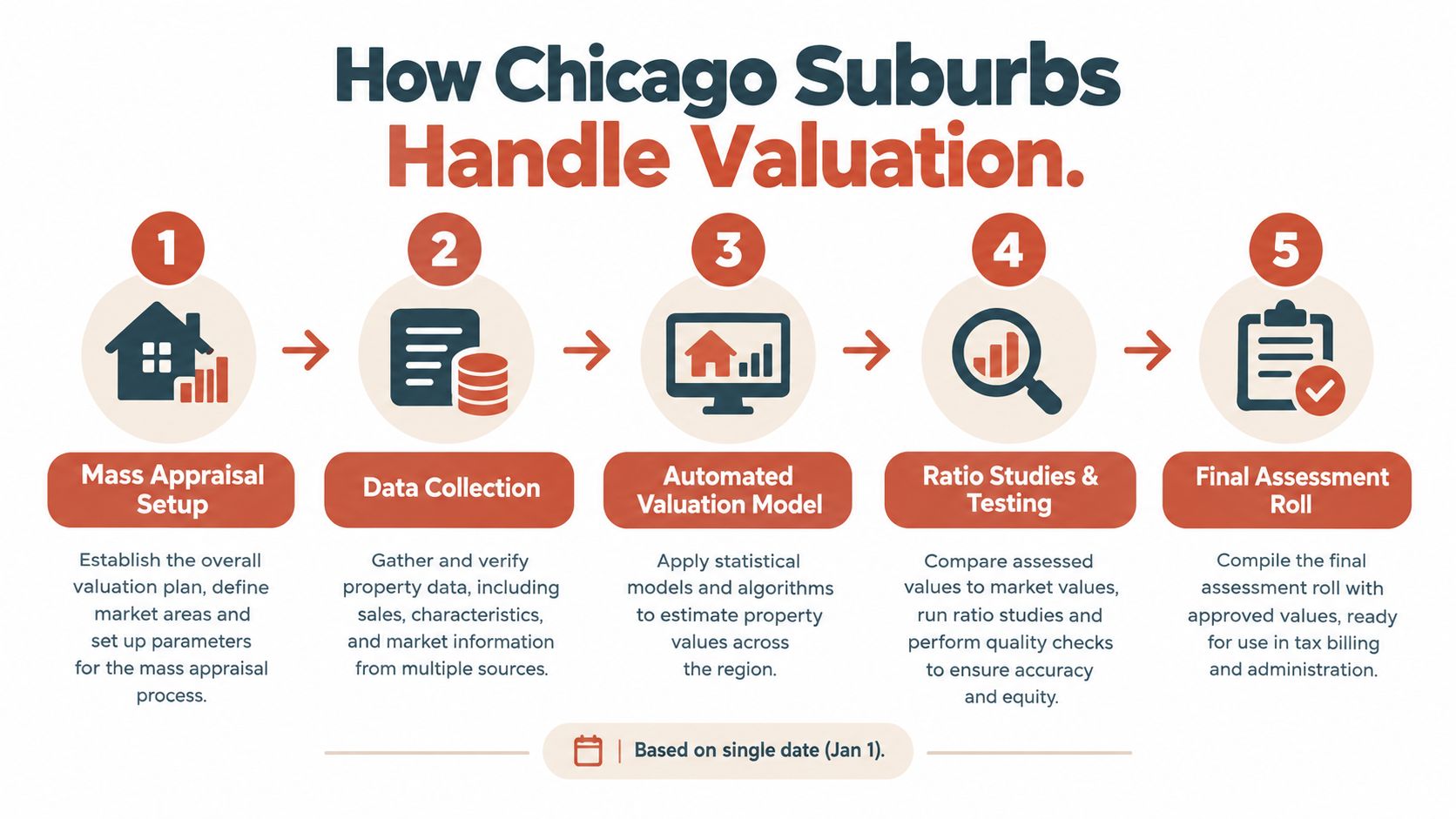
Suppose you own a bungalow in Oak Park and need a number for property taxes. The assessor is not setting a listing price for your specific home. The office is valuing many properties through mass appraisal, using shared data, standardized methods, and statistical testing as of a single date. Professional standards call for defining the market area, identifying local value factors, calibrating the model to neighborhood behavior, and reconciling the results (IAAO standard on mass appraisal).
Purpose changes the number you need. A tax assessment supports a local tax process. A market analysis addresses what buyers may pay for one home now. A mortgage appraisal answers a lender's risk question. That process explains why an assessed value in Melrose Park, Glen Ellyn, or Naperville may not match nearby asking prices. Our Chicago housing market trends update shows how those asking prices have moved over time.
The data has a long memory
Historical benchmarks help valuation professionals place current conditions in context. The FHFA House Price Index includes U.S. data beginning in 1975 Q1, covers all 50 states and more than 400 American cities, and provides metropolitan rankings across different time horizons (FHFA House Price Index). That record helps distinguish a local cycle from a single unusual sale.
Calibration also differs from suburb to suburb. An older, tightly spaced Oak Park neighborhood may require attention to lot size, additions, and transit access. A Naperville model may weigh newer construction, larger lots, school boundaries, and subdivision patterns differently. The same broad method can therefore produce different local results because the factors affecting value are not identical.
The wider housing market gives the figures practical importance. Federal Reserve data puts residential real estate outstanding at 59,656 billion dollars, up 5.7 percent from 2023:Q4 to 2024:Q4 (discussion of real-time assessor data and valuation). Whether the number supports a sale, a loan, a tax position, or an investment decision, read it alongside its purpose, date, and evidence.
Your Steps to Getting and Reading a Valuation
Start by writing down the decision you need to make. If you're considering selling a home in Elmhurst, you need a market-oriented pricing opinion. If a lender or legal process requests a formal report, you need to follow that party's requirements. If your concern is a tax bill, focus on the assessment and the local appeal process.
Use the right sequence
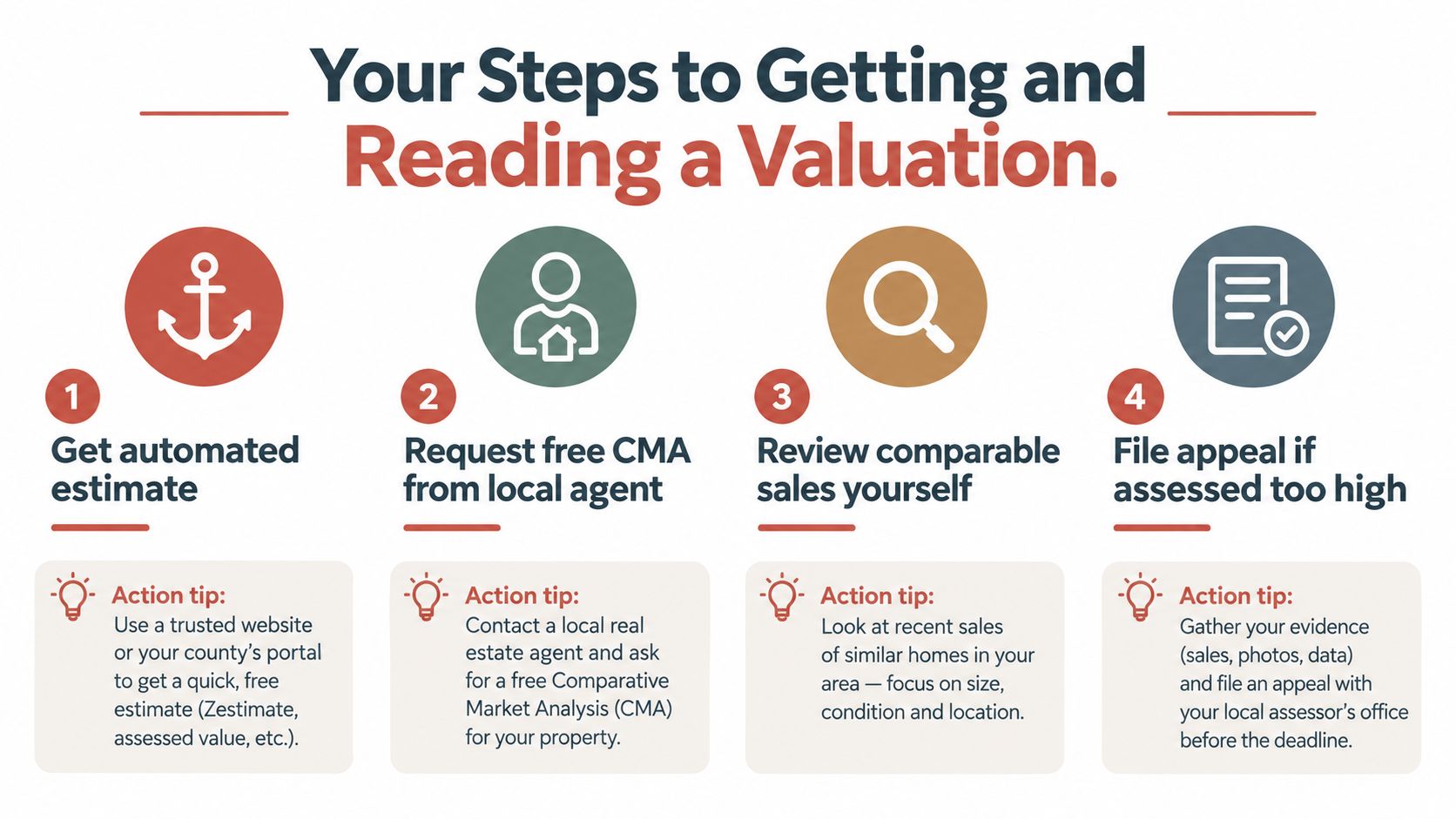
- Get a rough anchor. An automated estimate can give you a starting point, but treat it as a range-setting exercise rather than a final answer.
- Request a local CMA. Ask an agent to explain which comparable sales support the suggested price and how the agent accounted for condition, improvements, location, and competition.
- Order an appraisal when required. Use a professional appraiser when a lender, court, estate matter, or tax procedure calls for a formal report.
- Read the evidence, not just the conclusion. Check the comparable properties, sale dates, physical differences, adjustments, and stated purpose.
Questions worth asking
Before relying on any valuation, ask:
- What purpose does this number serve? A sale estimate isn't automatically suitable for a mortgage or tax appeal.
- Which comparable sales were selected? The report should identify them clearly and explain why they fit.
- What adjustments were made? Look for differences in condition, size, updates, lot, parking, and location.
- What information may be missing? An automated system or limited inspection may not capture renovations or defects.
- What should I do next? A useful valuation should lead to a decision, not just a number.
You don't need every valuation to match. You need to understand why the figures differ and whether each one answers your actual question. For a practical review of the finished analysis, see this home valuation report guide.
Homes By Carmen offers complimentary property valuation and strategy consultations for homeowners considering a sale, supported by local knowledge of Melrose Park and the western Chicago suburbs. Visit Homes By Carmen to start a conversation about your home's comparable sales, pricing options, and the valuation that fits your next move.