What's the most important question to ask a real estate agent, the one that reveals whether their advice will hold up when the deal gets difficult? It isn't necessarily “How long have you been in the business?” A résumé can show credentials, but it doesn't show how an agent thinks through pricing, inspections, negotiations, fees, or deadlines.
The strongest interview questions ask for evidence, numbers, examples, and a clear plan. Sellers should start with value, preparation, and the amount they need to keep after closing. Buyers should press for local market data, offer strategy, and guidance on contingencies. Both should understand communication standards, representation terms, compensation, and what happens when circumstances change.
The questions below are organized around the decisions an agent will influence. They also include practical follow-ups for western Chicagoland, including Melrose Park, Elmhurst, Downers Grove, Naperville, Oak Park, and Glen Ellyn. Use them to compare judgment, not just personality.
Table of Contents
- 1. What is my home actually worth, and how should we price it?
- 2. How much money will I actually walk away with after the sale?
- 3. What should I fix, update, or leave alone before listing?
- 4. What's happening in the local market right now, and how would that affect my buying strategy?
- 5. How often will you update me, and how will you communicate when something unexpected comes up?
- 6. What is your experience with transactions like mine, and can you share a recent example?
- 7. What is your track record on negotiations, and how do you approach getting me the best deal?
- 8. How will you help me understand and navigate the closing process?
- 9. How do you stay current with market trends, regulations, and real estate practices?
- 10. About Carmen Salerno, services, differentiators, and local expertise
- 11. What should you ask before you sign?
- 11-Point Comparison: Questions to Ask a Real Estate Agent
- Choose the Agent Whose Answers Hold Up
1. What is my home actually worth, and how should we price it?
A seller needs more than a confident estimate. Ask the agent for a comparative market analysis, or CMA, that explains the recommended price through comparable sales, current competition, property condition, and neighborhood-specific factors. The agent should be able to show you the properties behind the recommendation, not present a polished summary.
A Melrose Park homeowner might expect a higher price because the home has generous living space, while recent nearby sales reveal that buyers are paying more attention to updates, lot characteristics, or commute access. An Elmhurst seller may discover that a home's price per square foot looks reasonable across the neighborhood but sits above comparable properties only a short distance away. Those distinctions can change the launch strategy.
Ask how the recommended price fits your preferred timeline and financial target. A price that attracts strong early interest may serve you better than a higher figure that limits showings, but your agent should explain the trade-off rather than push a single answer.
- Request the actual comparables: Review the sale dates, locations, condition, size, and terms.
- Ask about current competition: Discuss similar homes listed nearby and how quickly they're attracting attention.
- Plan for a weak launch: Agree in advance on the signals that would justify a price review.
- Compare scenarios: Ask how different list prices could affect buyer interest and net proceeds.
For an initial estimate, you can also use this home valuation calculator, then ask the agent to refine the result with local data.
2. How much money will I actually walk away with after the sale?
The listing price is not the same as the money you'll receive. Net proceeds are calculated by subtracting the mortgage payoff, closing costs, agent commission, and repairs from the sale price, as explained in this seller net proceeds guide. Taxes, concessions, HOA charges, special assessments, liens, and other transaction expenses may also affect the final amount.
A useful agent should prepare a written estimate before you list. That estimate should show the expected sale price, current mortgage payoff, commission structure, closing expenses, tax prorations, anticipated repairs, and any seller credits under consideration. If you have an HOA, ask specifically about transfer fees and outstanding assessments. Also ask your lender for a current payoff statement, since the agent shouldn't guess at that figure.
The conversation can change the pricing decision. A seller in Downers Grove may discover that a seemingly attractive list price doesn't meet the amount needed for the next purchase. An Oak Park seller may also need to compare a lower offer with concessions against a higher offer with fewer terms, rather than focusing only on the headline number.
Practical rule: Choose the pricing strategy that supports your actual financial objective, not merely the number printed on the listing.
Ask when proceeds should be available, which closing responsibilities belong to the title company or attorney, and whether any payoff or lien issue could delay disbursement. For another perspective on transaction planning, review these Chicago seller resources for improving closing proceeds.
3. What should I fix, update, or leave alone before listing?
The best pre-listing advice separates necessary repairs from expensive improvements that may not return their cost. Independent guidance consistently places safety and structural concerns first because inspectors may flag them and serious defects can derail a transaction. Examples include foundation cracks, roof damage, electrical problems, plumbing leaks, and HVAC issues, as outlined by Better Homes and Gardens Real Estate.
A Naperville seller considering a major kitchen renovation should ask what buyers in that price range expect. Fresh paint, updated hardware, professional cleaning, decluttering, and staging may improve presentation without committing the seller to a full remodel. By contrast, an older roof or failing HVAC system may deserve attention because buyers could request credits, repairs, or additional inspections.
Ask the agent to rank recommendations by urgency and likely buyer impact. “Fix everything” isn't a strategy. Neither is leaving a known safety issue for the buyer without understanding how it could affect financing, disclosures, negotiations, and liability.
- Start with critical systems: Review the roof, HVAC, electrical, plumbing, foundation, and visible water issues.
- Separate cosmetic work: Discuss paint, lighting, flooring, landscaping, and staging as distinct choices.
- Get support for large expenses: Request contractor quotes and an explanation of likely value.
- Consider inspection timing: Ask whether a pre-listing inspection would reveal problems early.
- Clarify disclosure effects: Confirm how completed repairs and known defects should be documented.
A Glen Ellyn homeowner with dated fixtures may need presentation improvements rather than a full renovation. Practical curb appeal steps can also help, and this curb appeal guide offers ideas to discuss with the agent.
4. What's happening in the local market right now, and how would that affect my buying strategy?
A national headline won't tell you how to write an offer on a particular block. Ask the agent for neighborhood-level evidence covering inventory, recent sales, days on market, price movement, competing offers, inspection expectations, and appraisal outcomes. Then ask what those conditions mean for your budget and risk tolerance.
A buyer searching in Downers Grove may need one strategy for a well-maintained home with immediate activity and another for a property that has sat without an accepted offer. In Naperville, a buyer should ask how seasonal competition affects the neighborhoods and property types they're considering. In Oak Park, the agent should explain how financing terms, condition, location, and buyer demand interact at the buyer's price point.
Request MRED data or another clearly identified local source, not just phrases such as “it's a hot market” or “buyers have an advantage.” The useful answer connects evidence to action. That may mean deciding how much flexibility to keep in an inspection contingency, how quickly to review new listings, or whether a particular offer should prioritize price, certainty, or timing.
Follow-up questions for a serious market conversation
- Ask for the relevant geography: Countywide averages can hide major differences between neighborhoods.
- Compare similar properties: Focus on homes with similar condition, size, location, and intended use.
- Discuss offer structure: Ask which terms are currently helping buyers compete and which add unnecessary risk.
- Review appraisal concerns: Ask whether recent sales support the likely offer range.
- Set a search plan: Decide whether your timing calls for patience, speed, or broader neighborhood options.
A strong local expert won't promise to predict the market. They'll explain what the current evidence supports and where uncertainty remains.
5. How often will you update me, and how will you communicate when something unexpected comes up?
Communication problems usually start before the contract. Ask the agent to describe the normal rhythm, preferred channels, response expectations, and escalation process for inspections, appraisals, financing, offers, and closing issues.
The National Association of REALTORS® Home Buyers Survey found that 74% of buyers considered it important for their agent to call them personally about activity, while buyers also wanted immediate updates when a home was listed, repriced, or placed under contract. The same survey reported that 90% were very satisfied with their agent's knowledge of the purchase process, which makes process competence and notification habits important subjects to discuss upfront. Review the NAR Home Buyers Survey for that buyer feedback.
Communication preferences vary. Zillow's 2025 Consumer Housing Trends Report for Agents found that 53% of buyers preferred texting or a messenger app, compared with 33% who preferred phone calls. J.D. Power also found satisfaction scores were roughly 100 points higher when agents answered promptly, kept clients informed about milestones, and shared comparable properties, according to Zillow's 2025 report.
Ask:
- What happens routinely: Establish weekly updates or another agreed cadence.
- What counts as urgent: Clarify which events trigger an immediate call.
- Which channel fits each issue: Use text for quick coordination and written messages for decisions.
- Who covers absences: Learn who will respond if the agent is unavailable.
- How decisions are documented: Request written confirmation of material terms and deadlines.
6. What is your experience with transactions like mine, and can you share a recent example?
A long career does not automatically translate into relevant judgment. Ask about recent, relevant transactions that resemble your situation, whether you are a first-time buyer, investor, estate representative, relocation client, or seller of an as-is property.
An Elmhurst first-time buyer may need an agent who explains trade-offs without rushing decisions. An investor considering a duplex needs practical discussion of condition, financing, rental potential, and operating assumptions. A family selling an inherited home may need coordination with an attorney, several decision-makers, required disclosures, and an as-is pricing strategy.
Request one recent example with enough detail to assess the agent's reasoning. Ask which neighborhood and property type were involved, what complication arose, which decision the client had to make, and how the agent handled it. A routine problem-solving example can be more revealing than a dramatic success story.
Evidence worth requesting
- Recent transaction count: Ask how many comparable transactions the agent completed during the past 12 months.
- Relevant role: Confirm whether that work involved representing the buyer, seller, or both.
- Western Chicagoland activity: Ask about recent work in Elmhurst, Downers Grove, Naperville, or your specific target area.
- Property-type experience: Confirm experience with condos, duplexes, inherited homes, relocations, or as-is sales as applicable.
- Problem-solving example: Request the complication, the options considered, and the action taken.
- Client references: Seek references from clients with similar goals or circumstances.
Ask how the agent measures performance, including closed transactions, list-to-sale results, and time on market. Those measures matter only when the agent explains the property type, price range, market conditions, and client objective behind them. For buyer representation questions, review the consumer questions for interviewing a buyer's agent, then compare the answers with the agent's proposed representation terms and service plan.
7. What is your track record on negotiations, and how do you approach getting me the best deal?
Negotiation isn't limited to the purchase price. It can involve inspection credits, appraisal provisions, closing dates, possession, financing terms, personal property, and the certainty that the deal will close.
Ask for examples, but judge the answer carefully. A buyer's agent who always describes negotiation as “getting money off” may overlook the value of winning a property with a workable inspection period or a closing date that fits your move. A listing agent who talks only about the highest offer may underweight financing strength, appraisal risk, and the likelihood of smooth execution.
A Downers Grove buyer might benefit from an offer supported by comparable sales and realistic inspection estimates. A Naperville seller with multiple offers may need help comparing contingencies and timing rather than accepting the highest figure. In a competitive situation, the best strategy depends on your priorities and the evidence available at that moment.
Ask, “What would you protect first if the other side won't agree to everything?” The answer exposes the agent's priorities.
Follow up with these questions:
- How do you support an offer price: Ask which comparable sales and property facts will inform it.
- How do you use inspection findings: Discuss material defects, reasonable credits, and when to walk away.
- How do you compare competing offers: Ask how financing, contingencies, deadlines, and certainty are weighed.
- How do you handle conflict: Look for firm advocacy without unnecessary escalation.
- How do you advise on limits: Confirm that you'll understand the risk before approving a concession.
8. How will you help me understand and navigate the closing process?
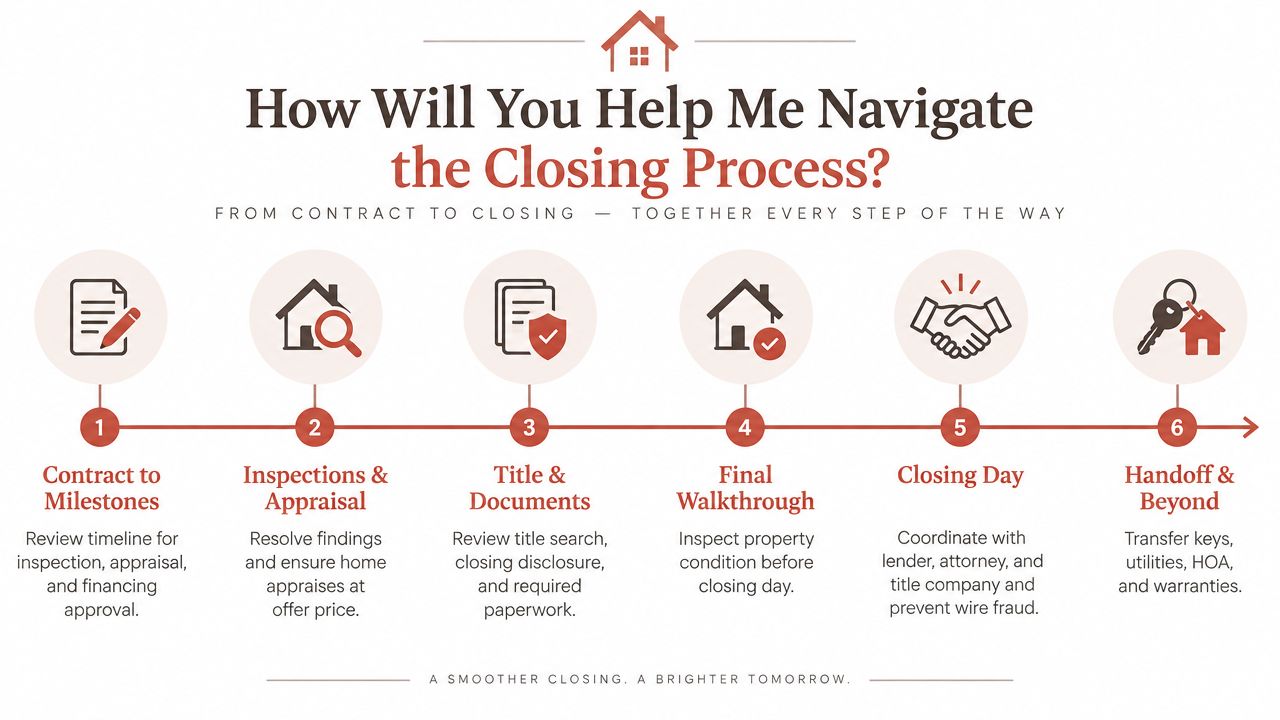
Closing support should be concrete. Ask the agent to explain what happens from signed contract through funding, including inspection, appraisal, financing, title review, attorney coordination, final walkthrough, document delivery, and post-closing responsibilities.
A first-time buyer should receive a written timeline that identifies who handles each task and when decisions are due. A seller should understand inspection and appraisal coordination, title requirements, utility transfers, property condition obligations, and the final walkthrough. If a lender, attorney, inspector, or title company owns a step, the agent should still explain how they'll monitor it and alert you to delays.
Ask about the closing disclosure and when you'll receive it. Ask how wire instructions will be verified, since funds should never be transferred solely on the basis of an unexpected email. Clarify whether the agent attends closing, how title issues are escalated, and what happens if an inspection or appraisal creates a dispute.
Questions to put on the closing timeline
- What do I need to provide: Request a written document list.
- Who monitors contingencies: Identify the person tracking inspection, appraisal, and financing deadlines.
- What happens at the walkthrough: Ask what condition, inclusions, systems, and agreed repairs you should verify.
- How are delays handled: Establish who communicates with the lender, attorneys, and title company.
- What remains after closing: Discuss HOA transfers, utilities, warranties, keys, and unresolved repairs.
Use this closing process timeline infographic as a visual prompt for your conversation.
9. How do you stay current with market trends, regulations, and real estate practices?
How does an agent turn new information into better advice for your transaction? Local conditions, transaction procedures, and representation rules change, so ask how the agent keeps knowledge current and applies it to client decisions.
A useful answer should name specific habits, such as reviewing MRED reports, checking public records, attending broker meetings, completing continuing education, following lender updates, or participating in local professional groups. Ask for a recent example of learning that changed pricing guidance, offer strategy, disclosures, or another client recommendation.
Ask how frequently market information is reviewed and how the agent separates dependable local evidence from broad commentary. For western Chicagoland, the follow-up should be specific: can the agent explain differences among Melrose Park, Elmhurst, Downers Grove, Naperville, Oak Park, and Glen Ellyn, rather than treating every western suburb as one market? That distinction can affect pricing, search priorities, offer terms, and preparation decisions.
Recent changes to U.S. brokerage rules make this interview topic practical for buyers and sellers. Written buyer-representation agreements, compensation disclosures, and negotiation practices may affect who pays an agent, which services are included, how long an agreement lasts, and what happens if the relationship ends early. Ask the agent to explain those points in plain language and identify which terms are negotiable.
Use these questions:
- What education did you complete recently: Request relevant courses, training, or professional updates.
- Which data do you use: Confirm whether recommendations rely on MRED, public records, and current comparable sales.
- How do you track rule changes: Ask how updates affect agreements, disclosures, compensation, and deadlines.
- How does learning affect your work: Request a recent example of changed advice, pricing, or strategy.
A strong agent should connect current knowledge to your actual decision, not recite credentials. Their answer should show how they reduce avoidable surprises while protecting your financial and transaction goals.
10. About Carmen Salerno, services, differentiators, and local expertise
Carmen Salerno is a licensed residential real estate professional serving Melrose Park and the greater Chicago area. Her services include buyer, seller, and rental representation, with support for home searches, tours, offer drafting, negotiation, inspection coordination, listing preparation, showings, and closing oversight.
For sellers, Carmen provides complimentary property valuations and neighborhood-specific CMAs supported by Midwest Real Estate Data, or MRED. For buyers, the service includes MLS-powered searches, tour scheduling, offer strategy, inspection coordination, and closing support. Rental clients can receive search and application assistance for apartments, condos, and single-family leases in Chicago and nearby suburbs.
The useful interview questions remain the same. Ask for examples in your neighborhood and price range, request a written pricing strategy before signing a listing agreement, and clarify how MRED data will support the recommendation. Ask for testimonials or references that address communication, negotiation, and transaction management.
A seller in Naperville might ask whether a costly renovation is necessary or whether preparation can focus on paint, staging, and presentation. A buyer in Downers Grove might ask how the agent would handle comparable sales, inspection terms, and appraisal risk in an offer. Those questions turn a general introduction into a practical strategy conversation.
Carmen also offers neighborhood guidance for Melrose Park, Elmhurst, Downers Grove, Naperville, Oak Park, and Glen Ellyn, along with buyer and seller guides, mortgage planning tools, and referrals to lenders, inspectors, attorneys, and other professionals. Client testimonials describe clear communication and a low-pressure approach, which you can evaluate by asking how updates, decisions, and unexpected issues will be handled.
11. What should you ask before you sign?
Before signing, ask every agent the same core questions and request supporting material where it matters. Compare the quality of the CMA, the clarity of the net proceeds estimate, the logic behind repair recommendations, the agent's relevant transaction experience, and the proposed negotiation strategy.
Buyers should read the written representation agreement carefully. Ask who pays compensation, what services are included, whether the agreement is exclusive, how long it lasts, what happens if the listing side offers less than the agreed compensation, and how early termination works. The post-2024 rules make these contractual details central to the selection decision, not paperwork to skim after choosing an agent.
Sellers should compare pricing evidence rather than choosing the highest suggested list price. Ask how the agent would respond if the listing receives limited attention, what marketing and showing support is included, how repairs and concessions affect the financial plan, and how the agent will communicate during the transaction.
Use this interview sequence:
- Ask for evidence: Request comparable sales, relevant transaction examples, written estimates, and clear service descriptions.
- Test trade-offs: Ask what the agent would prioritize if price, speed, certainty, and flexibility conflict.
- Verify local knowledge: Focus on your actual neighborhood and property type.
- Review the agreement: Understand compensation, duration, services, termination, and responsibilities.
- Check communication fit: Confirm channels, update frequency, response expectations, and backup coverage.
A complimentary valuation or strategy consultation from Homes By Carmen can give prospective sellers a practical starting point before they compare listing plans.
11-Point Comparison: Questions to Ask a Real Estate Agent
| Item | Implementation complexity | Resource requirements | Expected outcomes | Ideal use cases | Key advantages |
|---|---|---|---|---|---|
| What is my home actually worth, and how should we price it? | Medium, data analysis & comparables | MLS/MRED access, recent comps, market data | Data-driven listing price; reduced time on market | Sellers preparing to list in specific neighborhoods | Neighborhood-specific CMA; objective pricing |
| How much money will I actually walk away with after the sale? | High, detailed financial calculation | Mortgage payoffs, commission rates, closing cost estimates | Accurate net proceeds projection | Sellers planning finances or trades/relocations | Reveals true financial outcome; prevents surprises |
| What should I fix, update, or leave alone before listing? | Medium–High, inspection and ROI analysis | Pre-listing inspection, contractor quotes, neighborhood ROI data | Prioritized repair list and cost vs. benefit guidance | Sellers deciding on pre-listing improvements | Avoids over-investment; focuses on value-driving fixes |
| What's happening in the local market right now, and how would that affect my buying strategy? | Medium, ongoing market monitoring | Local inventory, absorption rates, interest-rate data | Adjusted offer strategy and timing recommendations | Buyers (and sellers) timing market entry | Neighborhood-level timing and negotiation guidance |
| How often will you update me, and how will you communicate when something unexpected comes up? | Low, set protocols & discipline | Communication plan, CRM tools, escalation procedures | Predictable updates and rapid response to issues | Any client needing transparency and reassurance | Reduces anxiety; establishes accountability |
| What is your experience with transactions like mine, and can you share a recent example? | Low, verification and reference checking | Transaction history, references, recent case studies | Confidence in agent fit and demonstrated competence | Clients with specific transaction types (first‑time, investor, estate) | Validates capability with concrete examples |
| What is your track record on negotiations, and how do you approach getting me the best deal? | Medium, strategy + evidence of outcomes | Comparable data, inspection estimates, negotiation examples | Improved price, terms, or concessions | Competitive markets or complex deals | Potential for significant savings or higher proceeds |
| How will you help me understand and navigate the closing process? | Medium, coordination across parties | Title company, lender, attorney, closing checklist | Smoother closing with fewer last‑minute issues | All transactions approaching closing | Reduces risk of delays and fraud; clarity on milestones |
| How do you stay current with market trends, regulations, and real estate practices? | Ongoing, continuous education | CE courses, professional memberships, market tools | Advice that reflects current rules and products | Clients requiring up‑to‑date, compliant guidance | Ensures current, informed recommendations |
| About Carmen Salerno, services, differentiators, and local expertise | Low, service summary | MRED access, neighborhood knowledge, guides | Tailored seller/buyer representation and resources | Chicago‑area clients in listed neighborhoods | Complimentary valuations; neighborhood expertise |
| What Should You Ask Before You Sign? | Low, checklist creation | Standard interview questions, comparables, written estimates | Clear basis for comparing agents and offers | Homeowners interviewing multiple agents | Standardizes evaluation; encourages evidence‑based selection |
Choose the Agent Whose Answers Hold Up
The best agent isn't necessarily the person with the longest résumé or the most aggressive promise. A polished presentation can still leave important questions unanswered about price, preparation, compensation, communication, negotiation, and closing responsibility.
Choose the professional whose answers remain clear when you ask for specifics. A capable agent should explain how they reached a valuation, what comparable properties support it, which repairs deserve attention, and how the recommendation connects to your financial goals. Buyers should hear a local market explanation tied to offer terms, contingencies, timing, and appraisal risk. Sellers should receive a realistic view of pricing, preparation costs, closing expenses, mortgage payoff, and net proceeds.
The 2024 rule changes make documentation especially important for buyers. Written representation agreements now deserve careful review, including the services promised, compensation arrangements, agreement duration, and termination rights. Don't assume that a friendly conversation explains the financial and contractual structure. Ask the agent to walk through every provision you don't understand before you sign.
Communication deserves the same scrutiny. Buyers have indicated that personal calls and immediate activity updates matter, while current preference data also points to strong demand for texting and messenger apps. Ask what the agent does, not what they believe clients generally prefer. A weekly written update, a prompt call about an offer, and an agreed process for appraisal or inspection problems can prevent confusion when the timeline tightens.
Use a simple action plan:
- Shortlist qualified agents: Focus on relevant western Chicagoland experience and the type of transaction you're planning.
- Ask the full question set: Give each agent the same opportunity to explain pricing, preparation, proceeds, market strategy, negotiation, communication, closing, and ongoing education.
- Request documentation: Review the CMA, net sheet, service plan, transaction examples, references, and written agreement.
- Test the strategy against your goals: Consider your timeline, budget, desired proceeds, flexibility, risk tolerance, and move.
- Choose clarity over bravado: Select the professional whose answers make your next decision easier and whose terms you understand.
For homeowners in Melrose Park, Elmhurst, Downers Grove, Naperville, Oak Park, or Glen Ellyn, local context matters because nearby communities can produce different pricing, preparation, and offer decisions. An agent should be able to explain those differences without relying on vague market language.
The right relationship is built on accountability. You should know what the agent will do, when they'll communicate, how they'll be paid, what evidence supports their advice, and how they'll respond when the transaction takes an unexpected turn. Those answers matter more than a memorable sales pitch.
Homes By Carmen offers complimentary property valuations, neighborhood-specific CMA guidance, buyer and seller representation, rental assistance, negotiation support, and transaction coordination across Melrose Park and western Chicagoland. Visit Homes By Carmen to request a conversation about your goals, timeline, budget, and the questions you should resolve before moving forward.