
You've toured a vintage bungalow in Melrose Park, a new construction in Joliet, and a Lakeview condo, and now every lender, listing, and assistance program seems to speak a different language. That confusion is normal. The mistake is treating Illinois first-time home buyer assistance as a generic pot of money instead of matching the program to the property you want.
The right question isn't “How much can I get?” It's, “Which home type, county, loan structure, and assistance rules fit together without creating a problem at closing?” That answer can change between a resale house, a condo, and new construction.
Table of Contents
- What Buying Your First Home in Illinois Actually Looks Like
- The State of First-Time Buyers in Illinois Right Now
- Getting Your Finances Ready Before You Shop
- Illinois First-Time Home Buyer Programs Worth Knowing
- Timeline From Search to Closing
- Beyond the Headline Grant What Cash You Still Need
- Your First-Time Buyer Checklist and Next Move
What Buying Your First Home in Illinois Actually Looks Like
Maya had three listing printouts on her kitchen table. The Melrose Park bungalow offered plaster walls, an older mechanical system, and a backyard suited to summer dinners. The Joliet new build looked clean and simple, but its builder contract and completion schedule created different concerns. The Lakeview condo had the location she wanted, yet the association documents and monthly assessment deserved as much attention as the unit.
Her income and credit were unchanged. The property changed the financing questions.

A resale bungalow calls for a close inspection of the roof, foundation, plumbing, electrical system, and deferred maintenance. New construction brings builder timelines, construction specifications, warranty terms, and a separate check that the assistance program permits the property. A condo requires review of association finances, insurance, rules, assessments, and project eligibility before you become attached to the unit.
Maya saw the problem clearly. Her income could qualify her for assistance, but the property type could determine whether that assistance was usable.
Practical rule: Choose the property lane first, confirm the program rules with an approved lender, and shop within those limits. Do not select assistance and then force an unsuitable home into it.
Illinois Housing Development Authority options can require more than the advertised assistance amount. Guidance identifies requirements such as a minimum borrower contribution, homebuyer education, and primary-residence occupancy. Cook County programs may also require education before closing according to this Illinois first-time buyer program guide. Those conditions affect your schedule and cash available for closing.
For buyers comparing Melrose Park, Cicero, Joliet, or nearby suburbs, use this sequence:
- Pick the property lane: Decide whether your search centers on a condo, existing single-family home, two-unit property, or new construction.
- Confirm assistance fit: Have the lender verify that the specific program allows the property type, location, and loan structure.
- Price the complete purchase: Include taxes, insurance, association costs, inspection needs, and closing expenses.
- Keep an exit plan: If assistance involves a second lien or occupancy conditions, understand the effect of refinancing, selling, or moving.
A condo may fit your budget but fail project eligibility. A resale home may qualify while requiring repair cash the program does not cover. New construction may reduce immediate maintenance concerns but create timing and contract risks. Match the assistance to the home, not the other way around.
The State of First-Time Buyers in Illinois Right Now
A 36-year-old buyer sitting at a kitchen table in Melrose Park may be ready to purchase, yet still competing against buyers with more equity and cash. Illinois first-time buyers are entering later and making up a smaller share of purchasers than the historical norm. Illinois REALTORS® reported that first-time buyers represented 26% of all homebuyers in 2022, compared with a historically typical share of about 40%, and 24% in 2023 in its Illinois homebuyer summary.
The typical first-time buyer was 36 years old in 2022, compared with 59 for repeat buyers. That gap reflects the conversations I have at kitchen tables. Many buyers arrive after years of renting, family changes, student debt, or repeated efforts to build enough cash. The correct assistance program depends on the home they can realistically buy, not just the amount advertised.
Illinois First-Time Buyer Market Snapshot
| Metric | Current Figure | What It Means |
|---|---|---|
| First-time buyer share in 2022 | 26% | First-time buyers were already a smaller part of the market than the historical norm. |
| Historically normal first-time buyer share | About 40% | The traditional entry point has become harder to reach. |
| First-time buyer share in 2023 | 24% | Competition and affordability pressures continued to affect entry-level buyers. |
| Typical first-time buyer age in 2022 | 36 | Buyers are often entering later, after a longer preparation period. |
| Typical repeat buyer age in 2022 | 59 | Repeat buyers generally bring different equity and experience to the transaction. |
Location changes the property decision. In Chicago, a condo or smaller home may fit the purchase budget, but association rules and monthly charges can change the payment. In Rockford, buyers may compare more varied housing stock and focus on condition and repair risk. In the collar counties, property taxes, insurance, commute preferences, and limited suitable inventory can make an approved budget feel smaller than the price on the listing.
Illinois also supports low-down-payment ownership. In 2024, private mortgage insurance helped more than 38,000 first-time and working-class Illinoisans buy homes, while 71% of Illinois borrowers using private mortgage insurance were first-time buyers. Nearly 35% had annual incomes below $75,000 according to the Illinois mortgage market release.
The practical lesson is straightforward. Do not wait for an unrealistic cash target, and do not choose assistance before choosing a suitable property lane. Match the program to the condo, resale home, two-unit property, or new construction you can buy. A disciplined financing plan and an experienced lender matter more than chasing one headline number.
Getting Your Finances Ready Before You Shop
A Melrose Park buyer can fall in love with a condo, receive a lender approval, and still discover that taxes and association charges make the payment unworkable. Set the budget from the complete monthly cost before you tour properties. A listing website cannot evaluate your debts, income history, taxes, insurance, or cash reserves.
Start with the file, not the fantasy
Pull your credit reports early and inspect every account. Dispute errors before applying, since an incorrect balance or late-payment notation can delay underwriting. Pay down revolving balances where possible. Avoid new credit, vehicle financing, and large purchases while the mortgage is under review.
Your lender will calculate debt-to-income using the future housing payment, not only today's rent. For a Chicago-area buyer, that payment can include principal, interest, property taxes, homeowners insurance, mortgage insurance, and a condo or townhome assessment. The same loan amount can work for a resale house and fail for a condo once association costs enter the calculation.
Choose the property lane before choosing assistance. A condo, resale home, two-unit property, and new construction can follow different eligibility rules, so have your lender test the program against the homes you intend to buy. For neighborhood-specific preparation, review these Chicago homebuyer tips before touring.
Build documentation that answers questions
Gather pay records, applicable tax documents, bank statements, identification, employment information, and explanations for unusual deposits. Self-employed buyers, commission earners, contract workers, and people who recently changed jobs should expect closer questions about income stability and documentation. Organize the file before an offer, not after the lender requests missing pages.
Separate your cash into three buckets:
- Down payment funds: Money assigned to the initial loan contribution.
- Closing funds: Cash for lender, title, prepaid, and transaction charges.
- Post-close reserves: Money left for repairs, moving, utilities, and emergencies.
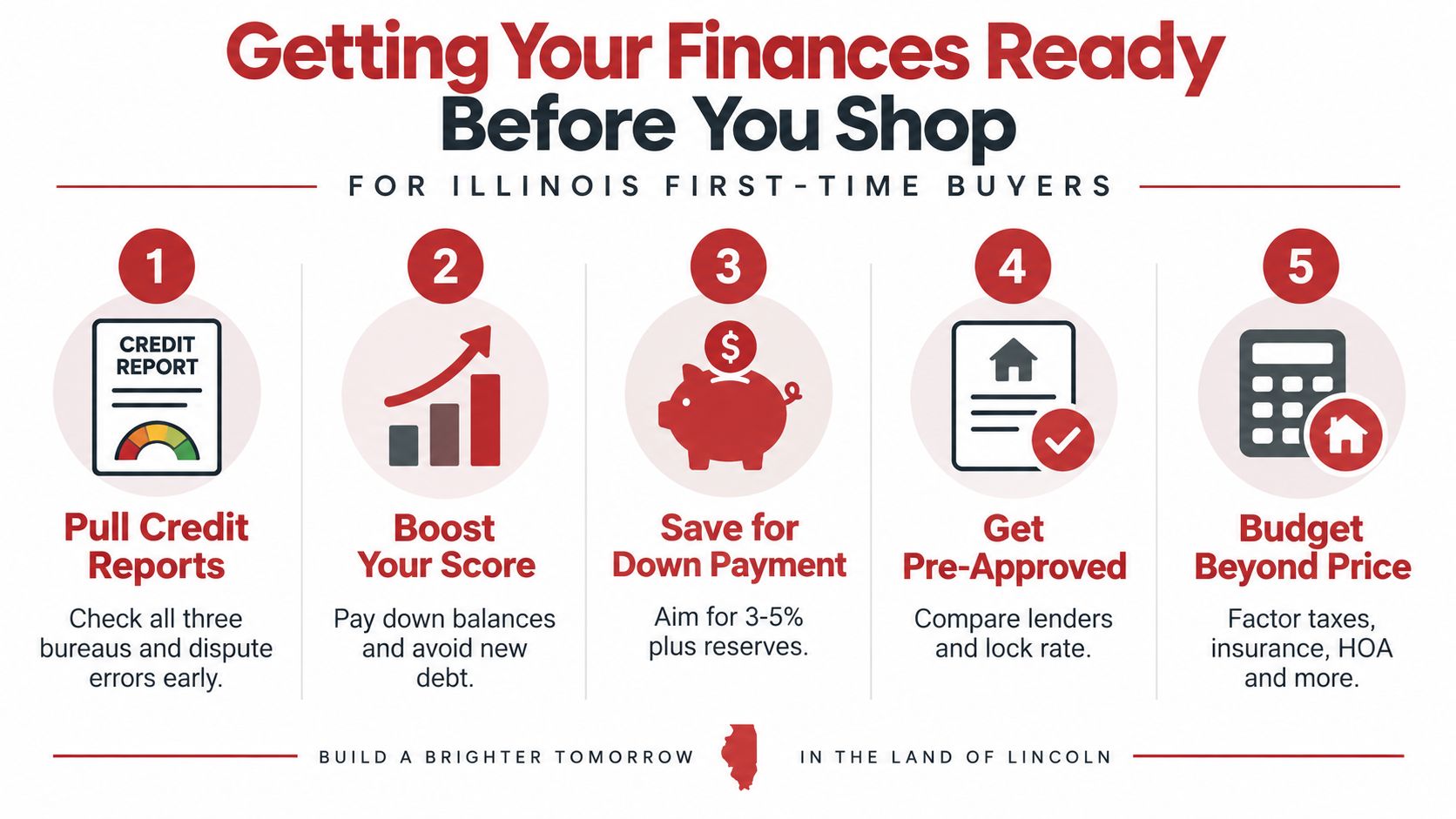
Homebuyer education may be part of the assistance pathway. IHDA loan options require buyers to contribute at least $1,000 or 1% of the purchase price, complete homebuyer education, and occupy the property as a primary residence. Schedule the education early and confirm the required borrower contribution with an approved lender before writing an offer.
Budget honestly: The lender approves a payment. You still have to live with the taxes, repairs, utilities, and association charges.
Property taxes deserve close attention in Melrose Park, Elmhurst, Oak Park, and nearby suburbs. Ask for the property identification information and review the actual tax history instead of trusting a rough online estimate. That review can determine whether the right match is a condo, resale home, or new construction property.
Illinois First-Time Home Buyer Programs Worth Knowing
A Melrose Park buyer can qualify for assistance and still choose the wrong property. A condo, resale bungalow, duplex, and new-construction home each bring different eligibility questions. Match the home first, then choose the money.
The newer Access Home program deserves a close look for buyers considering existing or new-construction homes. Launched on March 11, 2026, it offers up to $15,000 toward down payment and closing costs, with county-specific income caps according to the Governor's program announcement. Buyers in Cook County and nearby suburbs should confirm the current rules with an approved lender rather than rely on an older program summary.
Match the property before you match the money
| Program | Best For | Funding / Benefit | Key Restriction |
|---|---|---|---|
| IHDA Access Home | Buyers comparing eligible resale and new-construction homes | Up to $15,000 for down payment and closing costs, subject to program terms | County income caps and property eligibility must be confirmed with an approved lender |
| Other IHDA loan options | Buyers needing a structured state-backed mortgage pathway | May include down payment assistance under applicable program rules | Minimum borrower contribution, education, primary-residence occupancy, and property rules apply |
| Private mortgage insurance financing | Buyers using a low-down-payment mortgage | Helped more than 38,000 Illinois first-time and working-class buyers in 2024 per Illinois mortgage data | Mortgage insurance raises the monthly payment and does not replace a complete cash plan |
| Federal rural, veteran, or renovation pathways | Eligible buyers purchasing qualifying rural homes, using earned veteran benefits, or financing certain repairs | Benefits depend on borrower and property eligibility | Geographic, service, property-condition, or underwriting rules can limit use |
| Local or employer-linked assistance | Buyers whose county, municipality, or employer offers an eligible option | May supplement an approved first mortgage | Funding availability, income rules, education, lien terms, and stacking rules vary |
For a Berwyn or Melrose Park bungalow, inspect the home's condition before counting on assistance. Older roofs, electrical work, or other repairs can affect both the transaction and the loan structure. Ask whether the program permits the property type and whether assistance can be used alongside the planned financing.
A Joliet new build requires different questions. Confirm that the program covers the construction type, builder contract, completion schedule, and appraisal process. Do not assume a qualifying buyer automatically has a qualifying new-construction purchase.
For a Chicago condo, review the association and project requirements before focusing on the unit. The association's finances, insurance, project status, and property rules can affect eligibility. A lender should review those details early.
Illinois financing programs have provided substantial mortgage and down payment support across the state, including assistance to first-time buyers as summarized in Illinois mortgage data. Availability still depends on the specific borrower, property, lender, and program terms.
Do not stack every option just because it is available. A second lien, repayment condition, occupancy requirement, or resale restriction can shape your future choices. Before you fall in love with a property, have the lender explain the complete structure in writing, including what you repay, when repayment applies, and which property conditions could end the approval.
Timeline From Search to Closing
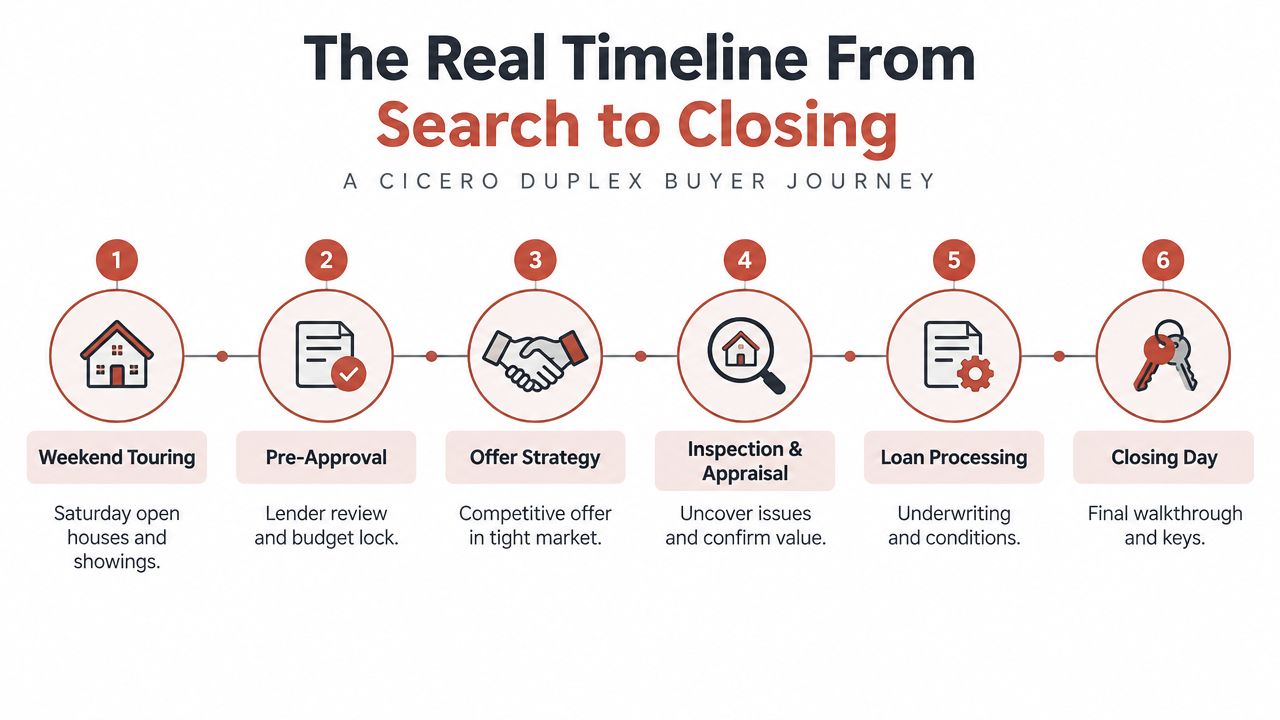
A Cicero buyer touring a duplex on Saturday may find a property with strong potential, then learn that the price reflects an older roof, plaster walls, dated electrical work, or an unfinished basement. That discovery changes the offer strategy, financing questions, and cash plan.
Before writing an offer, get pre-approved, set the amount of cash you will use, review the program rules, and choose terms that leave room for inspection and appraisal issues. Use MLS search guidance to organize your search. After acceptance, your lender and attorney control major transaction steps, so respond to their requests quickly.
Where the Illinois process gets complicated
After the seller accepts the offer, Illinois attorney review begins. The attorneys examine the contract and negotiate permitted changes. You schedule the inspection, while the lender orders the appraisal. On an older Cicero property, the inspection may lead to a repair request, a credit discussion, or a decision to withdraw under the contract terms.
The appraisal answers a separate question. It does not determine whether the furnace works reliably. It evaluates whether the property supports the contract price for the lender's purposes. If the value is lower than the agreed price, you and the lender must address the gap through renegotiation, a valuation challenge, additional funds, or another option allowed by the transaction.
Loan processing brings underwriting conditions. You may need to explain deposits, provide updated statements, document insurance, or answer questions about income and debts. Keep your finances stable while the lender reviews the file. Do not change jobs, open credit, move money without documentation, or make major purchases.
Buyer milestones and lender milestones
- You control: Document delivery, inspection scheduling, responsiveness, insurance selection, and final funds.
- Your agent coordinates: Showings, offer terms, inspection communication, deadlines, and transaction updates.
- The lender controls: Underwriting review, appraisal ordering, conditions, and the clear-to-close decision.
- The attorneys manage: Contract review, title matters, closing documents, and transaction adjustments.
- The closing team confirms: Final figures, certified funds or wire instructions, signatures, and possession.
A financed suburban purchase can move smoothly when each party answers promptly. Condos may require more time because association documents and project information need review. Cash purchases can move faster, while financing adds lender and appraisal dependencies.
Your job is not to rush every milestone. Treat every request as time-sensitive, keep documents organized, and ask for a clear deadline when someone assigns a task. That discipline prevents avoidable delays between the accepted offer and closing.
Beyond the Headline Grant What Cash You Still Need
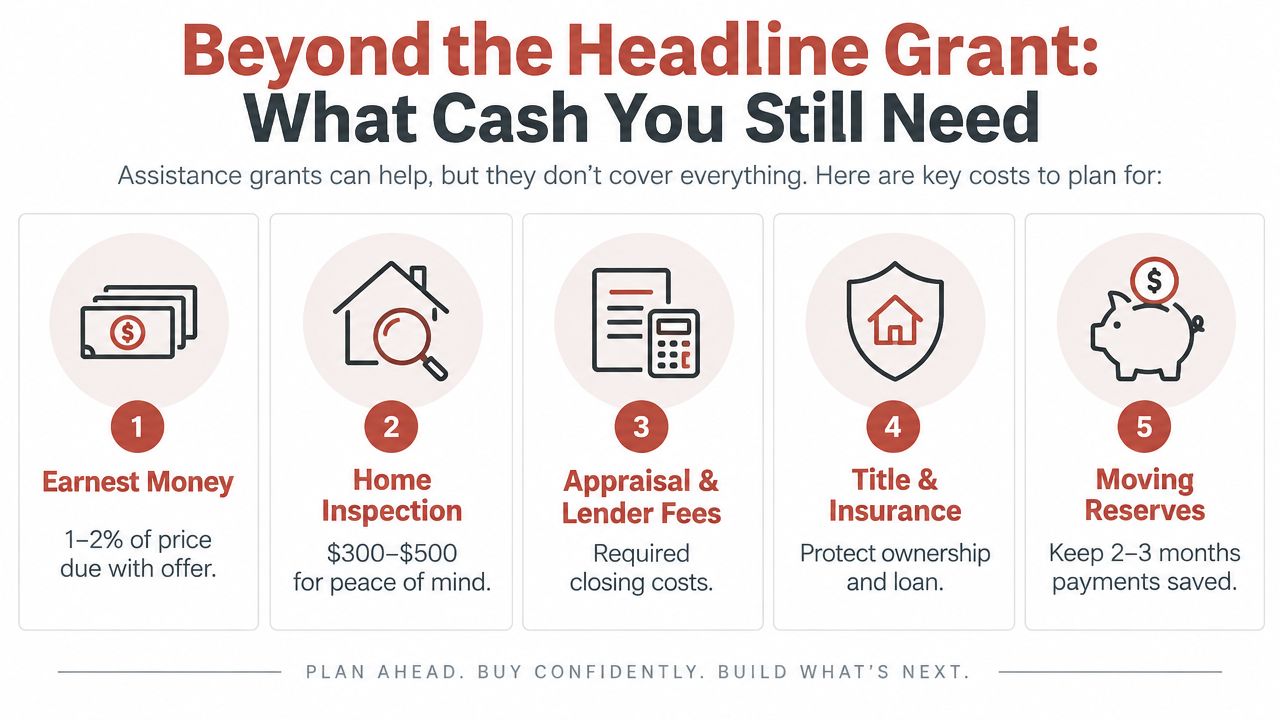
An assistance program can make a Melrose Park condo workable, while the same program may fit a resale house or new construction differently. The grant lowers the cash you bring to closing, but it does not make the purchase free. Plan for your required contribution, education timing, inspection, appraisal, insurance, prepaid items, moving, and immediate repairs.
For IHDA loan options, the minimum borrower contribution is $1,000 or 1% of the purchase price. Homebuyer education and primary-residence occupancy requirements also apply, as outlined in this program overview. Treat that contribution as a starting floor, not as the full amount needed for the transaction.
Cash appears in several places
Earnest money may be due with the offer. You may also pay for an inspection, appraisal, lender charges, title work, insurance, prepaid items, and moving costs. A resale home in Melrose Park or Berwyn can need repairs soon after closing, even when the inspection finds no emergency. A condo may shift some costs toward association documents, fees, or project-related review. New construction can bring different timing for inspections, deposits, and prepaid expenses.
FHLBank Chicago announced $28 million in 2026 grant funding for Illinois and Wisconsin homebuyers, with up to $10,000 for income-eligible households at or below 80% of area median income in its Illinois housing funding announcement. Availability and compatibility depend on the participating lender and program rules. Ask whether the assistance works with the property type and loan structure you are choosing. Two assistance sources do not automatically combine.
A second lien may carry repayment conditions. A grant may depend on occupancy, sale, refinance, or other requirements. Have the lender show every document, repayment trigger, and effect on future equity before you accept the money.
Cash-floor advice: Before writing an offer, keep funds available for the required borrower contribution, uncovered transaction expenses, moving needs, and a genuine post-closing reserve. If using nearly every dollar leaves no room for a repair, choose a less expensive property or change the assistance and loan structure.
Use this guide to Illinois closing costs for buyers to review the expenses that can appear beyond the grant. Match the program to the property, then confirm the remaining cash requirement with the lender before you offer.
Your First-Time Buyer Checklist and Next Move
A workable plan starts before the first showing. Put the dates on paper, tape the timeline to the refrigerator, and make sure everyone contributing money or documents knows what happens next.
90 days out
- Clean up credit: Pull reports, dispute errors, reduce balances, and avoid new debt.
- Gather documents: Organize income records, bank statements, identification, and explanations for unusual deposits.
- Interview lenders: Ask about approved assistance programs, property-type rules, borrower contribution, education, and second-lien terms.
60 days out
- Pre-qualify for programs: Confirm county income limits and whether you're considering resale, condo, two-unit, or new construction.
- Complete education early: Don't wait until the contract deadline if the chosen pathway requires a course before closing.
- Choose representation: Select an agent who understands western suburban inventory, offer terms, inspections, attorney review, and local transaction deadlines.
30 days out
- Commit to a property lane: Decide whether your priority is a condo, existing home, duplex, or new build.
- Source earnest money: Know where the funds will come from and document transfers before you need them.
- Prepare inspection logistics: Have inspectors, insurance contacts, and decision criteria ready before an offer is accepted.
During the final week
- Confirm wire instructions by phone: Never rely on an unexpected email requesting a change.
- Complete the final walkthrough: Verify agreed repairs, included items, condition, and vacancy.
- Set up utilities and moving plans: Schedule services and keep cash available for immediate household needs.
- Review the final figures: Confirm the amount due, required funds, and closing logistics with the attorney and lender.
Create the IHDA borrower portal account if your lender directs you to use it, verify county-level access, and request a SmartBuy eligibility review before writing an offer if that pathway may apply to your household. Program rules change, and older online summaries can describe a property category that no longer matches the current option.
Stop reading guides and book the lender call this week.
Homes By Carmen helps first-time buyers compare Melrose Park and nearby western Chicago suburbs, organize property searches, coordinate tours and inspections, and guide offers through closing. Visit Homes By Carmen to start a property-matching conversation and identify the right next step for your purchase.