
Most advice about a real estate broker Illinois search starts with the wrong question. It asks whether you need a “broker” or an “agent,” as if the label alone tells you who'll protect your money, manage the paperwork, and keep the deal moving.
In Illinois, the title matters because the state assigns different authority, supervision, and accountability to each license level. That difference has become even more practical since the 2025 buyer-agreement and compensation rule changes, because buyers now need clearer disclosure, cleaner negotiation, and a professional who understands how to structure a contract from the first showing.
| Dimension | Illinois Real Estate Broker | Illinois Real Estate Agent |
|---|---|---|
| Legal status | Holds an Illinois broker license, with broader authority and responsibility | Works under a sponsoring broker and can't operate independently |
| Supervision | Can supervise other licensees if properly licensed to do so | Must be supervised by a managing broker |
| Transaction handling | Can run a brokerage, handle compliance workflows, and take on direct accountability | Performs licensed activities within the brokerage's systems and rules |
| Fit for independent work | Can open a firm and manage office obligations | Can't legally act on their own without a sponsoring broker |
| Risk exposure | Carries direct responsibility for brokerage errors and oversight failures | Shares risk through the supervising broker structure |
| Consumer impact | Useful when a file needs heavier compliance, negotiation, or office-level judgment | Useful when the transaction is straightforward and the supervising broker is strong |
If you're buying or selling in Chicago or the suburbs, that table is the part that matters, not the casual title on a business card.
Table of Contents
- Why the Words Broker and Agent Are Not the Same Thing
- How Illinois Licenses Real Estate Professionals
- Broker Versus Agent Side by Side
- What Changed for Illinois Buyers in 2025
- Matching the Right Professional to Your Situation
- How to Vet a Broker or Agent Before You Sign
- Which One Should You Actually Hire
Why the Words Broker and Agent Are Not the Same Thing
A lot of people use “broker” and “agent” as if they mean the same job. In Illinois, they don't. A broker has a higher license tier and can legally do more than a salesperson or agent working under supervision, while an agent is tied to a sponsoring broker's office and can't strike out independently.
That difference shows up in daily work. The broker is the person who can own the brokerage structure, supervise licensees, and absorb the operational responsibility that comes with errors, disclosures, and office compliance. The agent can be highly skilled, but the agent still works within the broker's authority and procedures.
For a consumer, this matters because the person you talk to isn't always the person carrying the legal load. If a disclosure is missed, a signature is misplaced, or a contract term gets handled badly, the supervising broker's systems and coverage are part of what protects the transaction.
Practical rule: don't ask only, “Do I like this person?” Ask, “Who is legally responsible if something in my file goes wrong?”
Illinois is a broker-heavy state, which reinforces why the title distinction is so important. The state's July 1, 2026 active license report lists 48,825 licensed real estate brokers and 13,694 licensed managing brokers, plus 2,890 residential leasing agents and 2,801 broker corporations. That tells you the profession here runs on brokerage infrastructure, not casual independent activity, and the Illinois license report is where those license counts are tracked.
How Illinois Licenses Real Estate Professionals
Illinois doesn't hand out titles as branding. It assigns scopes of authority through education, exam steps, and supervision rules that shape who can do what. The entry point is the broker license, which follows 165 hours of pre-licensure education and the state licensing exam path described in the Illinois exam materials.
After that, Illinois adds a second layer for broker practice. The state requires 75 additional hours of post-license education for first-term brokers before first renewal, and those hours are organized into three 15-hour courses with exams covering applied brokerage principles, risk management and discipline, and transactional issues. That's not classroom filler, it's the state's way of testing whether someone can function responsibly in actual files. The post-license structure is set out in the Illinois administrative code for broker education, including the 50-question exam requirement for each course (Illinois broker post-license rules).
Illinois also makes continuing education very specific. Each renewing broker must complete 12 continuing-education hours every 2 years, split into 6 core hours and 6 elective hours, and the core block must include at least 2 hours of fair-housing training. For managing brokers, the state adds a separate 12-hour broker-management CE course on top of the standard renewal cycle (Illinois continuing-education rules).
Why the supervision rule changes the job
The supervising relationship matters as much as the education. Every salesperson or agent has to hang under a managing broker, and that broker is the one tied to office trust accounts, renewals, and discipline referrals. In plain English, the “designated managing broker” is not a marketing phrase. It's the person the state expects to keep the office compliant.
That's why a consumer should care whether the person across the table is a broker, a managing broker, or an agent operating inside a larger office. The title tells you who can sign, who can oversee, and who can be held responsible when the file gets messy.
Broker Versus Agent Side by Side
The clearest difference shows up in a real file, not in the vocabulary people use casually. In Illinois, the title tells you how much authority the person has, how much supervision sits above them, and how much of the paperwork lands on the managing broker if something goes wrong. That matters in DuPage, Cook, and Lake County, where small mistakes in disclosures or timing can slow a deal fast.
A broker can take broader responsibility inside the transaction. An agent works under that broker's legal umbrella, so the agent's day-to-day work still runs through supervision, review, and office procedures.
What that means in a real Illinois transaction
A first-time buyer usually sees the difference before the offer is even accepted. The person who drafts the agency disclosure, explains the buyer agreement, and checks whether the earnest money instructions match the contract may be the same person who later sends the file up to the managing broker for review. In a larger office, that review can catch missing initials, a stale addendum, or a seller credit that never made it into the final draft.
The same hierarchy shows up on the listing side. A seller may work with an agent at the front end, but the managing broker is the one with the final say on brokerage policies, trust-account handling, and what the office will stand behind if the file is challenged.
That is why the title matters more than the casual conversation suggests. A broker can be the person with more independence and broader accountability. An agent can still be highly skilled, but the work is done inside someone else's compliance structure.
For buyers and sellers who want a plain-English check on the title issue, the real estate agent Illinois guide lays out the terminology without losing sight of the legal structure. The useful question is still the same, who is reviewing the file, and who has to answer to IDFPR if the paperwork is off.
A managing broker's file review is not glamorous. It is the line-by-line check that catches a missing disclosure date, an earnest-money instruction that does not match the offer, or a contract addendum that never got routed to the other side. That kind of review is what protects a deal when the excitement wears off.
What Changed for Illinois Buyers in 2025
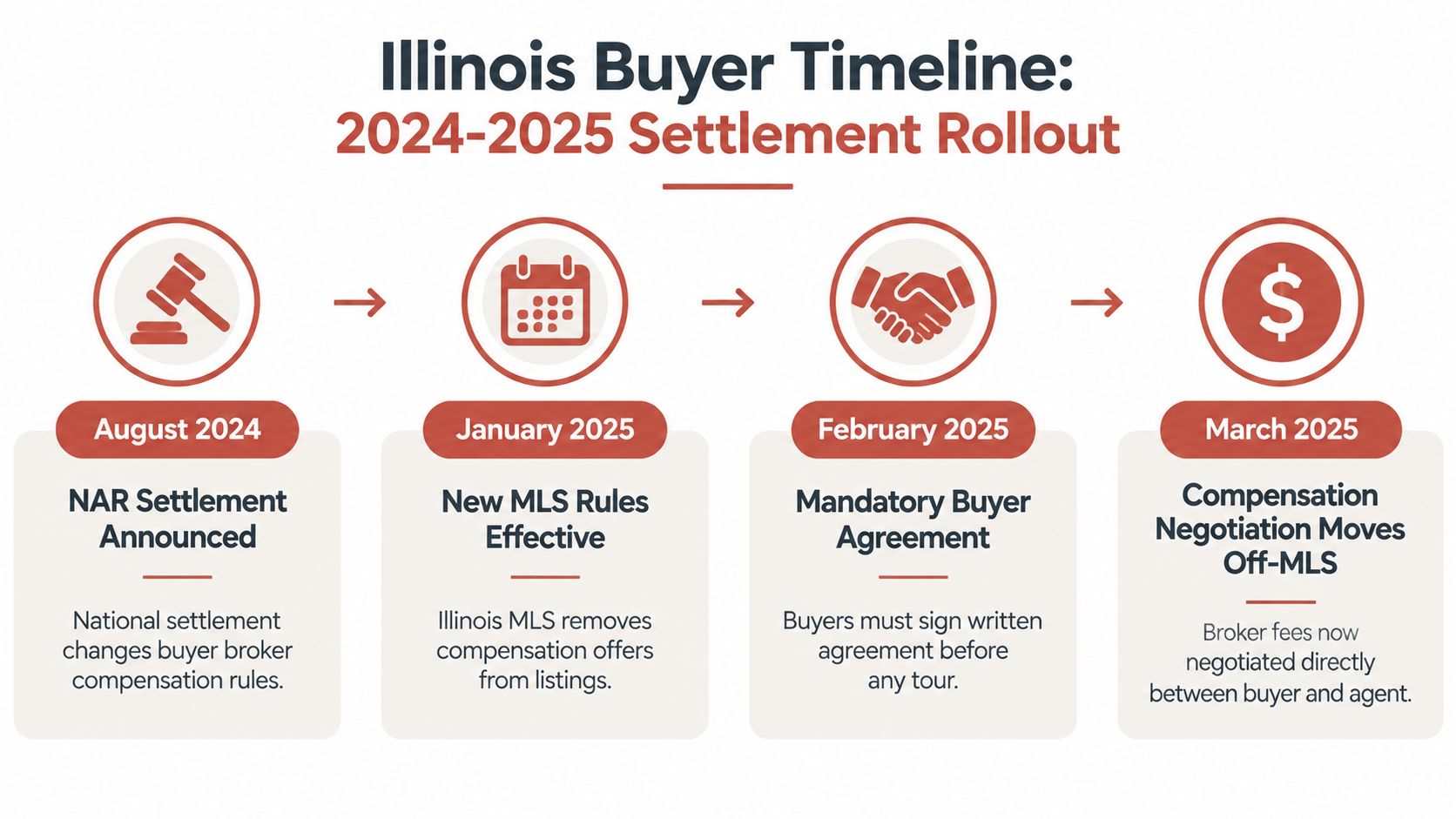
The biggest mistake buyers make now is assuming the old commission conversation still applies. In Illinois, the 2025 rule shift means buyers need written brokerage agreements before touring homes, and compensation can't be advertised on the MLS the way some consumers remember from earlier practice. That makes the front end of the relationship much more important, because the buyer has to understand scope, fee structure, and representation before the first showing.
Why this changes offer strategy
In a competing-bid market, the buyer agreement affects more than paperwork. It affects how the buyer talks about concessions, what the broker can discuss before a tour, and how the offer gets written when the seller is not advertising compensation in the MLS. That's especially relevant in places where homes still move briskly and buyers have to make clean, fast decisions.
Chicago-area market data shows why this matters. In May 2026, Redfin-derived reporting put Chicago's median sale price at $425,000, with homes spending a median of 47 days on market, inventory at 6,879 homes for sale, and a sale-to-list ratio of 101.8%. The broader Chicago metro report for the same period showed a median home sale price of $398,000, 46 days on market, 19,846 homes for sale, and 2.8 months of supply (Chicago market report). Those conditions mean the buyer's paperwork and negotiation plan can change the result.
The practical answer isn't “pay more attention.” It's to treat the buyer agreement as part of the strategy, not an afterthought. A well-run brokerage will explain the scope of representation, what services are included, and how the fee discussion works before the buyer commits to a series of showings.
For buyers trying to understand closing-side costs in this environment, this related guide on Illinois closing costs for buyers fits naturally with the new agreement requirements.
What smart buyers should ask before touring
- Who is my legal representative? Ask whether you're signing with a broker directly or with an agent under a managing broker's supervision.
- What does the buyer agreement cover? Make sure it spells out representation, scope, and compensation discussion in plain language.
- How do you handle offer strategy now? The answer should address concessions, net cost, and how the brokerage handles the fact that MLS compensation advertising is gone.
- Who reviews the paperwork? A clear brokerage should be able to tell you how forms move through the office before they reach the seller.
The 2025 rule change didn't make brokers optional. It made their guidance more important, because the buyer now has to negotiate earlier and with more clarity.
Matching the Right Professional to Your Situation
The right license type depends on the file, not on a slogan. A good match in western Chicagoland usually comes down to how much judgment, supervision, and local pricing nuance the transaction really needs.
Three common situations
A Melrose Park estate sale often calls for a managing broker or a broker working inside a well-run brokerage with strong supervisory oversight. When a home comes out of a multigenerational estate, the seller may need careful disclosure handling, calm coordination, and someone who can keep family members aligned on the paperwork. The value there is not flashy marketing, it's disciplined file management.
A Naperville move-up buyer writing against multiple competing offers usually benefits from a buyer-focused agent working under a strong broker, especially if that person is fluent in the new 2025 buyer-agreement process. The agent can move fast on showings, help frame the offer, and push strategy while the managing broker keeps the office side clean.
A Chicago condo investor buying several units a year in places like Lakeview and the West Loop may prefer a broker who can streamline transactions, coordinate repeated closings, and manage the file with less handoff. The more standardized the acquisition rhythm becomes, the more useful broker-level autonomy tends to be.
| Scenario | Best Fit | Why |
|---|---|---|
| Melrose Park estate sale | Managing broker | More supervision, more disclosure discipline, better for family-sensitive files |
| Naperville move-up buyer | Sponsored agent | Fast local execution, offer support, strong office backup |
| Chicago condo investor | Broker | Better for repeat transactions and cleaner file control |
If the property is emotionally complicated, the process usually needs heavier oversight. If the property is straightforward and the office is organized, a strong agent can be enough.
Western-suburb pricing also matters. Independent housing data shows suburban Cook County home prices continued rising in 2025, with one study reporting a 5.5% year-over-year increase countywide and the largest annual gains in Melrose Park/Maywood at 8.5% (Cook County house price index release). In practice, that means a seller in one suburb may need a much sharper pricing decision than a seller two towns away.
How to Vet a Broker or Agent Before You Sign
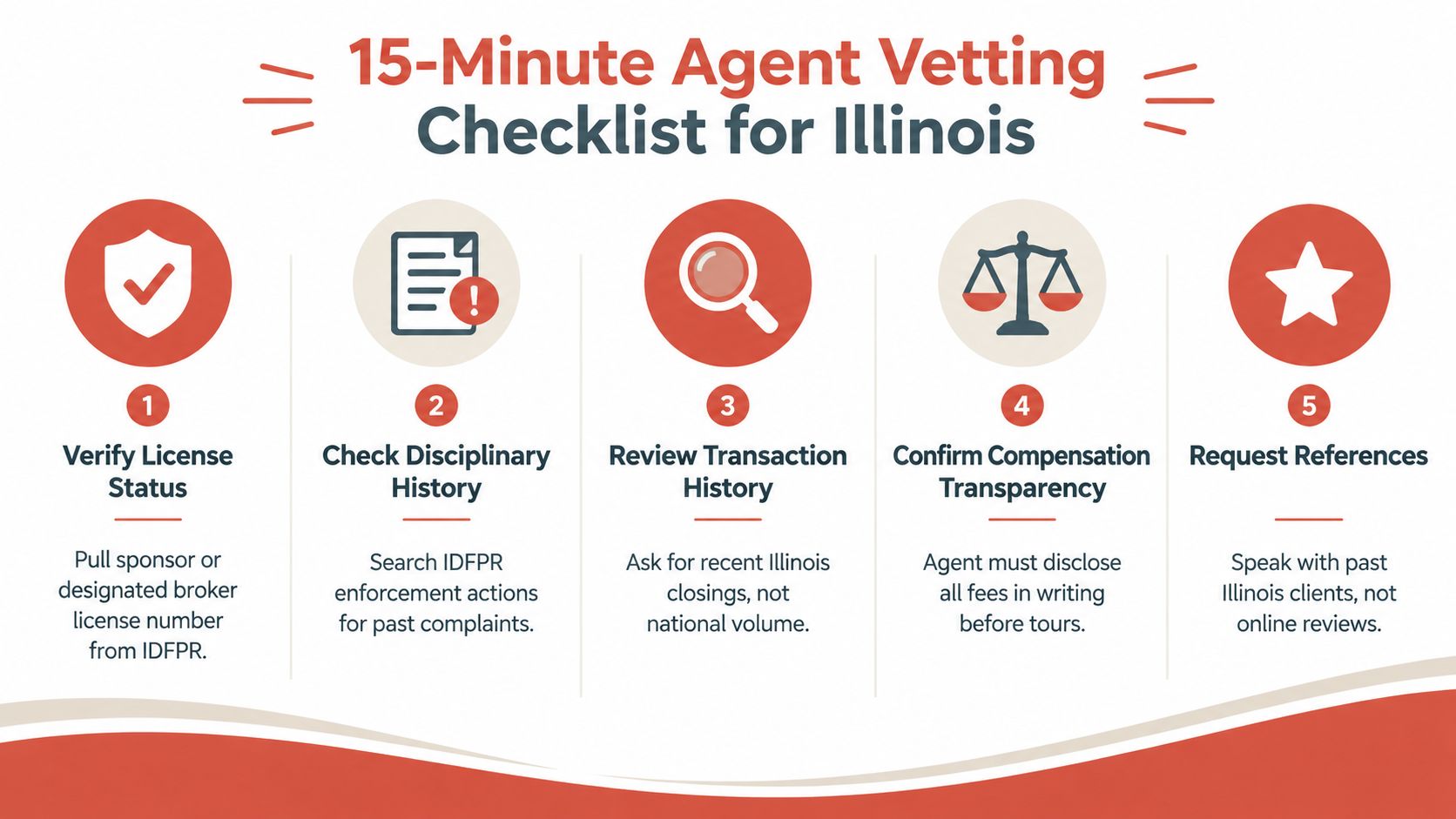
A decent interview takes about 15 minutes if you know what to check. Start with the license, because the license tells you who the state recognizes as the responsible party. Then move to the office structure, recent Illinois transactions, and compensation transparency.
What to verify first
- Verify license status. Pull the sponsor or designated broker license number from the Illinois Department of Financial and Professional Regulation's lookup and make sure it's active.
- Check disciplinary history. Ask whether there are any enforcement issues, and confirm the brokerage can explain them plainly.
- Review transaction history. Ask for recent Illinois closings, not vague claims about national volume.
- Confirm compensation transparency. The buyer or seller should know the fee discussion before tours or listing paperwork move forward.
- Request references. Talk to past Illinois clients who've closed, not just anyone who left a review online.
If the person can't name their supervising broker, that's a problem. If they're a broker but can't explain how trust-account procedures work in their office, that's another warning sign. And if someone starts with commission terms before discussing fiduciary duties, you're probably talking to a salesperson, not a fiduciary-minded professional.
For a consumer-friendly walkthrough of the interview process, this internal resource on how to find a good real estate agent can help you sharpen the questions you ask before signing anything.
The best 15-minute test is simple. Ask who supervises the file, what the office does with disclosures, how the compensation conversation works under the current rules, and what part of the transaction the professional personally handles versus hands off to the brokerage.
Which One Should You Actually Hire
If you're a first-time buyer in DuPage County under $400K, a sponsored agent is usually the right call, provided the agent works under a strong managing broker and can explain the new buyer-agreement process clearly. You need someone who can move quickly, translate the offer steps, and keep the paperwork tight without adding unnecessary complexity.
If you're selling a $500K+ western-suburb single-family home, a broker or a broker-led listing team is the better fit. That kind of file depends on pricing discipline, negotiation judgment, and office-level compliance, especially in a market where suburban pricing can vary sharply by town and property type.
If you're an investor closing 3 or more properties a year, hire a broker. Repeat closings reward someone who can supervise the workflow, keep the documents organized, and handle the transaction without constant handoffs.
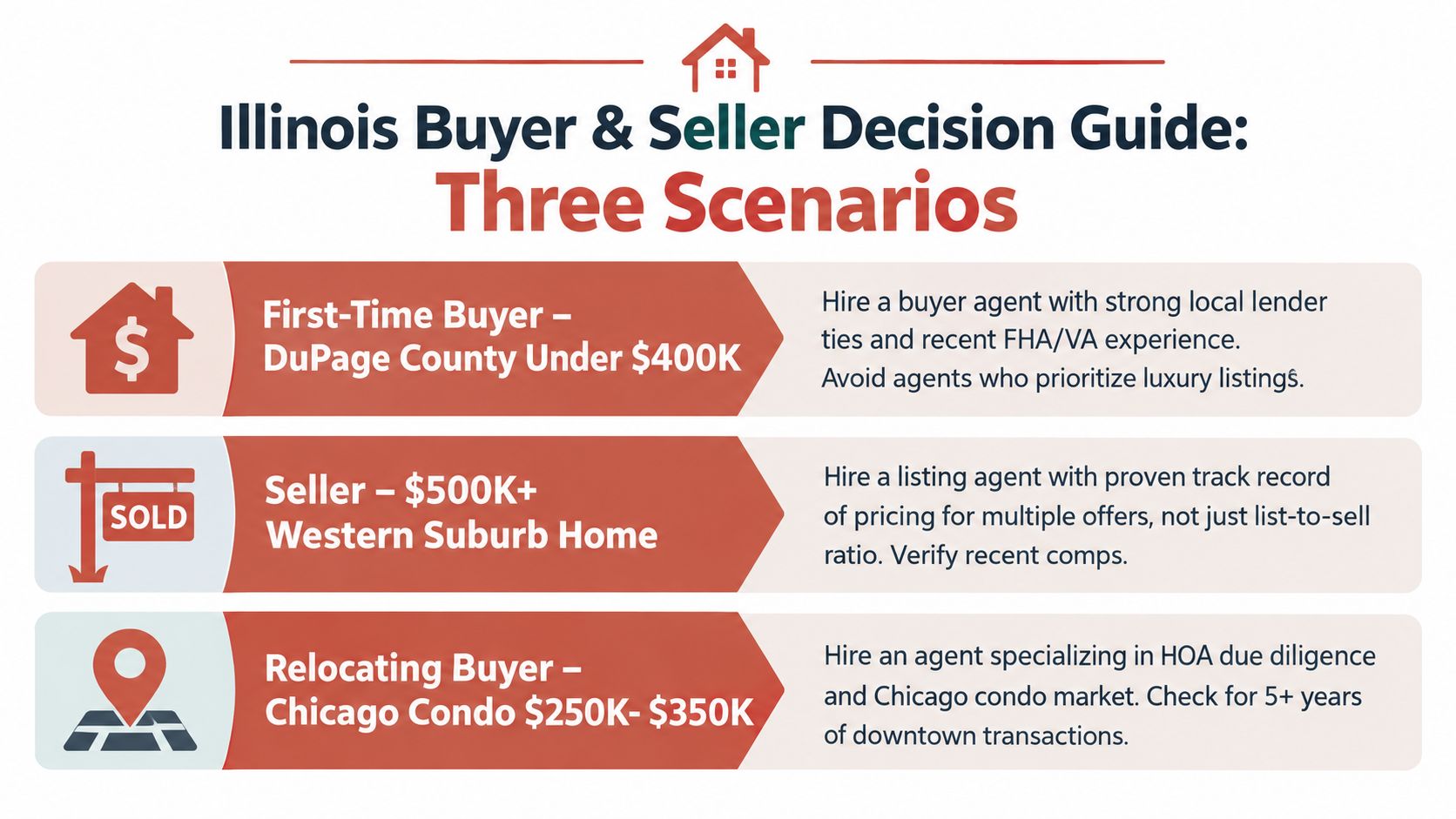
The cost-benefit question is straightforward. A broker's extra training and legal accountability pay for themselves when the file is complicated, the pricing stakes are high, or the transaction has little room for error. An agent is the right call when the deal is simple enough that the extra overhead doesn't change the outcome.
Homes By Carmen works with buyers, sellers, and renters across Melrose Park and western Chicagoland, with MLS-backed search, pricing guidance, offer support, and transaction coordination built around Illinois rules. If you're trying to decide whether your next move needs a broker, a buyer's agent, or a stronger strategy from the start, visit Homes By Carmen and start with a local conversation that fits your neighborhood and your timeline.