
The lowest down payment rarely makes a mortgage the best choice. A smaller upfront contribution can preserve cash for repairs and reserves, but it may also increase the loan balance, monthly payment, mortgage insurance, and long-term cost. First-time buyers should compare their credit profile, available cash, debt obligations, property type, location, service eligibility, expected time in the home, and assistance-program restrictions before choosing a loan label.
This guide compares eight financing paths for buyers in Melrose Park and western Chicagoland, from FHA and conventional loans to USDA, VA, Illinois assistance, portfolio lending, adjustable-rate mortgages, and alternative arrangements. The right answer may be a familiar program, a combination of a primary mortgage and assistance, or a strategy that delays purchase while reducing qualifying debt. Program rules can change, so verify current county limits, income thresholds, eligible addresses, repayment terms, and lender requirements before relying on any example. Homes By Carmen can help coordinate the property search, neighborhood research, offer decisions, and professional referrals, but a licensed lender remains responsible for mortgage eligibility and loan terms.
Table of Contents
- 1. FHA Loans
- 2. Conventional Loans With Low Down Payment Programs
- 3. USDA Loans
- 4. VA Loans
- 5. State and Local Down Payment Assistance Programs
- 6. Bank Portfolio Loans and Lender-Specific Programs
- 7. Adjustable-Rate Mortgages With Fixed Introductory Periods
- 8. Lease-to-Own and Seller Financing Alternatives
- 8-Option First-Time Homebuyer Mortgage Comparison
- Turn Eight Options Into One Defensible Plan
1. FHA Loans
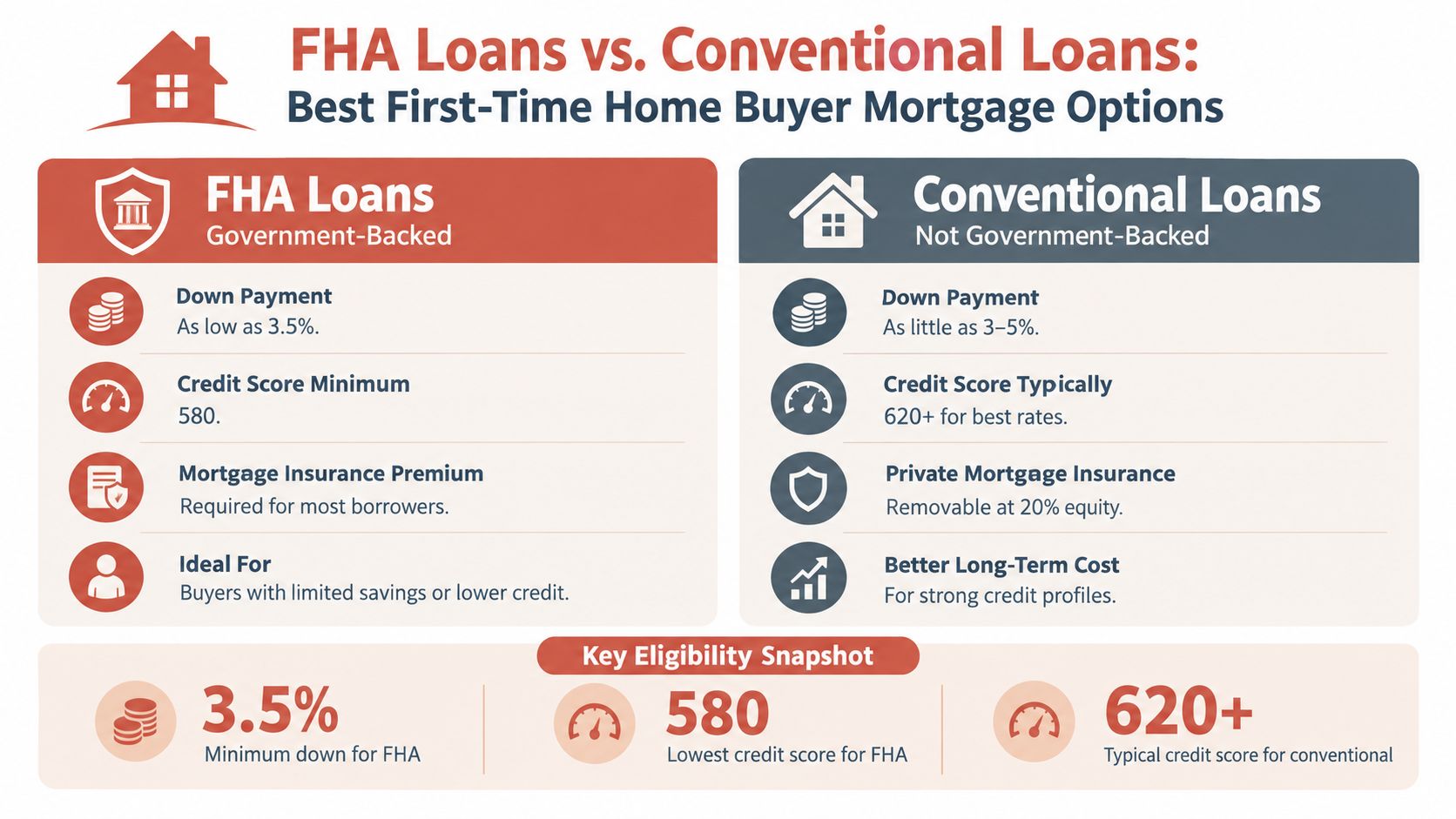
FHA financing can suit a buyer whose credit history or available savings makes conventional underwriting difficult. Because the Federal Housing Administration insures the loan, participating lenders may accept a borrower who needs more flexible qualification standards than a conventional application provides. That flexibility can help a first-time buyer compete for a home in Melrose Park or another western Chicagoland suburb when cash and credit are the main constraints.
FHA is not automatically the lowest-cost option. A smaller down payment usually creates a larger loan balance, and borrowers who put down less than 20% generally pay mortgage insurance until they build 20% equity, according to Freddie Mac's explanation of down payments and mortgage insurance. FHA borrowers should also review the mortgage insurance structure for their specific loan, plus lender fees, property taxes, homeowners insurance, and any condominium or association charges.
Who FHA may suit
FHA may be appropriate when you have:
- Limited cash: You need funds for closing, moving, immediate repairs, and emergency reserves.
- Developing credit: Your credit profile calls for a more flexible underwriting review.
- A modest purchase price: The full payment remains comfortable after mortgage insurance and local property expenses.
- An older property: Your lender and appraiser understand condition requirements for established Chicago-area homes.
A condominium buyer in Oak Park should have the lender review both borrower finances and property eligibility early. Appraisal concerns, association documentation, or property-condition issues can delay an otherwise acceptable application. The same review matters for older homes in Melrose Park, Elmhurst, or Downers Grove, where repair needs can affect both the offer and the loan timeline.
Illinois or local down payment assistance may layer onto an FHA mortgage, subject to program and lender rules. Ask how assistance changes the cash needed, monthly payment, repayment obligation, and offer terms.
Practical rule: Request an FHA and conventional quote for the same purchase price, loan term, taxes, insurance, and mortgage insurance assumptions. Compare the total payment and expected ownership cost, not just the initial cash requirement.
Use a first-time home buyer guide to organize questions before pre-approval. Homes By Carmen can help coordinate the property search, offer strategy, and lender communication, while the lender confirms FHA eligibility and conditions.
2. Conventional Loans With Low Down Payment Programs
Conventional financing can be the better fit for a first-time buyer with solid credit, stable income, manageable debts, and documented assets, but it is not automatically the cheapest option. Its strongest advantage often appears after closing: private mortgage insurance may be removed when the borrower meets the applicable equity and payment requirements, while FHA mortgage insurance can follow different rules. Compare the full ownership cost and expected time in the home.
For a buyer purchasing a $300,000 home, 3% down means bringing $9,000 toward the purchase before closing costs. 20% down means $60,000, leaving the buyer with more equity but less cash for reserves, improvements, or moving expenses. The lower contribution may preserve liquidity, yet it can produce a higher monthly payment through PMI, interest, or both.
A townhome buyer in Glen Ellyn may prefer conventional financing to keep funds available for flooring, appliances, or association-related expenses. A buyer choosing an older home in Berwyn or a two-flat in Elmwood Park may need a lender to review property condition, rental-income treatment, and building eligibility before relying on the loan for an offer.
Ask lenders to put these differences in writing:
- PMI treatment: What is the monthly cost, and when can cancellation or termination occur?
- Pricing: How do the rate, points, origination charges, and lender credits affect the payment?
- Cash sources: Can savings, an eligible gift, or Illinois or local assistance fund the transaction, and what documentation is required?
- Property rules: Will the lender accept the intended condo, townhome, or two-flat?
- Offer timing: Can underwriting, appraisal, and association review fit the seller's closing schedule?
Assistance may layer onto a conventional mortgage, subject to program and lender rules. Confirm whether it creates a deferred or repayable obligation, changes the monthly payment, or affects the offer's strength. A local real estate professional can help coordinate those questions with the lender while matching the financing to the property and negotiation timeline.
Use the home loan repayment calculator to model principal and interest, then request comparable Loan Estimates from multiple lenders. National mortgage-survey research found that borrowers who received homeownership education or counseling reported higher satisfaction with mortgage terms and the mortgage process, as documented in this FHFA and CFPB mortgage-originations study.
3. USDA Loans
USDA financing suits buyers who want little or no down payment and are willing to search in an eligible area. For western Chicagoland buyers, the address can decide whether this option works. A community may look suburban while individual properties require separate eligibility review, and much of the central metropolitan area may not qualify.
USDA eligibility also depends on household income, primary-residence use, property condition, and other program requirements. That makes the loan a narrow fit rather than a universal first-time buyer solution. Someone planning to buy an investment property or a home intended mainly for rental use needs another financing path.
Check the address before choosing the loan
A buyer searching beyond denser western suburbs may find a home that appears suitable because the surrounding community feels rural. The lender should verify the exact address through the current USDA process before the buyer builds an offer or financing plan around it. Confirm the applicable income rules at the same time.
USDA may fit poorly when:
- Income is near the program limit: A household can be financially ready to buy and still fall outside the permitted range.
- The search is concentrated in urban areas: Eligible inventory may not work for commuting, transit, schools, or family needs.
- The home needs unusual repairs: Property-condition concerns can affect approval and add uncertainty to the transaction.
- The buyer expects to rent the home: Owner occupancy is required.
The trade-off is straightforward. USDA can preserve more of a buyer's savings than a conventional loan, but program fees and other financing costs still affect the financed balance and monthly payment. Ask the lender to compare the required fees, total loan amount, principal and interest, property taxes, insurance, and closing cash against a conventional option.
A lender familiar with Illinois USDA applications can also clarify how its underwriting process handles the program's income and property requirements. A local real estate professional can help identify homes worth checking, flag address concerns early, and coordinate the lender's review with the property and offer strategy.
For a buyer focused on a specific condo in Oak Park or a home near a western suburban employment corridor, location limits may outweigh the down-payment advantage. For a buyer with flexible geography and limited savings, USDA deserves a direct comparison.
4. VA Loans
Eligible service members, veterans, and qualifying surviving spouses may have access to one of the strongest first-time buyer financing paths. VA financing may support a purchase with no down payment and without conventional private mortgage insurance. The lender and Department of Veterans Affairs must confirm eligibility, entitlement, and applicable program charges before the buyer relies on those benefits.
That flexibility can matter for a veteran relocating to the Chicago area. Keeping cash available for a job transition, moving costs, or improvements to an older suburban property may be more useful than putting money into the down payment. The trade-off is that a smaller upfront contribution does not remove the need for reserves or careful property review.
A VA appraisal is not a private inspection. The appraisal addresses value and certain property requirements, while an independent inspection examines mechanical systems, roof condition, drainage, and deferred maintenance. That distinction matters when an older home needs work before or soon after closing.
Set up the VA review before making offers
Request a Certificate of Eligibility through the VA or a lender before touring seriously. Ask the lender to address Entitlement, including how prior or existing VA use affects the purchase. Confirm the Funding charges, whether an exemption applies, and whether paying the charge upfront or financing it fits the buyer's cash plan.
The lender should also explain Property eligibility for the intended condo, townhome, or single-family home, along with Closing expectations, appraisal timing, and the documents required from each party. Discuss Future flexibility as well, including whether loan assumptions or entitlement rules could affect a later sale or purchase.
For a home in Elmhurst or Downers Grove, communication between the lender and real estate professionals can affect the offer strategy and transaction timing. The agent can help identify suitable properties, coordinate showings, structure inspection terms, and communicate with the listing side. The lender determines the borrower's qualification and loan terms.
VA's no-down-payment potential can preserve cash, but the buyer still needs to compare the full monthly obligation. Include property taxes, homeowners insurance, association dues, utilities, and maintenance before deciding how much house to pursue. A local professional can help coordinate those property costs with the lender's review and the offer terms.
5. State and Local Down Payment Assistance Programs
The lowest cash-to-close option may not produce the lowest ownership cost. Illinois assistance can make a purchase possible, but it does not replace the primary mortgage. In most cases, the assistance sits alongside FHA, conventional, or another first mortgage and may be forgiven, deferred, or repayable. The buyer needs clear answers about repayment triggers, second-lien recording, refinancing or sale, interest rates, and closing costs.
Illinois buyers should rely on current program documents, not an old article or verbal assurance. IHDA's Access programs describe assistance of 4% of the purchase price up to $6,000, 6% up to $15,000, or 10% up to $10,000, depending on the program and its terms, as shown on the IHDA lending programs page. IHDA's 2025 results reported $1 billion in first mortgages, $54.2 million in down-payment assistance, and 5,024 households receiving assistance. Nearly 89% of those recipients were first-time buyers.
Compare the cash benefit with the future obligation
A Melrose Park buyer could place these paths side by side:
- Standard financing: Conventional or FHA financing funded partly with the buyer's cash.
- IHDA assistance: A primary mortgage paired with assistance and its stated repayment terms.
- Larger down payment: More money invested at closing, potentially reducing the loan balance or mortgage insurance cost.
The lender should model monthly payment, mortgage insurance, closing costs, and repayment at sale or refinance. Ask how an assistance lien could affect a future transaction. Confirm income and purchase-price limits, eligible property types, occupancy rules, counseling requirements, and lender participation before writing an offer.
For buyers in western Chicagoland, a local real estate professional can help align the property, offer timeline, lender, and housing-counselor referrals. That coordination matters when a program's approval steps affect the offer or closing schedule. The lender and program administrator must confirm eligibility.

For a practical overview of Illinois options, review this Illinois first-time home buyer resource. Homes By Carmen can help connect the property search and offer timeline with lender and housing-counselor referrals, while administrators and lenders verify current program rules.
6. Bank Portfolio Loans and Lender-Specific Programs
A portfolio loan can help when standard underwriting does not reflect the borrower's actual finances. The originating bank keeps the loan rather than structuring it entirely for the secondary market, giving that institution more discretion over income review, credit history, reserves, or property conditions.
That discretion is not automatically a bargain. One bank may understand fluctuating business income or a recent job change, while another may require more reserves, charge higher fees, or offer a less competitive rate. A lender-specific first-time-buyer credit or reduced-fee program may lower cash needed at closing, but the benefit should be compared with the full loan cost.
Compare the loan against the borrower's real constraint
For a self-employed buyer looking at a two-flat in Berwyn or an older home in Downers Grove, ask the lender to explain exactly how the application will be evaluated. The right questions include:
- Income and eligibility: How are business deductions, commissions, bonuses, and recent employment changes treated? Are there limits on income, property type, occupancy, or loan size?
- Cash required: What down payment, reserves, closing costs, and prepaid expenses must be available?
- Insurance costs: Is mortgage insurance required? If so, how is it priced, and when can it end?
- Loan terms: Compare the rate, points, underwriting fee, other closing costs, repayment provisions, and any prepayment restriction.
- Ownership and servicing: Who will own and service the loan, and could that arrangement change?
- Approval and offer timing: Does the pre-approval reflect this specific product, and can the lender meet the contract deadline?
A portfolio loan may solve an eligibility issue while leaving affordability unchanged. Run the same purchase price and expected holding period through a portfolio option, a standard mortgage, and any assistance-linked alternative. Review monthly payment, cash at closing, insurance, and the cost of keeping or refinancing the loan.
In western Chicagoland, a local real estate professional can help test whether the property's condition, use, and offer timeline fit the lender's requirements. The lender controls underwriting, while the agent helps coordinate property facts, disclosures, and contract deadlines. Get every lender-specific promise in writing before relying on it.
7. Adjustable-Rate Mortgages With Fixed Introductory Periods
An adjustable-rate mortgage, or ARM, can suit a buyer with a specific, credible exit plan, but its introductory payment should never be the only affordability test. The initial rate stays fixed for a defined period. After that, the rate and payment may change based on the index, margin, adjustment schedule, and caps. A lower starting payment can preserve cash for renovations or reserves, yet the borrower carries the future payment risk.
The strongest ARM candidates usually expect to sell before the first adjustment or have a well-supported reason to refinance. A relocating household may fit the first case. A buyer planning to refinance needs more than an expectation. Home value, income, credit, interest rates, and lender approval could change before that opportunity arrives.
Compare the ARM with a fixed-rate loan using the same purchase price and holding period. Include cash needed at closing, available reserves, mortgage insurance, property taxes, insurance, repairs, and any association costs. An ARM may reduce the initial payment without improving the long-term cost, particularly if the buyer keeps the loan through several adjustments. Assistance from Illinois or a local program might help with upfront cash when the buyer and property qualify, but it does not remove payment risk or replace the lender's approval.
For a buyer considering an older home in Elmhurst or Glen Ellyn, test the decision against three ownership outcomes: an on-time sale, a delayed move, and no practical refinance. The budget should still work if the payment rises and property expenses increase. Ask for the highest payment permitted by the contract and identify when that payment could occur.
An ARM should be affordable at the projected maximum payment, not only at the introductory payment.
Before signing, obtain the index, margin, adjustment dates, initial and periodic caps, lifetime cap, and a written worst-case payment illustration. Mark the first adjustment date well before closing. A local real estate professional can coordinate the lender's timing with property condition, offer terms, and any assistance requirements, while the lender confirms eligibility and underwriting.
Long-term buyers may prefer fixed-rate predictability. Buyers with short ownership plans and sufficient reserves can give an ARM a disciplined comparison.
8. Lease-to-Own and Seller Financing Alternatives
Lease-to-own and seller financing may help a buyer who cannot qualify for a standard mortgage yet, but both shift risk into the contract. Neither arrangement guarantees future mortgage approval or provides the protections of a conventional closing. A buyer must compare the flexibility against legal cost, uncertain financing, and the possibility of losing money if the purchase never closes.
With lease-to-own, the buyer rents the home under an option or obligation to purchase later. The agreement should state the purchase price, option fee, rent credits, deadlines, maintenance duties, default consequences, and the result if financing cannot be obtained. Seller financing makes the owner the lender. The promissory note, security instrument, interest rate, payment schedule, late charges, and default remedies all need legal review.
Build a clear route to permanent financing
A buyer in Melrose Park rebuilding damaged credit may view lease-to-own as time to improve credit and save cash. That plan needs a lender's written assessment before signing. It should identify the credit, income, debt, or cash steps required for a future mortgage. Without that checkpoint, years of payments may leave the buyer with no financeable path and no completed purchase.
Put these terms in writing:
- Attorney review: Have an Illinois real estate attorney examine the agreement before any funds change hands.
- Written credits: Specify how rent credits are calculated, recorded, and applied to the purchase.
- Title and inspection work: Verify ownership, liens, property condition, and required disclosures.
- Payment responsibility: Assign taxes, insurance, repairs, utilities, and association charges.
- Exit terms: State what happens if financing fails, the seller defaults, or either party ends the arrangement.
For seller financing, confirm that the payment remains workable alongside taxes, insurance, repairs, and other ownership costs. The buyer should also understand whether the seller can transfer the note or whether a future lender will require specific documentation.
Homes By Carmen can identify properties where a seller may consider flexible terms and coordinate introductions to lenders, inspectors, and attorneys. The agent should not present either structure as legal advice or as a replacement for mortgage planning. Before committing, the buyer needs a written route toward a conventional, FHA, or other permanent mortgage.
8-Option First-Time Homebuyer Mortgage Comparison
| Program | Implementation complexity | Resource requirements | Expected outcomes | Ideal use cases | Key advantages |
|---|---|---|---|---|---|
| FHA Loans (Federal Housing Administration) | Moderate, standard mortgage process with FHA-specific appraisal and insurance steps | Down payment ~3.5%; credit ~580+ (or 10% for lower scores); FHA appraisal; mortgage insurance (MIP) | Easier qualification; higher monthly cost due to MIP; pathway to homeownership for lower-credit buyers | First-time buyers with limited savings or below-prime credit in established suburbs | Low down payment; flexible underwriting; widely available |
| Conventional Loans with Low Down Payment Programs | Low–Moderate, conventional underwriting, multiple lender options | Down payment 3–5%; credit typically 620+ (best rates 700+); PMI until 20% equity | Lower long-term cost if credit strong; PMI removable at 20% equity | Buyers with decent credit seeking lower lifetime costs or higher-value homes | Competitive rates for strong credit; PMI removable; faster closings |
| USDA Loans (Rural Housing Loans) | Moderate, additional eligibility and income verification; regional checks | Zero down; credit ~620+; property must be in eligible area; income limits apply | Zero-down purchase possible; lower rates but geographic/income constraints | Buyers in qualifying rural or exurban areas with limited down payment | True zero-down option; low rates; funding fee can be rolled into loan |
| VA Loans (Veterans Affairs Home Loans) | Moderate, VA COE and VA appraisal required; lender experienced with VA process preferred | Zero down; veterans/spouses eligibility; funding fee (0.5–3.6%); basic credit documentation | Very high affordability (no MI); low rates; strong resale value if assumable | Eligible veterans, active-duty service members, and surviving spouses | Zero down; no mortgage insurance; typically lowest rates; assumable |
| State & Local Down Payment Assistance Programs (IL/Chicago) | High, application intensive, timing coordination with lenders and often counseling | Varies: grants or forgivable seconds (5–10%); income and first-time buyer limits; counseling | Reduced cash at closing; may include deed restrictions and occupancy terms | Low- to moderate-income first-time buyers in targeted neighborhoods | Grants reduce or eliminate down payment; counseling and combined financing |
| Bank Portfolio Loans & Lender-Specific Programs | Moderate, lender-specific underwriting; requires shopping across banks | Down payments 0–5% possible; flexible credit documentation; lender-dependent terms | Access for non-traditional borrowers; variable rates/terms; potential faster decisions | Self-employed or atypical-credit buyers needing flexible underwriting | Custom underwriting; faster approvals; local program incentives |
| Adjustable-Rate Mortgages (ARMs) with Fixed Intro Periods | Moderate, requires understanding of index/margin and exit plan | Lower initial rate; typical fixed 3/5/7/10 years; solid credit recommended for best terms | Lower payments initially; payment uncertainty after reset; savings if sold/refinanced before reset | Buyers planning to move/sell or refinance within fixed period | Lower initial rates; improves qualification and monthly cash flow |
| Lease-to-Own & Seller Financing Alternatives | High, negotiable contracts, legal review strongly recommended | Minimal initial mortgage qualification; negotiated rent-credit, option fees; seller willingness required | Opportunity to occupy and build credit/equity; higher total cost and legal risk if terms unclear | Buyers temporarily ineligible for mortgage or needing time to improve credit | Pathway to ownership without immediate mortgage approval; flexible terms |
Turn Eight Options Into One Defensible Plan
Start with the borrower's actual financial position, not a favorite loan program. Review credit, income stability, recurring debts, cash reserves, and the amount available for closing without draining funds needed after move-in. Freddie Mac reports that the typical first-time-buyer down payment reached 10% in 2025, compared with 23% for repeat buyers, and that 10% was the highest recorded first-time-buyer figure since 1989, as described in Freddie Mac's first-time-buyer research. That context reinforces why buyers should compare cash-to-close strategies carefully rather than assume a smaller down payment is always best.
Next, define the search area and property type. A condo in Oak Park may create association and project-review questions that don't apply to a single-family home in Melrose Park. A property farther from the central suburbs may deserve a USDA eligibility review. An eligible veteran should verify VA entitlement early. Every buyer should ask the lender how taxes, insurance, association dues, mortgage insurance, assistance repayment, and reserves affect the actual monthly budget.
Then request comparable pre-approvals from multiple lenders. Give each lender the same target price, down payment assumption, occupancy plan, property type, and expected ownership period. Compare the official Loan Estimates rather than relying on a quoted rate alone. Review interest rate, points, lender fees, mortgage insurance, projected payment, cash to close, and the terms that could change after closing.
Use this decision sequence:
- Review the borrower profile: Confirm credit, income, debts, assets, and documentation.
- Protect post-closing cash: Keep reserves for repairs, moving costs, and unexpected expenses.
- Screen eligibility: Check VA service eligibility, USDA addresses, Illinois assistance rules, and lender-specific options.
- Compare FHA and conventional financing: Use the same assumptions and include insurance costs over the expected ownership period.
- Model assistance repayment: Determine whether the aid is forgiven, deferred, or repayable, and what triggers repayment.
- Stress-test an ARM: Use the maximum projected payment, not only the introductory payment.
- Review alternatives legally: Have an attorney examine lease-to-own or seller-financing documents.
- Coordinate the transaction: Align lender approval, property condition, inspection terms, appraisal timing, and offer deadlines.
First-time buyers remain central to owner-occupied lending even as their share of the broader market has shifted. The National Association of REALTORS® reported that first-time buyers represented 21% of all home buyers in 2025, while the typical first-time-buyer age rose to 40, according to the Freddie Mac summary of first-time-buyer activity. A buyer who has waited longer may have stronger income or savings, but may also carry student loans, auto payments, or other obligations that affect qualifying ratios.
Illinois buyers should also ask whether debt reduction would improve purchasing power more than adding the same cash to the down payment. IHDA's SmartBuy initiative offers $5,000 in down-payment assistance alongside up to $40,000 in student-debt relief, while Access Plus is intended to support underserved borrowers seeking small fixed-rate mortgages, generally $50,000 or less, paired with assistance, as described in IHDA's affordable homeownership information. Confirm current availability and eligibility directly before incorporating either option into an offer strategy.
Homes By Carmen can support the local part of the plan by narrowing the search across Melrose Park, Elmhurst, Downers Grove, Naperville, Oak Park, and Glen Ellyn; comparing neighborhood and property considerations; coordinating tours and inspections; drafting and negotiating offers; and referring buyers to lenders, housing counselors, inspectors, and attorneys. The lender remains responsible for mortgage approval, pricing, underwriting, and program terms. The most defensible choice is the one that fits the buyer's full budget, property, timeline, and likely ownership period after those professionals review the details.
If you're comparing the best first-time home buyer mortgage options in western Chicagoland, Homes By Carmen can help connect your financing plan to local listings, neighborhood guidance, offer strategy, inspection coordination, and trusted professional referrals. Start with a conversation about your target suburbs, property type, cash position, and timeline so you can pursue the right lender questions before making an offer.