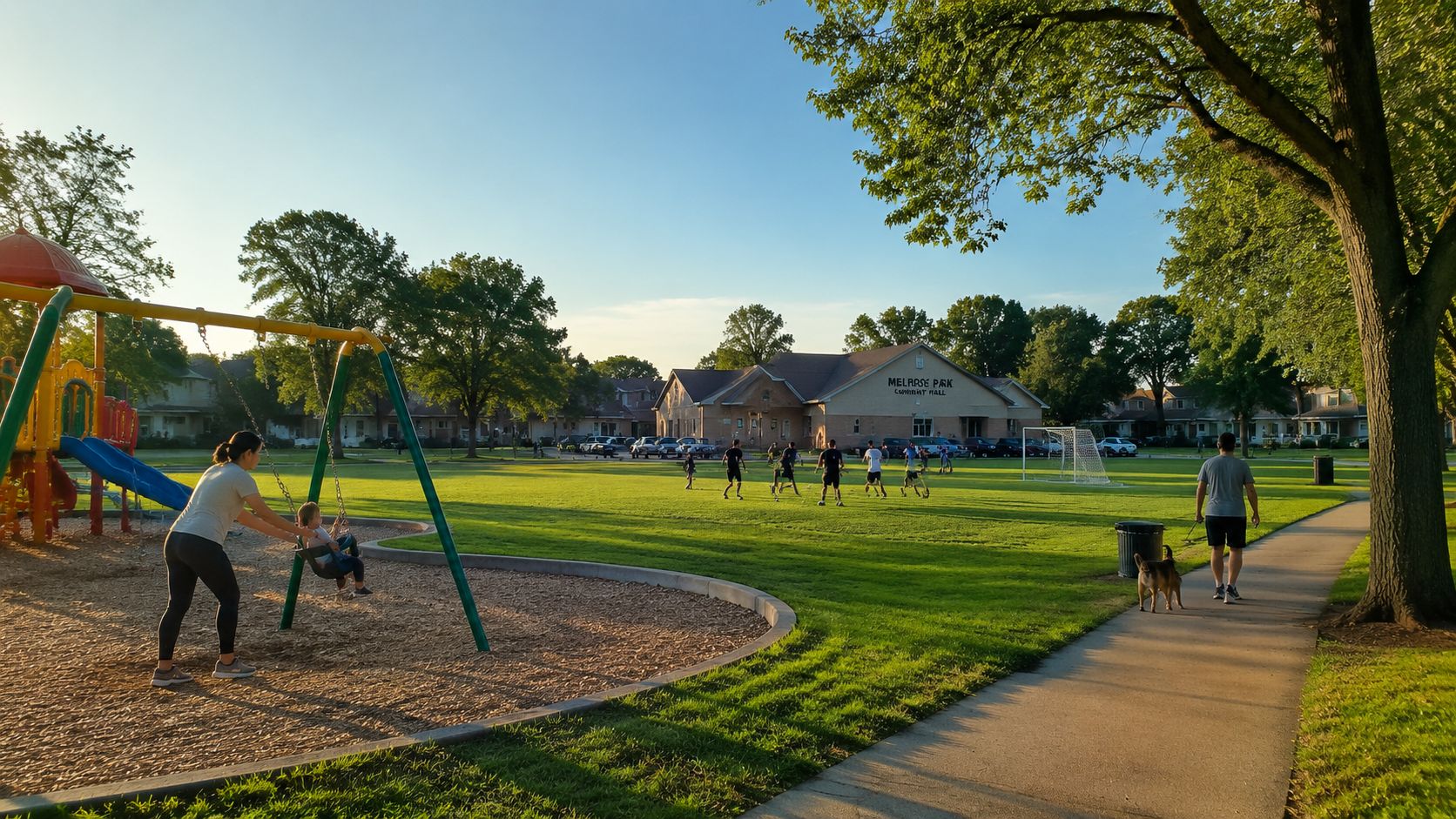
You're comparing homes around Bulger Park in Melrose Park, IL, and the listing makes the location sound simple: close to a neighborhood park, near transportation, convenient to everyday errands. The question is more practical. Will the park improve your routine, or will event traffic, sports activity, and parking pressure become part of your daily life?
Bulger Park is useful precisely because it's an active civic facility, not a quiet decorative green space. It combines playgrounds, sports areas, walking routes, open lawn, and a rental hall within a residential part of Melrose Park. That creates genuine value for families, renters, and buyers who want recreation nearby, but it also makes the surrounding blocks busier at predictable times.
Table of Contents
- A Saturday Morning at Bulger Park in Melrose Park IL
- What Bulger Park Is and Where It Sits
- Amenities and What They Offer Buyers
- Getting Around From Bulger Park
- Everyday Conveniences Near Bulger Park
- What Buyers Overlook About Living Next to a Park
- How Bulger Park Fits Into Your Home Search
A Saturday Morning at Bulger Park in Melrose Park IL
A Saturday morning at Bulger Park tells you more than a property description can. A parent pushes a toddler on the swings while children move between the playground and the open grass. Nearby, a pickup soccer game develops around the field, and the basketball court adds its own steady soundtrack of bouncing balls, sneakers, and shouted instructions.
Across the parking area, another family unloads folding tables from a van. They're preparing for a rented hall event, carrying supplies through the entrance while other drivers circle slowly for an open space. You notice cut grass, car doors closing, children calling to one another, and the familiar friction of a neighborhood facility that serves several groups at once.
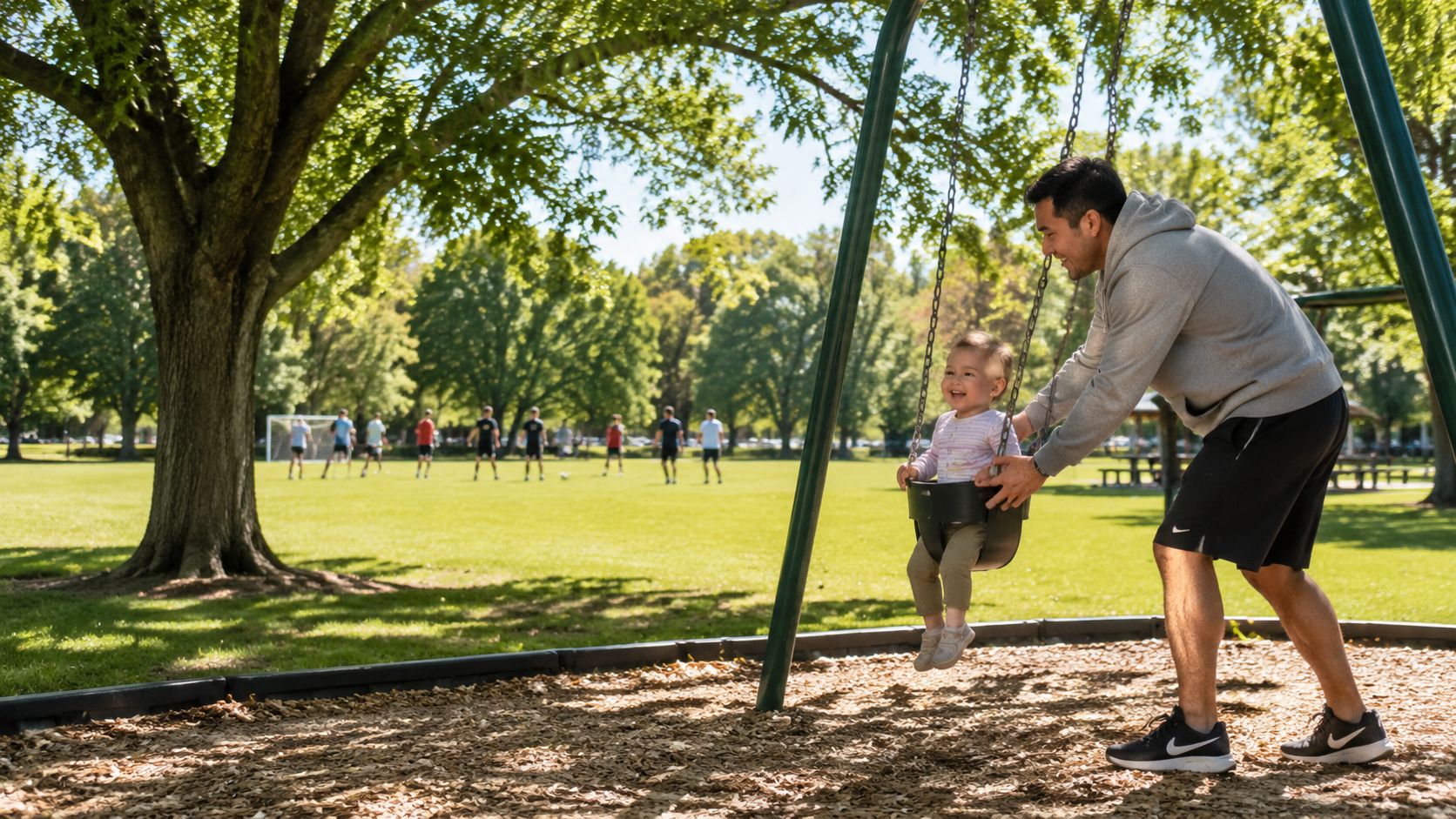
That's the correct mental model for Bulger Park. It's a working neighborhood park with programming, recreation, and private rentals. It isn't designed to feel secluded, and it doesn't operate like an occasional-use preserve. Residents use it for ordinary play, sports, walking, and community gatherings, while renters bring larger events into the same setting.
What a buyer should notice
If you're considering a home within a short drive, ask practical questions before getting attached to the address:
- Event-day activity: How does the street feel when the hall is rented?
- Parking: Do guests rely on the park lot, or do they spill onto nearby residential streets?
- Evening conditions: Are sports lights or late practices visible from the rear of nearby homes?
- Daily usefulness: Would your household use the playground, paths, or courts?
The park's location can make family routines easier, especially when children need a place to play without a long drive. It can also expose nearby residents to more noise and traffic than they expected. A buyer who visits only during a quiet weekday afternoon is missing part of the picture.
What Bulger Park Is and Where It Sits
If you are evaluating a home near Bulger Park, start with the daily route, not the amenity list. Bulger Park is a 6.6-acre park at 1601 Hirsch Street in Melrose Park, with listed coordinates of 41.9046, -87.8535, according to an independent park listing and a local facility directory (park details and location, verified facility location). It sits in a residential stretch, away from the village's main commercial roads. That gives nearby homes a neighborhood setting, while larger routes remain close enough to shape noise and drive times.
The Veterans Park District operates Bulger Park as part of its wider network of public recreation facilities serving Melrose Park and nearby communities (Veterans Park District parks and facilities). For buyers, that means the park is a civic facility with scheduled programming and organized use, not a private amenity reserved for the surrounding blocks.
Use the map in the right order
Check your likely trips first. North Avenue is the major east-west reference point north of the park, and Lake Street provides another east-west route to the south. The Melrose Park Metra station is at 1801 W. Main Street, giving commuters a specific rail location to test against their home-to-station routine (Metra station information). Metra access can help, but it does not erase the need to evaluate the station connection, transfer time, parking, and your actual work destination.
Bulger Park is a compact neighborhood resource, not a regional preserve or lakefront destination. Its value is proximity. Nearby households can reach several recreation options without a long drive, while organized activities can bring extra cars, voices, and movement into the surrounding streets.
Melrose Park had 24,796 residents in the 2020 Census and an estimated 23,999 residents in July 2024. Its formal naming history reaches back to 1894 (Veterans Park District community context). Those figures place Bulger Park within an established village, but the park will not solve every convenience problem. Buyers should still compare grocery runs, school routes, work commutes, and evening traffic. For broader context, review this guide to why living in Melrose Park can appeal to homebuyers.
Amenities and What They Offer Buyers
A Saturday at Bulger Park should make daily life easier, not become another planned outing. The playground suits families who want a short visit with young children. Open grass supports informal games and pickup sports, while paved paths make walking, supervising children, or taking a light jog more practical than a park built entirely around rough fields.
Match the facility to your household, then consider what it does not solve. A nearby park can reduce recreation-related driving, but it will not shorten a work commute, replace grocery access, or remove traffic and activity from surrounding streets during busy programs and events.
Match the feature to the household
- Playground: A practical choice for households with younger children who want accessible play close to home.
- Sports courts and fields: Tennis, soccer, basketball, and baseball areas give children, teens, and adults several ways to stay active nearby.
- Open lawn: Flexible space for informal games, family gatherings, and unstructured play. It offers less organization than a dedicated athletic complex.
- Paved pathways: Useful for walking and light jogging. Dog-walking may work, but buyers should confirm current rules and expect busier periods around active sports areas.
- Bulger Hall: A substantial neighborhood event venue rather than a simple clubhouse. District materials list a 325-person maximum capacity for the community center and a 300-person maximum for Bulger Hall, with full-day and half-day rental options (Bulger Park community center details).
Bulger Hall also has a full kitchen, ice machine, and coat room, according to the district's facility-rental information (Bulger Park rental facilities). Those features support family celebrations, community gatherings, and larger private events without requiring residents to leave the area.
| Amenity | What It Offers Buyers |
|---|---|
| Playground | Convenient everyday play for younger children |
| Sports areas | Recreation for children, teens, and adults |
| Open grass | Flexible room for informal activity |
| Paved paths | Walkable routes for strolling, jogging, and supervision |
| Bulger Hall | A local venue for private and community events |
The trade-off is scope. Bulger Park is a concentrated neighborhood resource, not a substitute for extensive natural areas, waterfront scenery, or specialized facilities. Buyers who want those experiences should review the wider Veterans Park District system before choosing a home.
Use nearby amenities as one part of the decision, alongside drive-time checks, Metra access, schools, taxes, lot size, and the work commute. This guide to neighborhood amenities that may increase your home's appeal offers broader context, but proximity alone should not decide the purchase.
Getting Around From Bulger Park
A home near Bulger Park can make Saturday recreation easy, but it does not automatically make the rest of Melrose Park convenient. For many buyers, a 5 to 10-minute drive is a sensible search range. It keeps the park within regular reach while leaving room to prioritize schools, taxes, lot size, parking, and the work commute.
Metra requires a closer look. The Melrose Park station is at 1801 W. Main Street on the Union Pacific West line. It is accessible, located in fare zone 2, and has no ticket vending machine on site, according to Melrose Park station details. Those facts do not make every nearby home a walk-to-train property. From the specific address, test the route, station access, parking situation, weather exposure, and connection to your office. A short drive to the station may be more realistic than a daily walk.
Compare the anchors, not the promises
North Avenue, also known as Route 64, handles many east-west errands and cross-suburban trips. Lake Street, Route 20, runs south of the park and connects drivers with regional roads and I-294. The I-290 extension also affects west-suburban travel. Each route can feel manageable midday and much slower during weekday rush periods.
| Destination | Distance | Drive Off-Peak | Drive Rush | Transit Option |
|---|---|---|---|---|
| Melrose Park Metra station | Nearby local trip | Short local drive | Allow extra time for congestion | Metra Union Pacific West line |
| North Avenue | Nearby arterial | Short local drive | Variable | Bus or car connection |
| Lake Street | South of the park | Short local drive | Variable | Bus or car connection |
| I-294 access | Via Lake Street and connecting roads | Depends on route | Often slower during peak periods | Not a direct rail substitute |
| I-290 extension | Regional road connection | Depends on entry point | Traffic-sensitive | Not a direct rail substitute |
Do not rely on a generic O'Hare drive time. The result changes with the property address, departure point, and traffic window. Run the trip during the hours you would travel.
Parking can change the daily experience too. Street spaces may become harder to find when hall rentals and youth sports overlap, particularly near the most convenient entrances. Compare driveway capacity, side-street access, and morning departure routes when two homes otherwise look similar. The closest house on a map may be slower to leave during rush hour.
Bulger Park improves local recreation access. It does not erase road congestion, create a simple rail commute, or solve every trip beyond the neighborhood. Evaluate it as one part of the convenience equation, not as a substitute for testing the full route from your prospective home.
Everyday Conveniences Near Bulger Park
Bulger Park can support recreation, but it doesn't solve every errand. Buyers still need to evaluate groceries, pharmacies, healthcare, restaurants, schools, and commuting roads as a connected system.
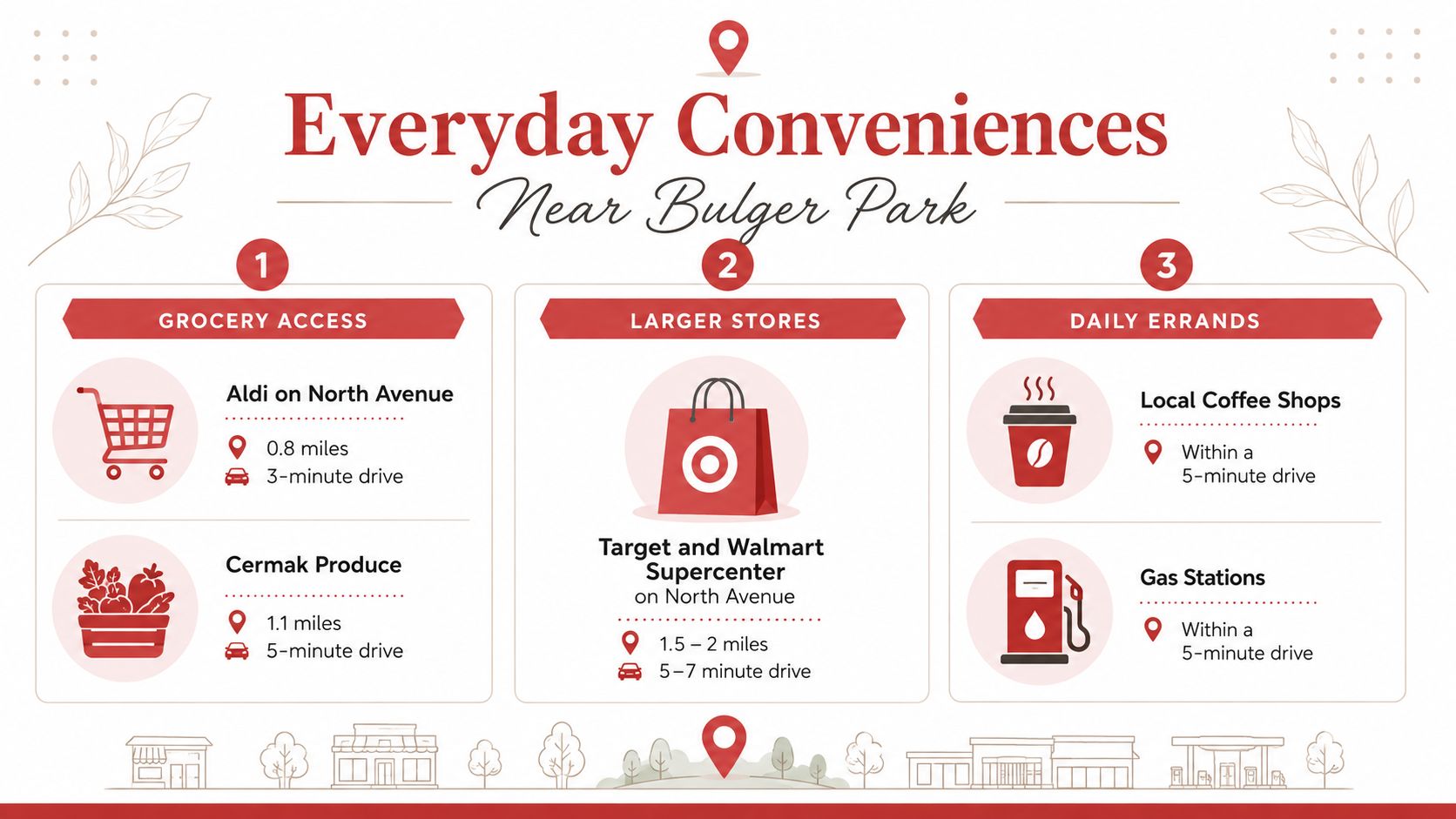
For groceries, North Avenue provides practical access to smaller-format shopping, including Aldi and Cermak Produce. Larger stores are available within a short drive in nearby River Forest or Maywood, while Mexican and Italian grocery options reflect the area's established local food culture. Most routine shopping trips can be handled without getting on the highway, which matters when you're comparing Melrose Park with denser communities where errands often involve more traffic or less convenient parking.
Build the routine around short trips
A realistic buyer's checklist looks like this:
- Groceries: Use North Avenue for quick trips, then compare larger retailers in surrounding communities for bulk shopping and household purchases.
- Dining: Expect family taquerias, casual chain restaurants, local coffee stops, and Italian dining to be more practical by car than by a long walk from every Bulger Park address.
- Healthcare: Check the exact location and hours of immediate-care clinics, pharmacies, and medical offices before assuming a convenient routine. The legacy Westlake Hospital site is part of the area's healthcare context, but buyers should verify current services rather than rely on an old landmark.
- Schools: School assignments depend on the property address and district boundaries. Confirm them directly for every listing, and treat nearby parochial options as a separate choice rather than assuming proximity guarantees placement.
- Shopping: North Avenue and nearby western suburbs provide broader retail access without requiring every trip to become a highway journey.
Restaurants and coffee stops can be convenient within a short drive, but don't overstate walkability. Some streets around Bulger Park feel residential and close-knit, while the commercial conveniences buyers ask about most are better judged by actual route and parking conditions.
The same rule applies to schools. A map can show a nearby campus, but it can't confirm assignment boundaries, transportation policies, enrollment conditions, or whether the school fits your priorities. Ask for those details before making an offer.
What Buyers Overlook About Living Next to a Park
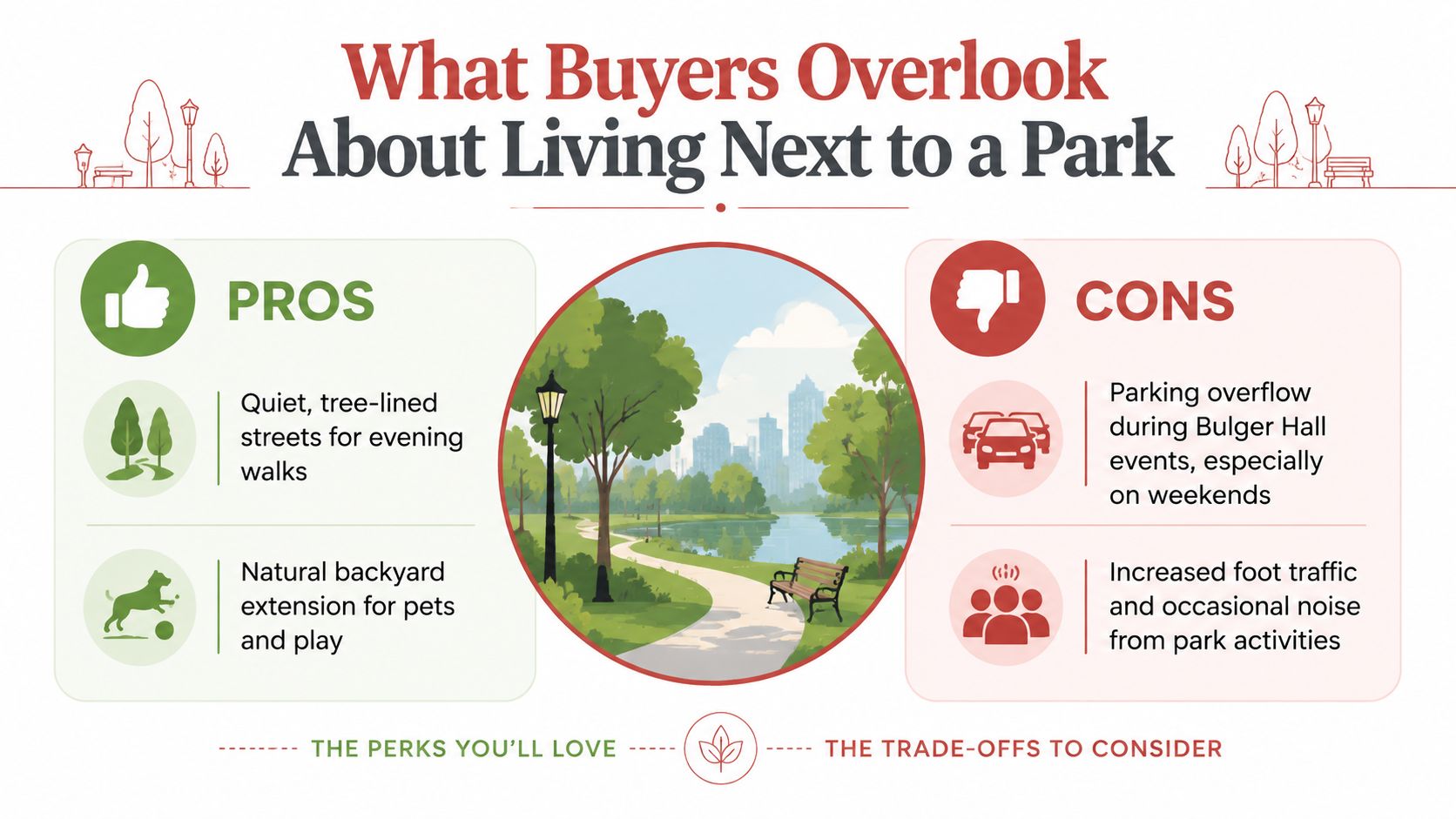
A park-facing home can look like a bargain in lifestyle terms. You get open space beyond the rear fence, fewer immediate structures, and a natural place for children or pets to use. But the same openness can expose the property to activity that a home on an interior block may avoid.
Bulger Hall is the main trade-off. Weddings, quinceañeras, baptisms, and other gatherings can bring more cars, guests, deliveries, and conversation to the surrounding streets. The district identifies the hall as a venue with capacity for substantial gatherings, so adjacent residents should assume that event-day activity is part of the location, not an unusual exception (facility capacity and rental information).
Inspect the block, not just the backyard view
Visit the property at different times and look for:
- Parking overflow: Count available spaces on adjacent streets during an active rental or youth sports period.
- Light spill: Check whether sports lighting reaches rear bedrooms, patios, or upper-level windows.
- Traffic shifts: Watch how cars move along Hirsch Street, 16th Avenue, and nearby residential streets when leagues and hall rentals overlap.
- School-related congestion: Ask whether nearby school drop-off and pickup patterns affect the same streets your household would use.
The upside can be real. A yard facing the park may feel larger and more open, and many buyers value a setting that gives children or pets an immediate outdoor extension. Those qualities can help a property attract attention when it's sold or rented, but they don't erase the need to price the noise and parking trade-off correctly.
Practical rule: If you're sensitive to evening activity, don't buy directly beside the hall based on a quiet showing. Visit during a scheduled event and judge the sound, parking, and traffic for yourself.
Proximity is a tolerance decision, not an objective upgrade. Some buyers will gladly accept occasional activity for the view and access. Others will prefer a home two or three blocks away, where the park remains convenient but the event footprint feels less immediate.
How Bulger Park Fits Into Your Home Search
Bulger Park should be one input in your Melrose Park home search, not the filter that decides everything. A buyer who prioritizes playground access may reasonably favor a nearby property, while another buyer may value a shorter commute, a larger lot, a quieter rear exposure, or a specific school assignment more.
The right comparison is block against block. A home immediately beside Bulger Hall may offer the strongest access and the most direct park outlook, but it also deserves closer review for event traffic and noise. A property farther away can preserve the recreational benefit while reducing the frequency with which hall activity affects your driveway, street, or backyard.
Use a buyer's decision grid
Evaluate each address across the factors that will still matter after the excitement of the showing wears off:
- Park relationship: Is the home directly adjacent, across from the park, or within a short drive?
- Commute pattern: Will you use Metra, major roads, a car-based commute, or a combination?
- School verification: Have you confirmed the assignment for the exact address?
- Lot and layout: Does the home give you privacy, parking, and a usable outdoor area?
- Resale liquidity: Will future buyers see the park as a benefit, or will the hall activity narrow the audience?
- Neighborhood trajectory: Does the surrounding area support the lifestyle and long-term plan you're buying for?
Ask your agent how often Bulger Hall is rented, whether the Veterans Park District has discussed capital improvements, and how nearby comparable sales have treated park-adjacent lots versus interior blocks. Those answers require property-specific research, not assumptions from a listing description.
For buyers who value community programming and convenient recreation, Bulger Park adds real daily-life utility. It won't replace transit access, manageable taxes, reliable school information, grocery convenience, or a workable commute. A careful agent should help you compare those variables rather than steering you toward a park just because it photographs well. This guide on finding a good real estate agent offers a useful standard for that conversation.
Homes By Carmen helps buyers evaluate Melrose Park properties through local neighborhood guidance, MLS-supported searches, tours, offer strategy, inspections, and closing coordination. If Bulger Park is part of your search, visit Homes By Carmen to discuss specific blocks, commute priorities, school questions, and the trade-offs between park access and event-day activity.