
An appraisal gap is the contract price minus the lower appraised value, so a $400,000 contract with a $380,000 appraisal leaves a $20,000 gap. That $20,000 has to come from somewhere before closing, because the lender won't finance it.
You're probably reading this for one of two reasons. Either the appraisal just came back lower than the price you agreed to pay, and your lender's email is sitting open on your phone. Or you're about to write an offer above list price on a house in Melrose Park, Elmhurst, or Downers Grove, and your agent used the phrase "appraisal gap coverage" as if you already knew what it meant.
Both situations come down to the same question, and it isn't whether the appraiser got it wrong. It's how much cash your offer requires under several appraisal outcomes, and which exits your contract still gives you when the number lands low. That's the order this guide follows: the math, the causes, the contract language, then the decision you make before you sign anything.
Table of Contents
- What an Appraisal Gap Means for Your Purchase
- Cash Needed at Different Appraisal Outcomes
- Why Appraisals Land Below the Contract Price
- Covering the Gap and Checking Contract Terms
- How to Work Through a Low Appraisal Step by Step
- Set Your Gap Cap Before You Write the Offer
What an Appraisal Gap Means for Your Purchase
Say you agreed to pay $400,000 for a house. Three weeks into the contract, the lender's appraiser signs off on $380,000. Two numbers, one property, and a $20,000 difference between them. That difference is the gap.
The two numbers come from different places. The contract price is what you and the seller negotiated and signed. The appraisal is an independent professional opinion of market value, ordered by your lender, built from recent sales of similar homes. It's like agreeing to pay a sticker price while your bank independently checks that price against what comparable items sold for last month. The bank isn't grading your taste. It's deciding how much collateral it's holding.
Then the lender does the arithmetic that catches buyers off guard. Loan-to-value is calculated against the lesser of the contract price or the appraised value, as the Consumer Financial Protection Bureau's mortgage glossary explains in its key terms. A $360,000 loan on a $400,000 contract looks like 90% LTV. Against a $380,000 appraisal, that same $360,000 loan is 94.7% LTV, and suddenly you're in a different underwriting lane with different pricing and possibly mortgage insurance.
The lender lends against the lower number, not the number you agreed to pay.
Nothing changed about the house, your income, or your credit. The loan amount stayed the same and the ratio moved anyway. That's why the useful mental model isn't "the appraisal came in low." It's "my financing just got recalculated against a smaller collateral base."
What you now know: a gap is a financing and negotiation event. It isn't a verdict on the home's worth, and it isn't proof you overpaid. Appraisers work from closings that happened weeks or months ago, and they can land below a price that today's buyers would happily support.
Cash Needed at Different Appraisal Outcomes
Abstract worry doesn't help anyone. Dollar figures do. Take one offer and stress-test it.
Assumptions: a $400,000 contract, a planned 10% down payment, and a loan sized at 90% LTV on the appraised value. Each appraisal outcome changes the cash you bring to the closing table.
| Appraised value | Gap vs. $400,000 price | Maximum loan at 90% LTV | Total cash needed |
|---|---|---|---|
| $400,000 | $0 | $360,000 | $40,000 |
| $390,000 | $10,000 | $351,000 | $49,000 |
| $380,000 | $20,000 | $342,000 | $58,000 |
| $360,000 | $40,000 | $324,000 | $76,000 |
Two rules generate every row. Maximum loan equals 90% of the appraised value. Total cash equals the contract price minus that loan. Nothing else is happening in the table, which means you can rerun it with your own price, down payment percentage, and lender threshold in about two minutes.
Read the rows in order and a pattern shows up. A $10,000 gap doesn't cost you $10,000. It costs you $9,000 in this structure, because the loan shrinks by $9,000 and you make up the rest. At a $40,000 gap, the loan drops $36,000 and your cash requirement rises $36,000, from $40,000 to $76,000. The gap and the extra cash track each other closely whenever the appraisal is the binding number.
A stricter threshold changes the answer
Now change one assumption and watch the same $20,000 gap bite harder. On a $500,000 purchase appraised at $480,000, an 80% LTV limit caps the loan at $384,000 instead of the $400,000 a price-based 80% loan would have allowed. Total cash climbs to $116,000, which is $16,000 more than planned, before a single closing cost. The Consumer Financial Protection Bureau's explanation of differing valuations is a useful reference for why a lender may hold more than one opinion of value during underwriting.
Run this before you fall in love: the cash column, not the gap column, is the number that decides whether you can close.
Loan type matters here too. Conventional, FHA, and VA loans carry different LTV ceilings, insurance rules, and appraisal requirements, and VA financing includes its own protections when the appraisal comes in under the price. Confirm your program's actual threshold with your lender rather than assuming the 90% or 80% figures above apply to you.
Why Appraisals Land Below the Contract Price
Picture a listing that draws five offers in a weekend. The winning bid sits $25,000 above anything that has closed on that block in the last six months, because six other buyers pushed it there. The appraiser opens the file, finds no closed sale that supports the number, and reports what the evidence shows. That's the ordinary origin of a gap.
Four conditions produce most of them.
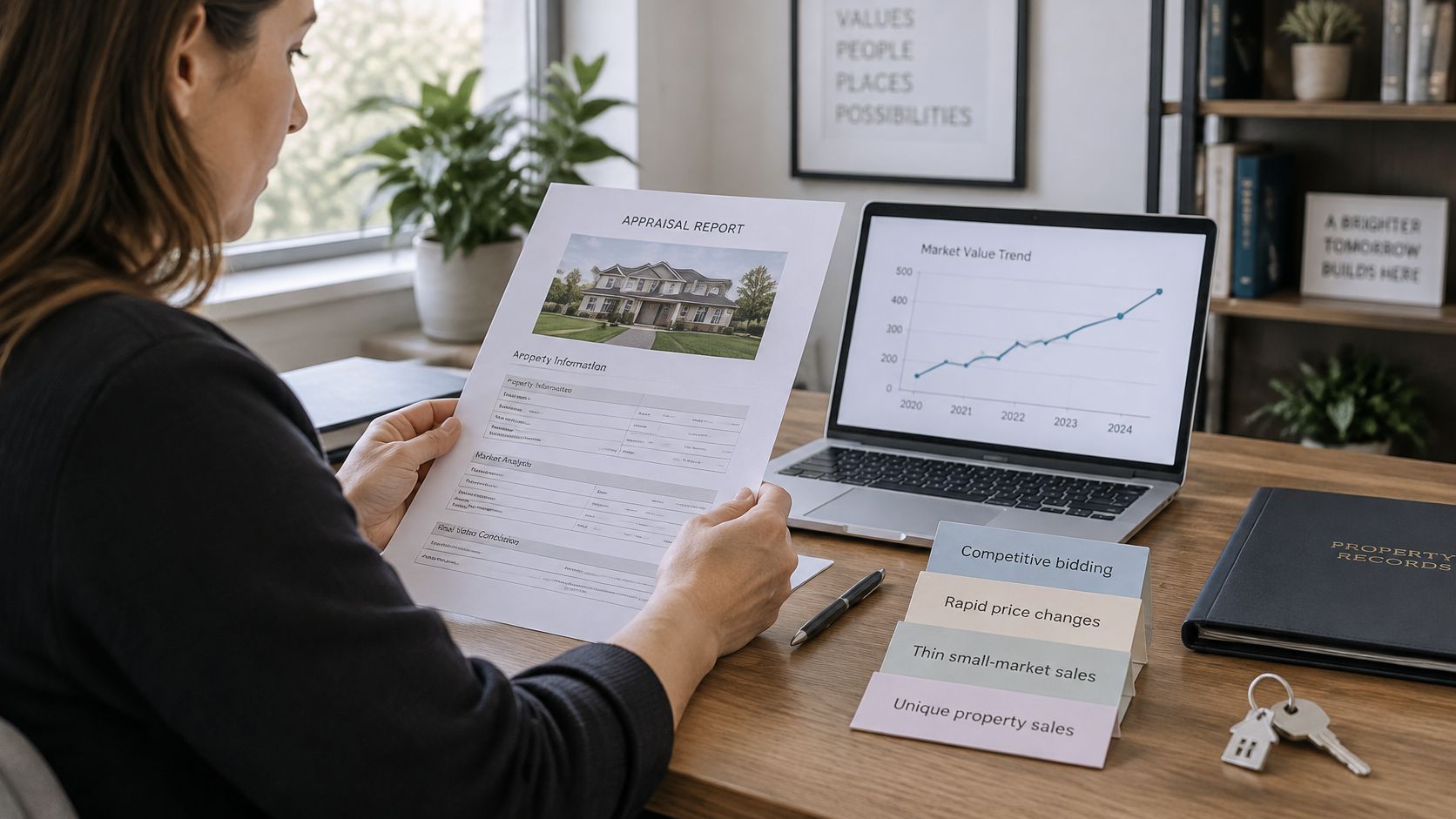
- Competitive bidding: buyers offer above recent comparable sales to win, and the appraisal follows the sales, not the competition.
- Fast-moving prices: appraisers work from closings, and closings lag. When values move quickly, the evidence is stale by definition.
- Thin comparable sales: small subdivisions, custom homes, and unusual lots may have no similar recent sale to point to.
- Unusual features: additions, one-off renovations, inherited or as-is condition, and location quirks that don't fit a standard adjustment grid.
How often does this happen? Less often than bidding-war stories suggest. A Federal Reserve Bank of Philadelphia study of millions of home-purchase appraisals found that fewer than 10% came in below the transaction price, while more than one-third were exactly equal to it. Corporate Settlement Solutions measured the same pattern across 19 East Coast and Midwest states, finding 8% of appraisals under the sale price in the second half of 2024, down from 12% in the second half of 2023, as HousingWire reported.
That base rate is reassuring for a typical purchase. It also tells you nothing about the specific house you're bidding on. Gaps cluster in exactly the conditions listed above, so a home with six near-identical recent sales down the street and a home with one comparable from eight months ago carry very different risk even in the same market.
A gap also isn't automatically evidence of overpayment. Two appraisers can review the same property and reach different conclusions using different comparables, different dates, or different adjustments for condition. Ask the practical question instead: which comparable sales did the appraiser use, and do those sales resemble this house? A comparative market analysis built from the same sales data gives you a way to test the report rather than accept or resent it.
Covering the Gap and Checking Contract Terms
When the appraisal lands low, the money has to land somewhere. Either the seller absorbs it through a lower price, you absorb it in cash, the two of you split it, or the deal ends. Those are the options, and everything else in this section is detail hanging off them.
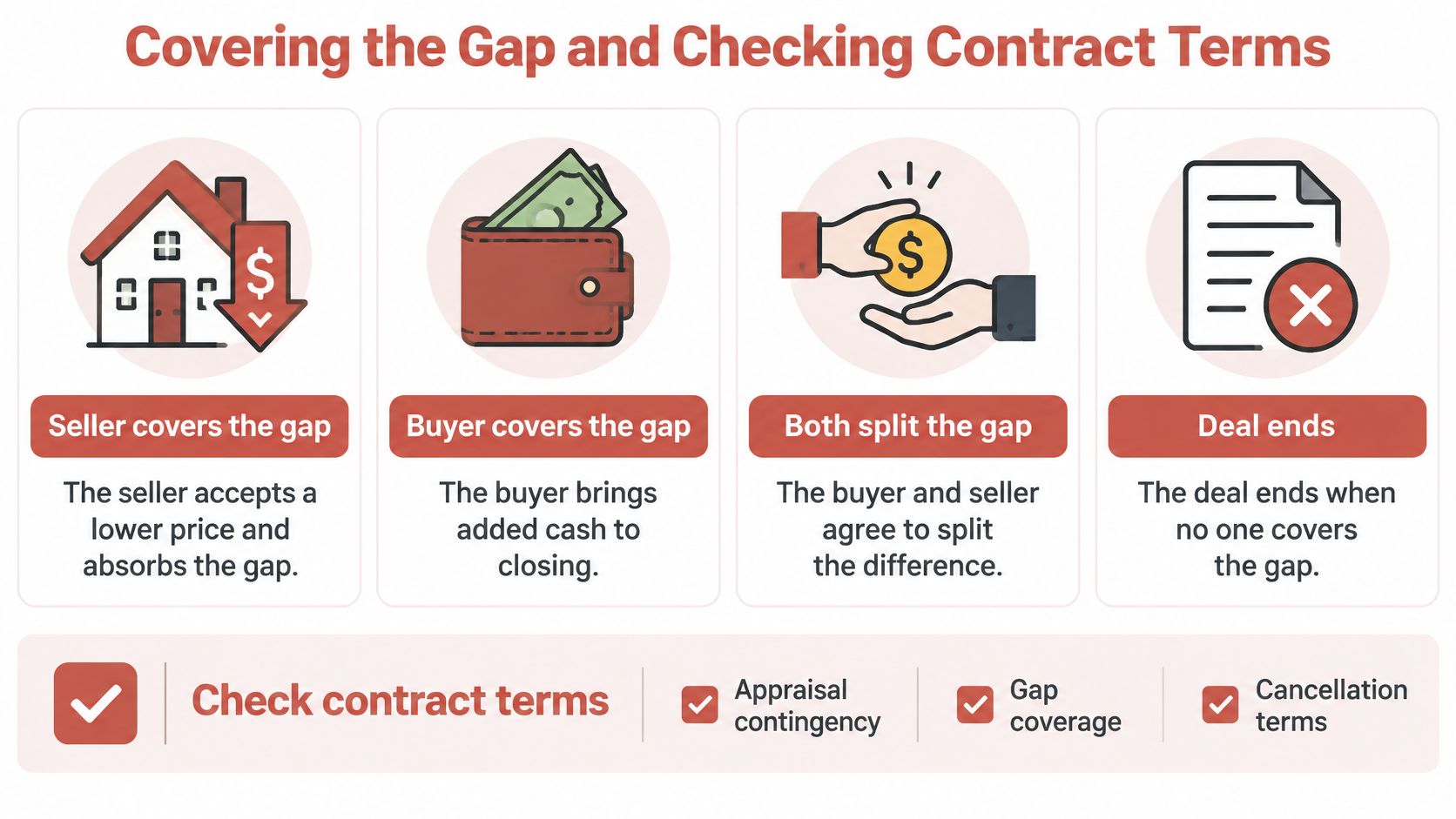
| Option | Who absorbs the gap | Works best when | Main risk |
|---|---|---|---|
| Seller cuts price to appraised value | Seller | Seller wants the deal and the lender will finance on the appraisal | Seller's net proceeds fall |
| Buyer pays the difference in cash | Buyer | Buyer has liquid reserves and wants to keep the contract price | Extra cash needed before closing |
| Split the gap | Buyer and seller | Both sides want to keep the deal and the split is written into the contract | Needs a clear written clause |
| Lender reconsideration of value | Lender review | Appraisal has factual errors or missed comparables | Not guaranteed and can take time |
| Cancel under appraisal contingency | Nobody, deal ends | Contract includes an appraisal contingency and the gap exceeds your limit | Deal is lost, though earnest money is typically returned under the contingency |
| Waived appraisal contingency | Buyer | Competitive offer where the buyer accepts valuation risk | Buyer may pay the full shortfall with no exit |
Three terms that get confused constantly
Appraisal contingency. This is your exit. If the appraisal comes in below the contract price, you can renegotiate, bring cash, or terminate and generally recover your earnest money, depending on how the clause is written. It's the reason a low appraisal doesn't have to become a low appraisal you pay for. Learn more about what an appraisal contingency covers before you decide whether to keep or drop it.
Appraisal gap clause. This is your commitment. You promise to pay a set dollar amount above the appraised value, and the cap is the entire point. A workable clause needs five pieces: a stated maximum, a named source of cash, a deadline, a rule for what happens if the gap exceeds the cap, and a termination right at that ceiling. Without the cap, you've promised to cover an unknown number.
Appraisal waiver. This removes the lender's requirement for an appraisal and shifts the entire shortfall to you with no exit. It can strengthen an offer, and it is not evidence that the home is worth the price. Waiver use has swung hard: combined Fannie Mae and Freddie Mac waiver use was about 16% of loans in June 2025, down from nearly 50% at the March 2021 peak, while Fannie Mae's expansion to certain 80% to 90% CLTV purchase loans lifted waiver use in those higher-LTV loans from roughly 2% in February 2025 to about 15% by June, according to the Appraisal Institute's appraisal news coverage.
The honest test for a waiver: if the appraisal came in 10% under your price tomorrow, could you write that check without touching your emergency fund? If not, the waiver isn't a strategy, it's a gamble.
This decision has real consequences. A 2021 National Association of REALTORS® survey found that 23% of contracts were delayed because of appraisal issues and approximately 12% were terminated for that reason, while 25% of buyers had waived their appraisal contingency in August 2021. Reconsideration of value deserves a mention here too: federal guidance describes it as a lender request asking the appraiser to reassess potential deficiencies or new information. It is not an automatic borrower remedy, and it doesn't guarantee a different number.
Cash buyers and FHA or VA borrowers operate under different rules again, so confirm your program's specifics with your lender before you sign anything.
How to Work Through a Low Appraisal Step by Step
The appraisal arrives, the number is low, and the clock on your contingency starts running. Work the sequence in order rather than reacting to the number itself.
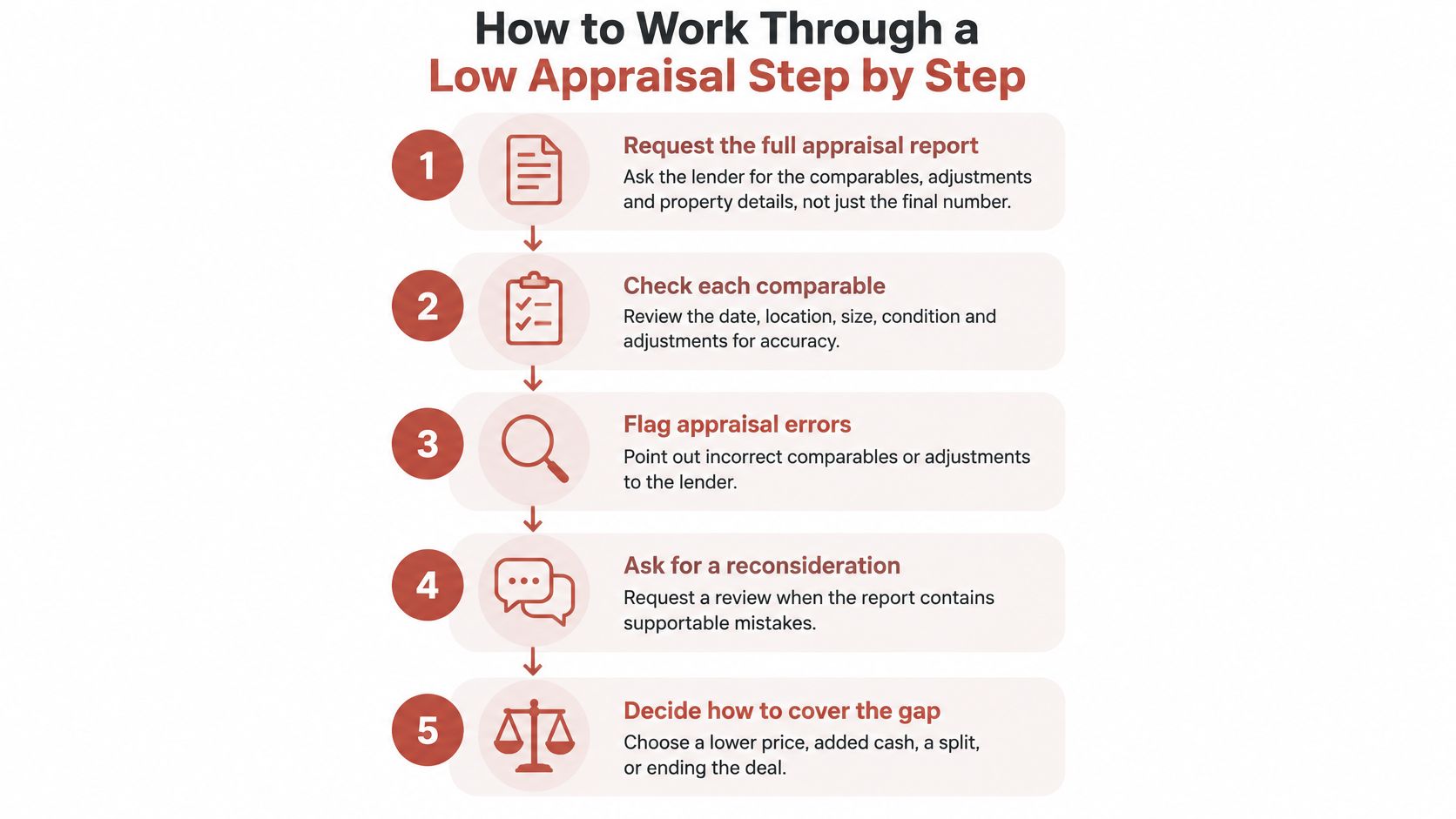
Request the full report from your lender. You need the comparables, the adjustment grid, and the property details, not just the final figure. Buyers who only read the bottom line have nothing to challenge and nothing to negotiate with.
Audit each comparable. Check the date of sale, distance from the subject, condition, square footage, lot size, and features. Note factual errors such as a wrong room count, a missed finished basement, or a renovation the appraiser never saw.
Ask your agent for a fresh sales analysis. Test whether the appraiser's choices match what closed recently. The most common slip here is comparing the appraisal to the list price instead of to closed sales.
Request a reconsideration of value only when you have grounds. Material factual errors or comparable sales the appraiser missed are the legitimate basis. Treat it as a review request, not a guaranteed correction, and expect it to take time.
Recalculate your cash using the outcome table. Add closing costs, prepaid items, and your moving budget to the gap figure. The number that matters is total funds to close, not the gap in isolation.
Choose your response. Seller price reduction, your own cash, a written split, or seller credits toward your costs. Each has a different effect on your reserves, and a credit is not the same thing as a price cut.
Put the agreement in writing. Dollar amount, source of funds, and a deadline. Verbal understandings between agents have a way of evaporating when the closing disclosure gets drafted.
Watch the contract dates. Your appraisal contingency period and earnest money deadlines define how long the choice stays yours. Miss the window and your advantage disappears along with your exit.
A resolved file looks unremarkable, which is the goal. A revised lender approval reflecting the new loan amount, a signed amendment matching what both sides agreed, and a closing date that doesn't move. If any of those three is missing, the negotiation isn't finished yet.
Set Your Gap Cap Before You Write the Offer
One decision belongs before the offer, not after the appraisal: the maximum cash you'll add above your lender's maximum loan. Write it down as a number before you tour anything, and write it into the offer with a cap.
Calculate it with the table method. Take the appraisal values that are plausible for the property, find total cash needed at each, then subtract the reserves you want left after closing, including your emergency fund. Set your cap below whatever remains. A cap you can't fund isn't coverage, it's a future problem with a deadline attached.
Before offering, get an independent read on value, something like a comparable sales analysis from a local agent, and compare it to the price you plan to pay. A free expert home valuation and strategy call from Homes By Carmen will give you that outside view for a property you're preparing to sell, and the same sales logic applies when you're testing an offer on the buy side. Confirm your loan program's limits at the same time, since conventional, FHA, VA, and cash purchases don't share the same threshold.
Then apply the exit rule in advance. If the gap exceeds your cap, renegotiate the price, use your appraisal contingency if the contract includes one, or pay the shortfall only if you decided beforehand that this house is worth it to you. Deciding in the moment, with a deadline running and a moving truck booked, is how buyers end up draining accounts they promised themselves they'd protect.
Price negotiation is where most of this gets settled, and knowing your position before you sit down changes the conversation. These real estate negotiation tips for buyers cover the moves that tend to work when a low appraisal puts the price back on the table.
The gap is a number you can plan for, not a surprise to react to.
Homes By Carmen helps buyers and sellers across Melrose Park, Elmhurst, Oak Park, and the surrounding western suburbs work through the numbers before an offer goes in, including how much cash each appraisal outcome would require. If you're weighing a bid above list price, or you need a realistic valuation on a home you're about to sell, we can build those scenarios with you and review the contract terms that decide who pays. Visit Homes By Carmen to schedule a consultation or get answers to your real estate questions.