
You've cleaned out the garage, updated the kitchen, and started wondering whether now is the right time to sell your suburban Chicago home. One question quickly leads to three more: What can I sell my house for? How long might it take? And how much money would I keep after the sale?
A reliable answer isn't a single automated estimate. It combines recent local sales, your home's condition, current competition, buyer financing, and a realistic calculation of selling expenses. The result should be a defensible price range and a net-proceeds estimate, not just an attractive number on a valuation website.
Table of Contents
- Getting Started with Your Home Valuation Journey
- Understanding Home Value Essentials
- Key Factors That Affect Your Home Price
- How to Estimate Your Home Price with Comparative Market Analysis
- Comparing Automated Estimates with Manual Methods
- Real Examples from Western Chicagoland Neighborhoods
- Developing a Pricing Strategy for Net Proceeds
- Next Steps and Free Valuation Offer
Getting Started with Your Home Valuation Journey
Start by separating three figures that sellers often blend together: market value, list price, and net proceeds. Market value reflects what a qualified buyer may pay based on comparable homes. List price is the public strategy you choose to attract that buyer. Net proceeds are what remains after expenses, credits, repairs, taxes, loan payoff, and other deductions.
A homeowner in Elmhurst might see an online estimate that looks encouraging, then discover that the figure doesn't account for an unfinished basement, an older roof, or a competing renovated home nearby. Another owner in Downers Grove might list below the top end of the estimated range to create stronger early activity. The right decision depends on the property and the seller's priorities.
A practical valuation process usually has three layers:
- Automated estimate: Use it as a quick starting point, not a final answer.
- Comparative market analysis: Match the home against nearby closed, pending, and active properties.
- Net-sheet review: Estimate what different sale and concession scenarios would leave you with.
By the end of that process, you should understand not only what the house might sell for, but also which preparation and pricing strategy makes financial sense.
Understanding Home Value Essentials
A home's value is local. A national median can provide context, but it can't tell you what a specific house in Melrose Park, Oak Park, Elmhurst, or Naperville should sell for. The Federal Housing Finance Agency's explanation of its House Price Index shows why geographic precision matters. FHFA uses data from more than 100 million home sale and refinance transactions and applies a repeat-sales method that compares price changes for the same property over time.
Think of a national average like the price tag at a large grocery chain. It tells you something about broad pricing, but it doesn't tell you what a seasonal product costs at a neighborhood farmers market today. Local supply, timing, quality, and buyer preferences change the result.
Three numbers sellers should keep separate
Market value is the estimated price supported by buyer behavior and comparable sales. List price is the amount you choose to advertise, which may be positioned to attract broad interest, test the upper range, or encourage competition. Net proceeds are the amount you keep after the transaction costs and negotiated deductions.
The national benchmark can still help frame the conversation. In March 2025, the U.S. median existing-home price was $403,700, up 2.7% from March 2024, while existing-home sales were at a 4.02 million seasonally adjusted annual rate and were 2.4% lower than a year earlier, according to the National Association of REALTORS®’ existing-home sales data. Those figures show why price level and market speed should be considered together, but they don't value an individual Chicagoland property.
Recent nearby sales remain the strongest foundation. Compare homes with similar living area, lot size, age, bedroom count, property type, renovation level, and location. A house near a train station, a home with a finished basement, and a property on a busy road may produce different buyer responses even when their square footage looks similar.
Practical rule: Use broad market data to understand the environment, then use nearby comparable sales to estimate your own home's likely range.
Key Factors That Affect Your Home Price
Buyers and appraisers don't evaluate a house by square footage alone. They compare the complete package, including location, layout, condition, improvements, and the alternatives available when the property launches.
Location creates the first boundary. A home's school-access pattern, transit convenience, street setting, lot characteristics, and proximity to shopping or employment can affect demand. Two homes in the same suburb may compete in different micro-markets because one is walkable to a station and the other depends on driving.
Condition determines how many buyers can say yes. Updated kitchens and bathrooms may improve appeal, but deferred maintenance can create inspection concerns, financing complications, or requests for credits. A clean, well-maintained older home can compete effectively without receiving a full renovation, while a property with visible defects may need a lower position or an as-is strategy.
Layout matters beyond size. Bedroom placement, storage, basement finish, garage capacity, natural light, and functional flow influence how buyers experience the property. A larger home with an awkward layout may attract less interest than a smaller home that uses its space efficiently.
Timing and competition shape the outcome. Current listings show what buyers can choose today. Pending sales reveal what buyers are accepting, while closed sales confirm what transactions achieved.
Concessions can change the economics. A comparable that sold for $400,000 with a $10,000 seller credit shouldn't automatically be treated as equivalent to a no-credit sale at the same price. Fannie Mae's guidance on comparable-sale adjustments explains that the adjustment should reflect the market's reaction to the concession, not a mechanical subtraction in every situation.
That distinction matters when a buyer requests a rate buydown, closing-cost credit, repair allowance, or prepaid expense. The headline price may look strong while the seller's economic result is lower.
How to Estimate Your Home Price with Comparative Market Analysis
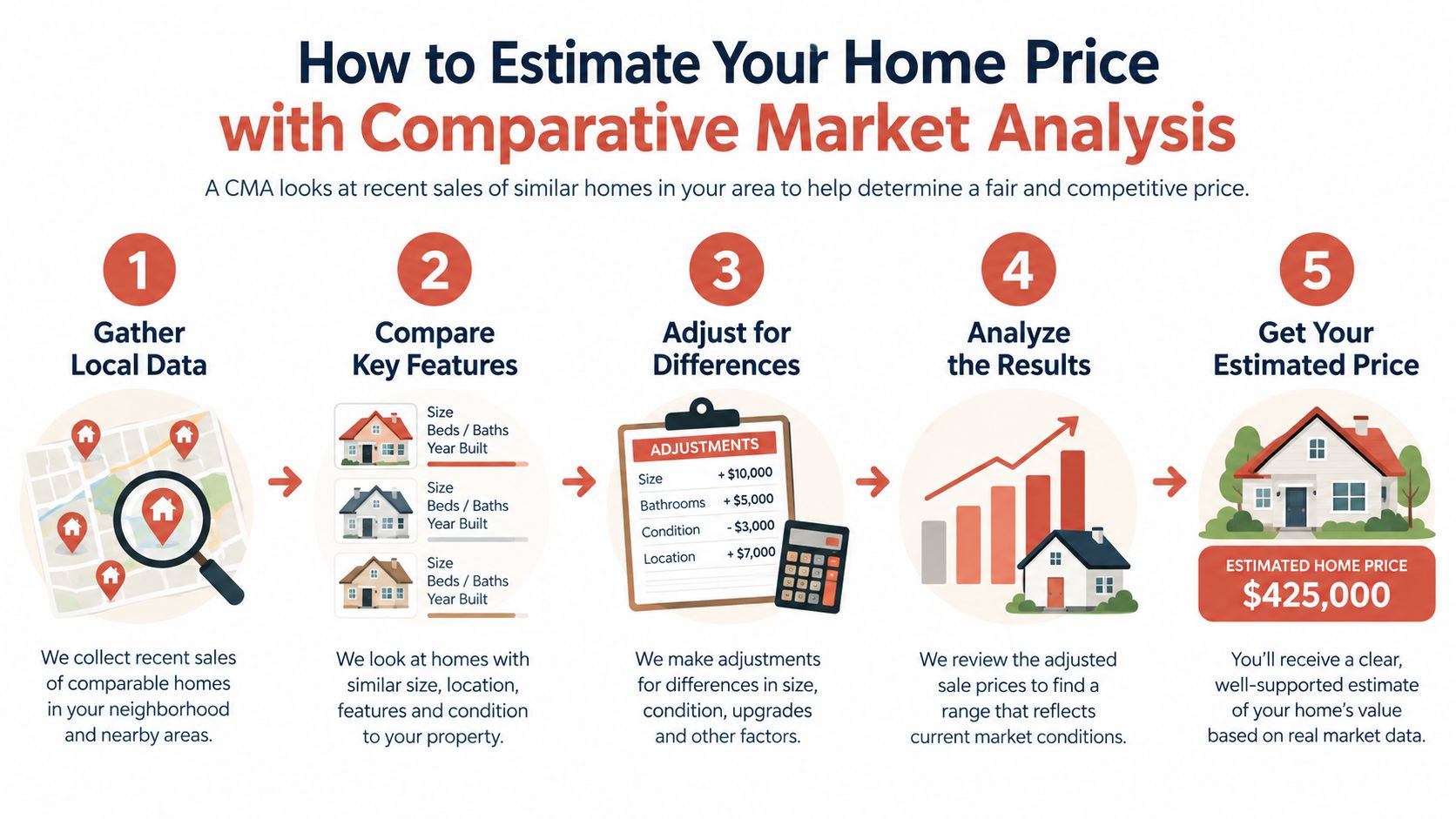
A comparative market analysis, or CMA, turns general market information into a property-specific estimate. It doesn't promise an exact sale price. Instead, it organizes evidence so you can make a reasoned pricing decision.
Start with closed comparable sales
Fannie Mae appraisal guidance calls for at least three closed comparable sales in the sales-comparison approach and recommends similar properties based on location, site, room count, finished area, architectural style, and condition. The comparable-sales guidance also supports analyzing the differences between the subject property and each comparable.
For an Elmhurst bungalow, begin with nearby bungalows that share a similar age, lot pattern, bedroom count, and renovation level. For a Downers Grove townhouse, prioritize the same development or a directly competing community when possible. For a Naperville family home, school-access patterns, subdivision design, basement finish, and garage capacity may be more useful than a broad municipal boundary.
Adjust for meaningful differences
Don't average the comparable prices. Ask how buyers appear to value each difference.
- Select recent closed sales that compete for the same buyer.
- Review pending contracts to understand current activity.
- Study active listings as competing inventory, not proof of value.
- Adjust for condition and features, including renovation quality, lot size, finished area, garage space, and functional layout.
- Consider timing, because an older sale may need a supported market-condition adjustment.
A finished basement shouldn't automatically receive the same adjustment in every neighborhood. The relevant question is whether local buyers paid more for comparable finished space, and how much more.
You can also use a free comparative market analysis resource to organize the information before discussing the results with a local professional. A useful report should explain why each comparable was selected and how its differences affect the range.
The final CMA should give you a range, a recommended list-price position, and a clear explanation of the risks. Pricing at the top may maximize the opportunity per buyer, but an unsupported price can reduce early activity. Pricing with evidence gives you a better chance of attracting serious attention from the start.
Comparing Automated Estimates with Manual Methods
Automated estimates are convenient because they provide an immediate ballpark figure. They can help you begin a conversation, especially when you're still deciding whether to sell. Their weakness is detail. An algorithm may not understand a remodeled kitchen, an unusual floor plan, a poorly maintained neighboring property, or a location difference that matters to local buyers.
Price per square foot has a similar limitation. It can help compare homes with closely matched layouts and conditions, but it becomes misleading when one property has a finished basement, larger lot, superior renovation, or different functional design.
| Approach | Pros | Cons |
|---|---|---|
| Automated estimate | Fast, accessible, useful for an initial range | May miss condition, layout, micro-location, and concessions |
| Price per square foot | Simple and easy to calculate | Can confuse size with buyer appeal and ignore meaningful differences |
| Comparative market analysis | Uses local evidence and property-specific adjustments | Requires good comparable selection and professional judgment |
Use an online home valuation calculator as an opening reference, then test the result against local closed sales. If the automated figure sits far outside the range supported by comparable homes, investigate why rather than accepting either number automatically.
A manual CMA is usually more useful when the property is renovated, inherited, tenant-occupied, outdated, unusual, or being sold as-is. Those conditions can materially change the buyer pool, the likely concessions, and the preparation decision.
Real Examples from Western Chicagoland Neighborhoods
Consider three hypothetical pricing discussions that reflect the kinds of differences western suburban sellers need to evaluate. These are illustrations of the method, not reported transactions or promises of specific results.
In Elmhurst, a renovated bungalow may compete strongly when its kitchen, mechanical systems, basement, and exterior presentation compare favorably with nearby closed sales. The seller shouldn't rely on the highest nearby price alone. The analysis should identify whether those homes matched the bungalow's lot, architectural style, updates, and location. If the property is positioned above the evidence, buyers may compare it with newer or larger alternatives instead.
In Downers Grove, an as-is townhouse requires a different conversation. The relevant comparables should reflect attached-home demand, association costs, interior condition, parking, and any known repair issues. A buyer offering a higher contract price with a substantial repair credit may produce less favorable net proceeds than a slightly lower offer with fewer concessions. The seller should compare the complete offer terms, not just the first number on the page.
In Naperville, a family home with mid-range updates may sit between renovated properties and homes needing substantial work. Buyers may appreciate clean presentation and functional improvements, but they may not pay the same amount as they would for a fully updated home. A CMA can show whether selective improvements, such as repairs that remove inspection objections, are more sensible than a broad remodel.
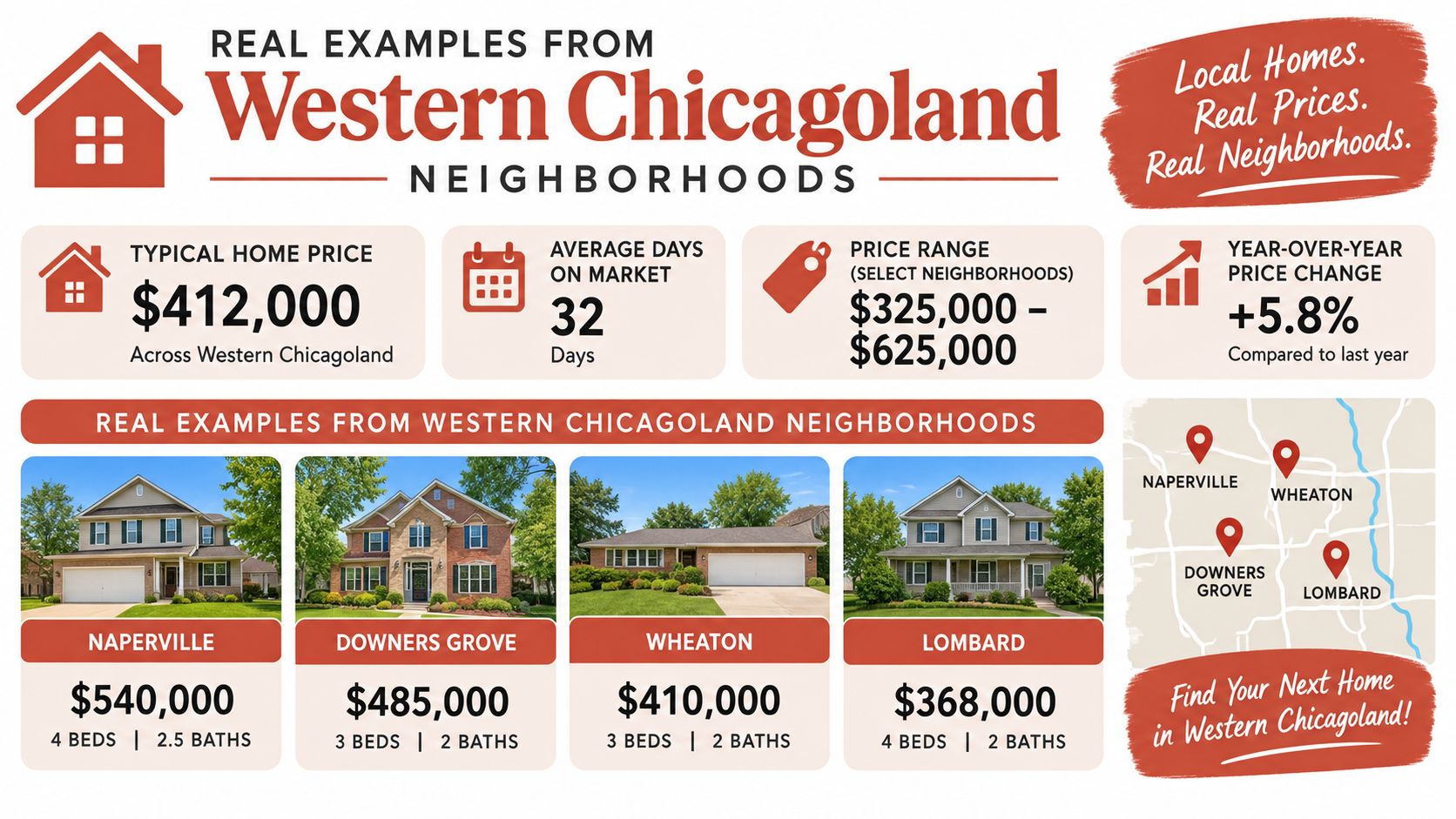
The broader local picture reinforces the need for property-level analysis. In March 2026, Chicagoland suburban median prices rose nearly 5% year over year to $403,250, while homes averaged 53 days on market, according to Chicago Agent Magazine's market coverage. Appreciation alone doesn't guarantee that a particular Elmhurst, Downers Grove, or Naperville home will sell quickly at its target price.
Here's a related overview of the practical valuation process:
Developing a Pricing Strategy for Net Proceeds
The highest list price isn't automatically the best financial result. Sellers should compare what each strategy may leave in their account after preparation, concessions, transaction expenses, mortgage payoff, taxes, and the cost of waiting.

Build three practical scenarios
Sell as-is. Estimate the likely price based on current condition, then subtract expected buyer credits, preparation expenses, selling costs, and any carrying costs associated with the transaction.
Make minor improvements. Focus on repairs or presentation changes that remove major objections. A working fixture, corrected safety issue, improved exterior appearance, or resolved maintenance concern may matter more than a cosmetic project with uncertain buyer response.
Fully update the home. Estimate the post-renovation price, then subtract the renovation budget, delay-related costs, selling expenses, and the risk that the market won't reward every dollar invested.
For each scenario, calculate both the gross contract price and the estimated net proceeds. Include brokerage compensation, transfer taxes, attorney and title charges, prorated taxes, liens, mortgage payoff, repair credits, buyer concessions, and carrying costs. Local municipal charges and property-specific expenses can make the net figure meaningfully different from the public sale price.
Concessions deserve special attention. In 2026, 39% of prospective U.S. sellers expected to make concessions, compared with 30% in 2025, according to the Realtor.com sellers survey. A rate buydown or closing-cost credit may help a buyer afford the home while preserving the advertised price, but it still reduces the seller's economic result.
Net-sheet test: If a preparation project increases the expected sale price but leaves little or no additional net proceeds after cost, delay, and risk, it may not be the right project.
The strongest offer may also depend on appraisal support, financing, inspection terms, closing timing, and certainty. Compare the complete package before choosing between a higher price with credits and a lower price with fewer deductions.
Next Steps and Free Valuation Offer
Begin with the information you already have. Gather your purchase details, improvement records, tax information, mortgage balance, known repair issues, and a clear description of the home's current condition. Then compare that information with recent nearby sales, current competition, and pending activity.
Treat automated estimates as a rough reference. Use a CMA to understand the local evidence. Finally, request a net-sheet review so you can compare an as-is sale, a lightly prepared sale, and a more extensive improvement plan.
A personalized valuation should answer practical questions:
- Likely price range: What comparable homes support, and why.
- Positioning options: Whether the property should target the upper range, attract early activity, or compete on value.
- Preparation priorities: Which repairs or presentation changes may affect buyer response.
- Estimated net proceeds: What may remain after transaction expenses, concessions, liens, payoff amounts, and preparation costs.
- Offer analysis: How financing, credits, contingencies, and appraisal risk affect the value of an offer.
Homeowners in Melrose Park, Elmhurst, Downers Grove, Naperville, Oak Park, and nearby western suburbs can request a free home valuation from Homes By Carmen. The report is intended to support a pricing discussion based on local comparable properties and the home's specific condition. You can use that information to decide whether selling now, making selected improvements, or waiting better fits your goals.
You don't need to commit to listing before asking what the numbers look like. A confidential consultation can clarify the likely range, the expected net proceeds, and the tradeoffs between speed, preparation, concessions, and maximum market exposure.
Homes By Carmen provides local home valuation guidance and seller representation for homeowners across western Chicagoland. Visit Homes By Carmen to request a property-specific pricing conversation and learn what your home may realistically sell for and what you could keep after the sale.